

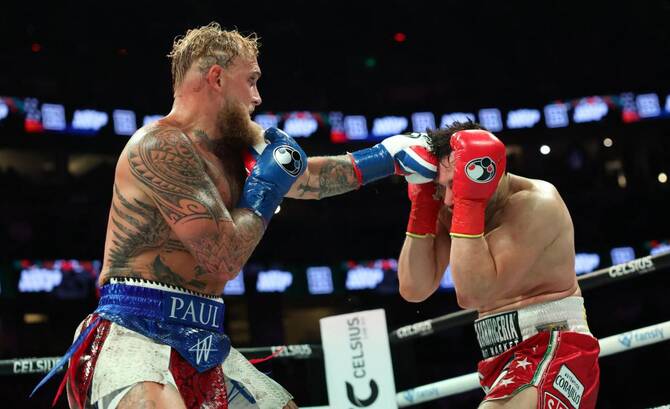
YouTuber Jake Paul cruises past Julio Cesar Chavez Jr.

YouTuber-turned-boxer Jake Paul cruised to victory over Mexico’s Julio Cesar Chavez Jr. on Saturday in a one-sided cruiserweight bout in California. (AFP)
Short Url
Updated 29 June 2025
Follow

YouTuber Jake Paul cruises past Julio Cesar Chavez Jr.

  • YouTuber-turned-boxer dominated from the outset to win by unanimous decision
  • Influencer has earned millions from a string of lucrative contests in his ring career

ANAHEIM, United States: YouTuber-turned-boxer Jake Paul cruised to victory over Mexico’s Julio Cesar Chavez Jr. on Saturday in a one-sided cruiserweight bout in California.

Paul, whose last fight was a controversial clash with 58-year-old former heavyweight champion Mike Tyson in November, dominated from the outset to win by unanimous decision.

The 28-year-old influencer, who has earned millions from a string of lucrative contests in a ring career that has spanned 13 fights, had too much speed and power for Chavez Jr.

The three judges at ringside scored the 10-round fight 99-91, 97-93, 98-92 in Paul’s favor.

Chavez Jr., the 39-year-old son of Mexican boxing great Julio Cesar Chavez, barely looked capable of mustering a response during a one-sided bout.

Chavez Jr. failed to land a single punch in the opening round, a pattern that followed the remainder of the contest, with Paul easily outscoring the veteran of 63 professional fights.

Paul, who reportedly pocketed around $40 million for his made-for-Netflix fight with Tyson last year, received around $300,000 guaranteed from Saturday’s bout.

However the American is expected to earn around $8 million-$10 million from the fight once earnings from pay-per-view and sponsorships are taken into account.


From events to ecosystems — WFS highlights Saudi football’s long-term vision

Updated 6 sec ago
Follow

From events to ecosystems — WFS highlights Saudi football’s long-term vision

  • Mai Alhelabi: We’ve actually been functioning as an ecosystem since 2023 — all the government entities, private-sector partners, and of course the AFC
  • Al-Qadsiah CEO James Bisgrove: We know we’re in a competitive environment, but ultimately, we do have a long-term focus,

RIYADH: The second and final day of the World Football Summit in Riyadh put one question firmly in the spotlight: How should Saudi football balance immediate success and long-term growth?

At first glance, the challenge seems rooted most strongly in the Saudi Pro League, but discussions at MISK City made it clear the real work extends into the wider ecosystem.

This was evident when Mai Alhelabi, CEO of the AFC Asian Cup 2027 Local Organizing Committee, took the stage to discuss Saudi Arabia’s fast-evolving hosting capabilities.

“We’ve actually been functioning as an ecosystem since 2023 — all the government entities, private-sector partners, and of course the AFC — all working together every single day,” she said.

Recent tournaments such as the AFC U17 Asian Cup and the AFC Champions League Elite Finals, as well as the upcoming AFC U23 Asian Cup, each add a layer of readiness to the Kingdom’s expanding football portfolio.

While coordination at national level is easier to align, club football presents a different challenge — the balance between club goals and overall national growth.

Al-Qadsiah CEO James Bisgrove highlighted the trade-off between competing immediately and building sustainably.

“We know we’re in a competitive environment, but ultimately, we do have a long-term focus,” he said. “Al-Qadsiah is a deeply strategic club and community engagement is key to our success.”

Speaking later to Arab News, Bisgrove added that while Al-Qadsiah’s rise was vital for the club’s identity, its ambitions extended outward, with the hope its “Khobar to the World” approach could have a wider effect on the development of Saudi football.

The head of the Middle East and North Africa region at the Bundesliga International, Khalid Basyuni, offered another perspective. With a background in taking a major European league to new markets, he pointed out that even as Saudi football set out a long-term vision, it was still in the earliest stage of its development. Acknowledging that is crucial when shaping what comes next.

“The passion of fans here is similar to Europe, but as opposed to the Bundesliga which has been established for years, Saudi is still in its early stages,” he said.

A mix of global expertise, local experience and strategic honesty made for a sharp reminder of where Saudi football stands today — and how critical it will be to strike the right balance between short-term excitement and long-term transformation.