

Morocco’s Atlantic gambit: linking restive Sahel to ocean

1 / 5
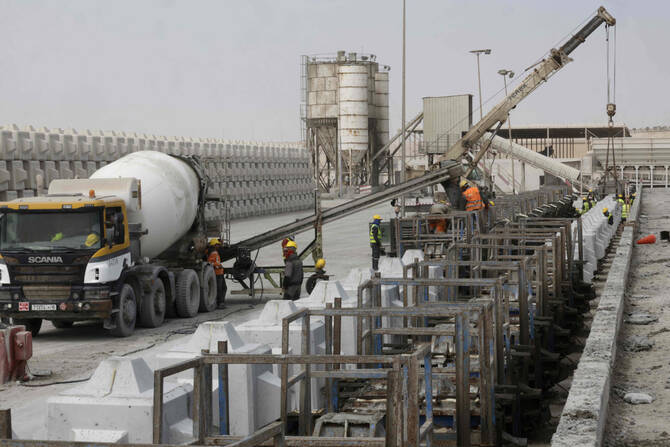
Work takes place during the construction of the Dakhla Atlantic Port in the Western Sahara on May 26, 2025. (AFP)
2 / 5
Work takes place during the construction of the Dakhla Atlantic Port in the Western Sahara on May 26, 2025. (AFP)
3 / 5
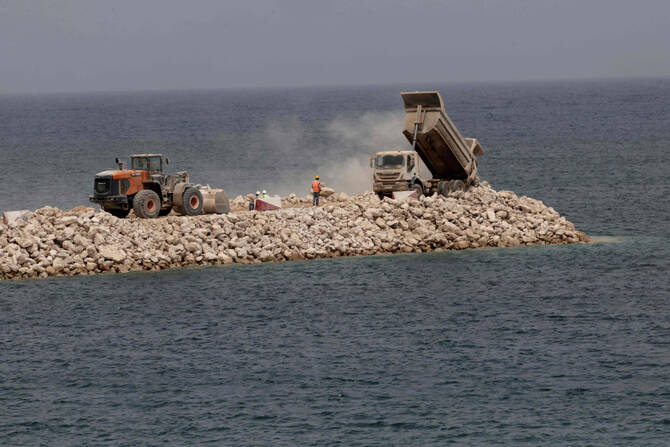
Work takes place during the construction of the Dakhla Atlantic Port in the Western Sahara on May 26, 2025. (AFP)
4 / 5
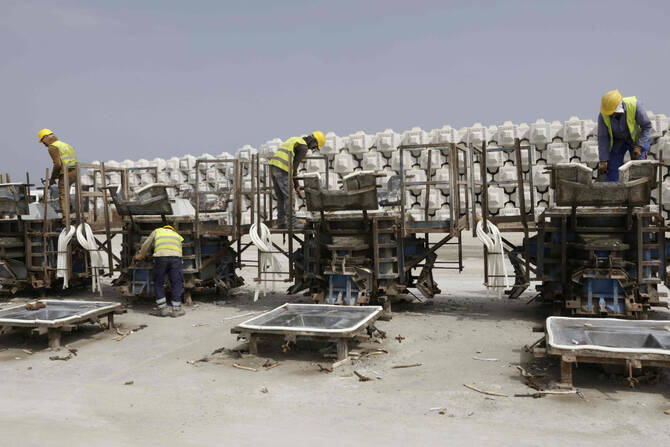
Work takes place during the construction of the Dakhla Atlantic Port in the Western Sahara on May 26, 2025. (AFP)
5 / 5
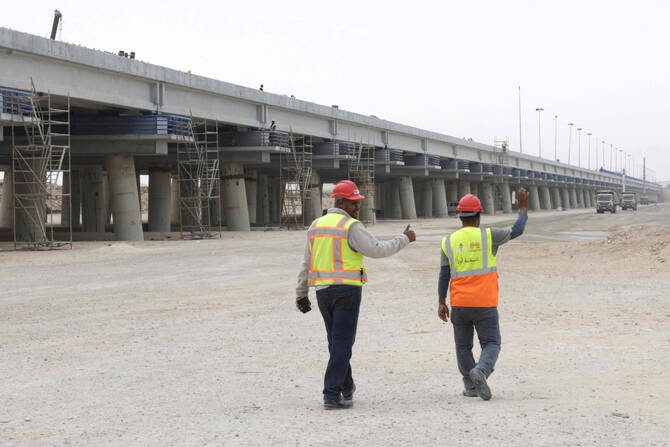
Work takes place during the construction of the Dakhla Atlantic Port in the Western Sahara on May 26, 2025. (AFP)
Short Url
Updated 29 June 2025
Follow

Morocco’s Atlantic gambit: linking restive Sahel to ocean

  • The “Atlantic Initiative” promises ocean access to Mali, Burkina Faso and Niger through a new $1.3-billion port in the Western Sahara
  • But the project remains fraught with challenges at a time when military coups in the Sahel states have brought new leaderships to power

EL ARGOUB: A planned trade corridor linking the landlocked Sahel to the Atlantic is at the heart of an ambitious Moroccan project to tackle regional instability and consolidate its grip on disputed Western Sahara.

The “Atlantic Initiative” promises ocean access to Mali, Burkina Faso and Niger through a new $1.3-billion port in the former Spanish colony claimed by the pro-independence Polisario Front but largely controlled by Morocco.

But the project remains fraught with challenges at a time when military coups in the Sahel states have brought new leaderships to power intent on overturning longstanding political alignments following years of militant violence.

The Moroccan initiative aims to “substantially transform the economy of these countries” and “the region,” said King Mohammed VI when announcing it in late 2023.

The “Dakhla Atlantic” port, scheduled for completion at El Argoub by 2028, also serves Rabat’s goal of cementing its grip on Western Sahara after US President Donald Trump recognized its sovereignty over the territory in 2020.

Morocco’s regional rival Algeria backs the Polisario but has seen its relations with Mali, Burkina Faso and Niger fray in recent months after the downing a Malian drone.

Military coups over the past five years have seen the three Sahel states pivot toward Russia in a bid to restore their sovereignty and control over natural resources after decades within the sphere of influence of their former colonial ruler France.

French troops were forced to abandon their bases in the three countries, ending their role in the fight against militants who have found sanctuary in the vast semi-arid region on the southern edge of the Sahara.

After both the African Union and West African bloc ECOWAS imposed economic sanctions on the new juntas, Morocco emerged as an early ally, with Niger calling the megaproject “a godsend.”

“Morocco was one of the first countries where we found understanding at a time when ECOWAS and other countries were on the verge of waging war against us,” Niger’s Foreign Minister Bakary Yaou Sangare said in April during a visit to Rabat alongside his Malian and Burkinabe counterparts.

The Sahel countries established a bloc of their own — the Alliance of Sahel States (AES) — in September 2023 but have remained dependent on the ports of ECOWAS countries like Benin, Ghana, Ivory Coast and Togo.

Rising tensions with the West African bloc could restrict their access to those ports, boosting the appeal of the alternative trade outlet being offered by Rabat.

Morocco has been seeking to position itself as a middleman between Europe and the Sahel states, said Beatriz Mesa, a professor at the International University of Rabat.

With militant networks like Al-Qaeda and the Daesh group striking ever deeper into sub-Saharan Africa, the security threat has intensified since the departure of French-led troops.

Morocco was now “profiting from these failures by placing itself as a reliable Global South partner,” Mesa said.

Its initiative has won the backing of key actors including the United States, France and the Gulf Arab states, who could provide financial support, according to specialist journal Afrique(s) en mouvement.

But for now the proposed trade corridor is little more than an aspiration, with thousands of kilometers (many hundreds of miles) of desert road-building needed to turn it into a reality.

“There are still many steps to take,” since a road and rail network “doesn’t exist,” said Seidik Abba, head of the Sahel-focused think tank CIRES.

Rida Lyammouri of the Policy Center for the New South said the road route from Morocco through Western Sahara to Mauritania is “almost complete,” even though it has been targeted by Polisario fighters.

Abdelmalek Alaoui, head of the Moroccan Institute for Strategic Intelligence, said it could cost as much as $1 billion to build a land corridor through Mauritania, Mali and Niger all the way to Chad, 3,100 kilometers (1,900 miles) to the east.

And even if the construction work is completed, insecurity is likely to pose a persistent threat to the corridor’s viability, he said.


Russia says Ukraine attacked Putin’s home, Kyiv calls this ‘lie’

Satellite imagery shows Vladimir Putin’s residential complex in Roshchino, Novgorod Region, Russia August 31, 2023. (Reuters)
Updated 56 min 3 sec ago
Follow

Russia says Ukraine attacked Putin’s home, Kyiv calls this ‘lie’

  • Zelensky called Russia’s claim “complete fabrication” designed to derail peace process, suggested Moscow was preparing to intensify bombardment of Ukraine

KYIV: Russia accused Ukraine on Monday of having fired dozens of drones at one of President Vladimir Putin’s homes, an accusation that Ukraine called a “lie” aimed at undermining US-led efforts to end the war.
Russian Foreign Minister Sergei Lavrov, who does not typically announce drone strikes, said Ukraine had fired “91 long-range unmanned aerial vehicles” at Putin’s residence in the Novgorod region between late Sunday and early Monday, all of which were shot down.
“Given the complete degeneration of the criminal Kyiv regime, which has shifted to a policy of state terrorism, Russia’s negotiating position will be reconsidered,” Lavrov said, without elaborating.
Ukrainian President Volodymyr Zelensky, who met with US President Donald Trump on Sunday for talks on ending the war, called Russia’s claim “a complete fabrication” designed to derail the peace process and suggested Moscow was preparing to intensify its bombardment of Ukraine.
“Russia is at it again, using dangerous statements to undermine all achievements of our shared diplomatic efforts with President Trump’s team,” the Ukrainian leader wrote on X.
Russia’s accusation comes at a pivotal moment in the peace process.
Ukraine says it has agreed to 90 percent of a US-drafted peace plan — including the issue of post-war security guarantees — though the issue of territory in a post-war settlement remains unresolved.
Russia, which has stayed silent about what parts of the US plan it has agreed to, said Monday it was still committed to the peace process but would “revise” its position in light of the alleged drone attack.
Russia invaded Ukraine in February 2022, describing it as a “special military operation” to demilitarise the country and prevent the expansion of NATO.
Kyiv and its European allies say the war, the largest and deadliest on European soil since World War II, is an unprovoked and illegal land grab that has resulted in a tidal wave of violence and destruction.
Territory main sticking point
Trump has held talks with both sides in recent days, including a phone call with Putin on Monday that the White House described as “positive.”
During talks with Zelensky on Sunday, Trump offered Kyiv long-sought-after security guarantees for a period of 15 years, according to Kyiv.
But the issue of territory and the future of the Moscow-occupied Zaporizhzhia nuclear power plant in southern Ukraine remain unresolved, Zelensky said.
Zelensky said Monday that Kyiv was ready for “any” format of meetings — including with Putin if necessary — but said he still did not think the Kremlin chief wanted peace.
The current plan, revised after weeks of intense US-Ukrainian negotiations, would stop the war at the current frontlines in the eastern Donbas region and establish a demilitarised area.
But the Kremlin has shown no sign of compromise.
Putin said Monday that Russia was pressing ahead with its plan to capture four Ukrainian regions it announced the annexation of in 2022 and that his troops were “confidently advancing.”
Moscow on Monday said it took another village, Dibrova, in Ukraine’s eastern Donetsk region.