

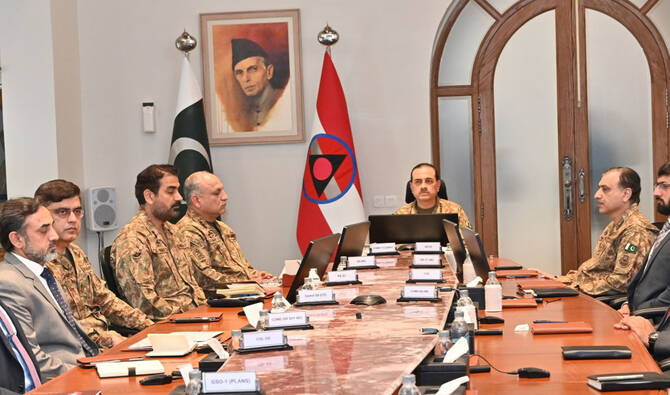

KARACHI: Pakistan’s army chief, Field Marshal Asim Munir, on Saturday vowed retribution after 13 soldiers were killed in a suicide bombing on an armed forces convoy in the country’s northwestern tribal belt, in one of the deadliest attacks on security personnel in recent months.
The military said the convoy was targeted in Mir Ali, a town in North Waziristan near the Afghan border, when an explosives-laden vehicle rammed into one of the lead vehicles after a failed attempt by a suicide bomber to detonate earlier.
Three civilians, including two children and a woman, were also injured in the blast.
Militant violence has surged in northwestern Khyber Pakhtunkhwa province in recent years, particularly in the tribal region, where attacks have targeted soldiers, police, government officials and civilian residents.
Saturday’s assault marked one of the highest single-day tolls for security forces this year. The military said it was followed by the killing of 14 militants in a firefight during a clearance operation launched by the security forces.
“Field Marshal Syed Asim Munir … visited Corps Headquarters Peshawar today, where he was briefed in detail on the prevailing security situation and ongoing counter-terrorism operations,” the military’s media wing, Inter-Services Public Relations (ISPR), said in a statement. “During the visit, the Field Marshal also attended funeral of Shuhada [martyrs] of the incident at Bannu Garrison and visited the injured at Bannu CMH [Combined Military Hospital].”

In this handout photo released by Pakistan’s Inter-Services Public Relations (ISPR), Pakistan Army Chief Field Marshal Asim Munir visits soldiers injured in a militant attack on Bannu Garrison, at the Combined Military Hospital in Bannu, Pakistan, on June 28, 2025. (Handout/ISPR)
“Reiterating the state’s uncompromising stance, the Chief of Army Staff vowed that all facilitators, abettors, and perpetrators of terrorism will be relentlessly pursued and brought to justice— without exception and at all costs, and the face of true perpetrator of terrorism in the region will be exposed to the entire world,” the statement added.
Most militant attacks in Khyber Pakhtunkhwa have been claimed by fighters belonging to the Tehreek-e-Taliban Pakistan (TTP), an umbrella group of armed factions that the Pakistani state refers to as khawarij — a term rooted in Islamic history used to describe a violent extremist sect that rebelled against authority and declared other Muslims as apostates.
The army described the assault as a “cowardly attack planned and orchestrated by the terrorist state of India” and executed by its “proxy Fitna Al-Khawarij.”
It said Pakistani forces intercepted the initial suicide bomber, but the attackers rammed a second explosive-laden vehicle into the convoy, killing 13 soldiers.

In this handout photo released by Pakistan’s Inter-Services Public Relations (ISPR), Pakistan Army Chief Field Marshal Asim Munir (3R), along with Interior Minister Mohsin Naqvi (2R) and others, offers funeral prayers for soldiers killed in a militant attack on Bannu Garrison, in Bannu, Pakistan, on June 28, 2025. (Handout/ISPR)
“The blood of every innocent Pakistani shall always be avenged,” the ISPR quoted the army chief as saying. “Any attempt to undermine Pakistan’s internal stability will be met with swift and decisive retribution.”
He also called for increased institutional support for civilian law enforcement agencies, particularly the Khyber Pakhtunkhwa Police, urging government stakeholders to prioritize capacity enhancement while reaffirming the army’s commitment to assist.
In a separate statement, Prime Minister Shehbaz Sharif condemned the attack, offering prayers for the fallen soldiers and condolences to their families. He praised the security forces for their response, including the killing of 14 militants, and said the entire nation saluted its martyrs.
“We are determined to eliminate every form of terrorism from the country,” Sharif said.


