

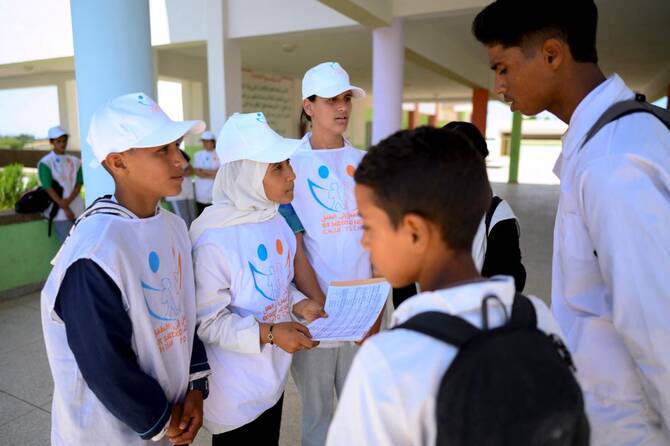

TIFLET, Morocco: Moroccan student Said Rifai, 15, is on a mission to help his peers pursue education in a country where an estimated 270,000 children drop out of school each year.
“We must help them come back,” said Rifai, who goes to middle school in Tiflet, a town east of the capital Rabat, and has already helped several of his friends back to school as part of a national youth-led effort.
To tackle the problem, which educators and officials warn exacerbates social inequalities and drives poverty, Moroccan authorities offer dropouts a chance back in with support from fellow students.
One of Rifai’s classmates, Doha El Ghazouli, who is also 15, said that together they had helped several friends return to school “before they abandoned their future.”
Huda Enebcha, 16, told AFP how she and her friend Ghazouli managed to convince a neighbor to resume her studies.
“We helped her review the most difficult subjects, and we showed her videos of some school activities,” said Enebcha.
“She finally agreed after a lot of effort.”
To ease the transition back into the education system, the “second chance school” scheme offers some teenagers vocational training alongside remedial classes, with an emphasis on giving former dropouts agency and choice.
Hssain Oujour, who leads the national program, said 70 percent of the teenagers enrolled in it have taken up vocational training that could help them enter the labor force, with another 20 percent returning to the traditional school system.
Across Morocco, a country of 37 million people, classrooms are often overcrowded, and the public education system is generally viewed as inferior to private institutions, which charge fees that can be prohibitive for many families.
Around 250 million children worldwide lack basic literacy skills, and in Morocco, nearly one in four inhabitants — around nine million people — are illiterate, according to the UN children’s agency UNICEF.
Dropout rates tend to be higher in rural and impoverished areas, said Said Tamouh, the principal of the Jawhara School in Tiflet that the students interviewed by AFP attend.
An NGO-run “second chance school” nearby has some 110 students, who can sign up for art classes, hairdressing training or classical Arabic language courses.
Sanae Sami, 17, who took up a make-up class, said she was “truly” given another shot at pursuing education.
“When you leave school, there’s nothing for you,” she said.
“That’s why I decided to come back, especially thanks to the teachers at this center.”
Hafida El Fakir, who heads the Salam association which runs the school, said that “support and guidance” were key in helping students “succeed and go far.”
Amine Othmane, a student who had re-entered the system last year with encouragement from his friends, is now helping others.
To convince dropouts, he said, “they first have to regret leaving and want to return.”
Back in school, 18-year-old Aya Benzaki now hopes to achieve her dream of graduating with a diploma, and Jihane Errafii, 17, said she was grateful for the friends who had supported her journey.
“I just needed someone to lend me a hand.”


