

Morocco says 2024 ‘hottest year’ on record

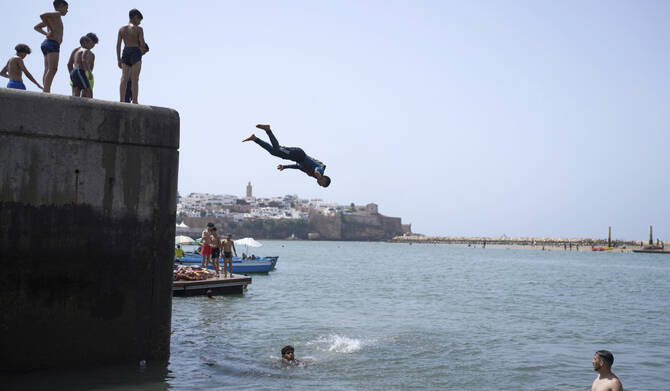
Boys jump into a river to cool down during a hot sumer day, in Rabat, Morocco, Friday, June 20, 2025. (AP)
Short Url
Updated 21 June 2025
Follow

Morocco says 2024 ‘hottest year’ on record

  • Moroccan climatologist Mohammed-Said Karrouk, who also heads Morocco’s National Future Planet Committee, warned that the kingdom’s geography and climate make it more vulnerable to temperature extremes

RABAT: The year 2024 was Morocco’s hottest on record, the North African country’s meteorological agency said on Friday, mirroring the record surface temperatures measured globally.
In an annual report, the agency said it recorded an average temperature anomaly of +1.49 degrees Celsius (+2.7 Fahrenheit) last year compared to the 1991-2020 period.
“The year 2024 stands out as the hottest ever recorded in Morocco,” it said, adding that every month in 2024, excluding June and September, had been hotter than the average for the 1991-2020 reference period.
Several cities broke daily heat records, with 47.6 degrees Celsius (117.7 Fahrenheit) in Marrakech and 47.7 degrees Celsius (117.8 Fahrenheit) in Beni Mellal in July last year, the agency said.
It also noted “an increase in thermal anomalies, particularly during the autumn and winter seasons.”
Morocco’s all-time heat record was set in August 2023, when temperatures hit 50.4 degrees Celsius (122 Fahrenheit) in Agadir.
The country, which is enduring a seventh straight year of drought, registered an average rainfall deficit of -24.7 percent last year, the report said.
The agency said last year’s data reflected “an amplification of climate contrasts in Morocco, where prolonged droughts alternate with episodes of extreme precipitation.”
Torrential rains in September 2024 — causing floods and killing 18 people — “did not reverse the overall rainfall deficit,” it added.
Moroccan climatologist Mohammed-Said Karrouk, who also heads Morocco’s National Future Planet Committee, warned that the kingdom’s geography and climate make it more vulnerable to temperature extremes.
He said warming was now observed in all seasons.
“In autumn, lingering summer heat combined with gradually cooling temperatures favors violent downpours, which have become more dangerous due to excess humidity in the atmosphere,” he said.
“In winter, the heat originating mostly from warming tropical oceans now influences North Africa as well.”
A former member of the UN Intergovernmental Panel on Climate Change, Karrouk also warned of a recent intensification of the West African monsoon — a seasonal wind system that brings moist air from the Atlantic Ocean — which he linked to the deadly September floods.
He called for the construction of shelters to protect vulnerable populations and dams to capture water — a valuable resource with Morocco’s unrelenting drought.
Weather extremes have taken a toll on farming, a vital sector for Morocco which employs nearly a third of its active population and accounts for 12 percent of GDP.
Scientists say that recurring heatwaves are a clear marker of global warming and that they are set to become more frequent, longer and more intense.
Fuelled by human-driven climate change, 2024 was the warmest year on record globally — and 2025 is projected to rank among the top three.


Iran FM tells UN all military bases of ‘hostile forces’ legitimate targets

Updated 6 sec ago
Follow

Iran FM tells UN all military bases of ‘hostile forces’ legitimate targets

  • UN chief condemns escalation, calls for immediate return to negotiating table
  • Emergency session of Security Council set to convene on Saturday in New York

NEW YORK: Iran will use “all necessary defensive capabilities and means” to confront attacks by the US and Israel, and will treat “all bases, facilities, and assets of the hostile forces in the region” as legitimate military targets under its right to self-defense, Foreign Minister Abbas Araghchi said on Saturday.

In a letter to UN Secretary-General Antonio Guterres and the president of the Security Council, Araghchi said US and Israeli airstrikes are “a clear violation” of the UN Charter and amount to “an open armed aggression” against Iran.

Tehran is exercising its “inherent and lawful right of self-defense” under the UN Charter, he added.

The letter, seen by Arab News, accused the US and Israel of launching coordinated, large-scale attacks on Iranian territory, targeting defensive facilities and civilian sites in several cities.

Araghchi said Iran will continue to act “decisively and without hesitation until the aggression ceases fully and unequivocally,” adding that the US and Israel “shall bear full and direct responsibility for all ensuing consequences, including any escalation arising from their unlawful actions.”

He called on the 15-member Security Council to convene an emergency meeting to address a “breach of peace which is a real and serious threat to international peace and security,” and urged UN member states to “unequivocally condemn this act of aggression.”

An emergency session of the council is set to convene in New York on Saturday, requested by France, Bahrain, Colombia, China and Russia.

The Russian mission at the UN said in a statement that during the meeting, Moscow will demand that the US and Israel “immediately cease their illegal and escalatory actions and embark on a path toward a political and diplomatic settlement.” It added that “Russia is willing to provide all necessary assistance in this process.”

Meanwhile, Guterres condemned the military escalation, saying “the use of force by the United States and Israel against Iran, and the subsequent retaliation by Iran across the region, undermine international peace and security.”

The UN Charter clearly prohibits “the threat of the use of force against the territorial integrity or political independence of any state, or in any other manner inconsistent with the Purposes of the United Nations,” Guterres said in a statement.

He called for an immediate cessation of hostilities and de-escalation, and an immediate return to the negotiating table, adding that “failing to do so risks a wider regional conflict with grave consequences for civilians and regional stability.”

UN human rights chief Volker Turk also deplored the escalation and warned that civilians are the ones who end up paying “the ultimate price.”

He said: “Bombs and missiles are not the way to resolve differences but only result in death, destruction and human misery.”

Turk called for restraint and implored the parties “to see reason, to de-escalate, and (return) to the ‘negotiating table’ where they had been actively seeking a solution only hours earlier.”