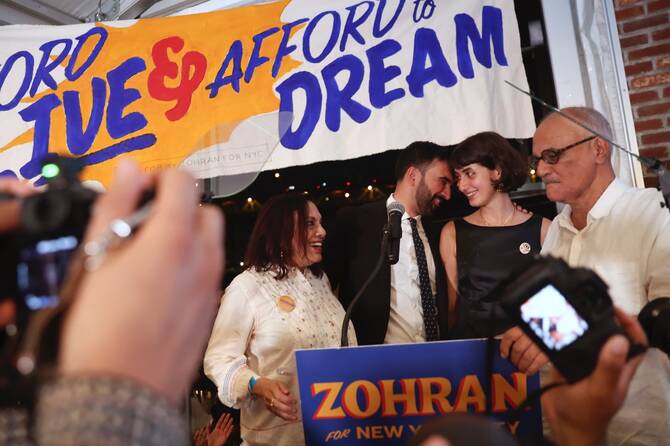
The success of Zohran Mamdani in New York City’s Democratic primary for mayor is euphoric for Hari Kondabolu, a stand-up comedian who’s been friends with the candidate for 15 years.
Mamdani stunned the political establishment when he declared victory in the primary on Tuesday, a ranked choice election in which his strongest competition, former New York Gov. Andrew Cuomo, conceded defeat.
When he launched his campaign, the unabashed democratic socialist ranked near the bottom of the pack. Now, the 33-year-old state assemblyman has a chance to be New York City’s first Asian American and Muslim mayor. Mamdani’s family came to the United States when he was 7, and he became a citizen in 2018. He was born to Indian parents in Kampala, Uganda.
For Kondabolu, this moment is not just exciting, but emotional.
“I think so many of us have had those experiences in New York of being brown and in a city that has always been really diverse and feels like ours. But after 9/11, like you start to question it like, is this our city too,” Kondabolu said. “And 25 years later ... it’s surreal, like this is the same city but it’s not because we’ve elected this person.”
Mamdani’s campaign has piqued the interest of many Indian, Pakistani and other South Asian Americans, as well as Muslims — even those who may not agree with Mamdani on every issue. Despite that opposition, some still see his rise as a sign of hope in a city where racism and xenophobia erupted following the Sept. 11, 2001, terrorist attacks.
South Asians and Muslims riveted by primary in New York, and beyond
Many of New York City’s over 300,000 South Asian residents have been inspired by Mamdani’s extraordinary trajectory.
“My mom was texting her friends to vote for him. I’ve never seen my mother do that before,” Kondabolu said. “So the idea that it’s gotten our whole family activated in this way — this is, like, personal.”
Snigdha Sur, founder and CEO of The Juggernaut, an online publication reporting on South Asians, has been fascinated by the response from some people in India and the diaspora.
“So many global South Asians ... they’re like, ‘Oh, this guy is my mayor and I don’t live in New York City,’” Sur said.
At the same time, some are also concerned or angered by Mamdani’s past remarks about Indian Prime Minister Narendra Modi, who he publicly called a “war criminal.”
In Michigan, Thasin Sardar has been following Mamdani’s ascent online. When he first heard him, he struck him as “genuine” and he felt “an instant connection,” he said.
“As a Muslim American, this victory puts my trust back in the people,” said Sardar, who was born and raised in India. “I am happy that there are people who value the candidate and his policies more than his personal religious beliefs and didn’t vote him down because of the color of his skin, or the fact that he was an immigrant with an uncommon name.”
New York voter Zainab Shabbir said family members in California, and beyond, have also excitedly taken note.
“My family in California, they were very much like, ‘Oh, it’s so nice to see a South Asian Muslim candidate be a mayor of a major city,’” she said. A brother told her Mamdani’s rise is a great example for his kids, she said.
But the 34-year-old — who donated, voted and canvassed for Mamdani — said it was his vision for New York City that was the draw for her. She and her husband briefly chatted with Mamdani at a fundraiser and she found him to be “very friendly and genuine.”
She suspects that for some who aren’t very politically active, Mamdani’s political ascent could make a difference.
“There’s a lot of Muslim communities like my parents’ generation who are focused a lot more on the politics back home and less on the politics here in America,” said Shabbir. “Seeing people like Zohran Mamdani be in office, it’ll really change that perspective in a lot of people.”
Embracing Indian and Muslim roots
Supporters and pundits agree that Mamdani’s campaign has demonstrated social media savvy and authenticity. He visited multiple mosques. In videos, he speaks in Hindi or gives a touch of Bollywood. Other South Asian American politicians such as Democratic Rep. Ro Khanna praised that.
“I love that he didn’t run away from his heritage. I mean, he did video clips with Amitabh Bachchan and Hindi movies,” Khanna said, referencing the Indian actor. “He shows that one can embrace their roots and their heritage and yet succeed in American politics.”
But his triumph also reflects “the urgency of the economic message, the challenge that people are facing in terms of rent, in terms of the cost of living, and how speaking to that is so powerful,” the progressive California Democrat added.
Tanzeela Rahman, a daughter of Muslim immigrants from Bangladesh, said she grew up “very low income” in New York.
“I felt seen by him in a way politicians have not seen me ever,” the 29-year-old financial systems analyst said. “I think very few people in government understand … how hard it is to survive in New York City.”
She found Mamdani to be “unabashedly Muslim” and also “a voice, who, literally, to me sounds like a New Yorker who’s stepping in and saying, hey, let’s reclaim our power,” she said.
While Mamdani has been speaking to the working class, he had a somewhat privileged upbringing. His mother is filmmaker Mira Nair and his father, Mahmood Mamdani, is a professor at Columbia University.
He lived in Queens but attended The Bronx High School of Science. Even as a teen, he cared about social justice, Kondabolu, the comedian, recalled.
His campaign messaging on issues such as affordable housing and free bus rides might not resonate with South Asian households in New York City who have income levels above the median. But, the irony is that his campaign and “great kind of soundbites” earned support from that demographic, too, according to Sur.
“It was, I think, a surprise that he did so well among the wealthiest, including his own community,” Sur said.
Mamdani’s outspoken support for Palestinian causes and criticism of Israel and its military campaign in Gaza resonated with pro-Palestinian residents, including Muslims, but caused tension in the mayor’s race. Some of his positions and remarks on the charged issue have drawn recriminations from opponents and some Jewish groups, though he’s also been endorsed by some Jewish politicians and activists.
Racism and xenophobia
Mamdani’s success immediately elicited strong anti-Muslim and anti-immigrant rhetoric from some high-profile conservatives on social media, including conservative media personality Charlie Kirk who posted that “legal immigration can ruin your country.” In response, Democratic Congressman Maxwell Frost, the youngest member of Congress, tweeted “For years they sold people the lie of ‘we have no problem if you come the right way!’”
His supporters aren’t concerned that racism and Islamophobia will distract from Mamdani’s campaign. Those feelings clearly weren’t “enough for him to lose” the primary, Kondabolu said.
“There’s a new generation that wants their voice heard and that generation came out in full force, not just by voting, but by, like, getting all these other people to be emotionally invested in this candidate,” Kondabolu said. “That’s extraordinary.”


Many South Asians and Muslims in NYC and beyond electrified by Mamdani’s mayoral primary triumph
https://arab.news/bpbgs
Many South Asians and Muslims in NYC and beyond electrified by Mamdani’s mayoral primary triumph

- Some his rise as a sign of hope in a city where racism and xenophobia erupted following the Sept. 11, 2001, terrorist attack


Trump takes unconventional approach to communicating to the public about war in Iran
- The communications strategy opened Trump to criticism that he hadn’t done enough to explain the rationale and objectives of the war
Typical of an unconventional presidency, the Trump administration waited more than 48 hours to make any live, public communication to the American people about why it had decided to go to war with Iran.
President Donald Trump discussed why he launched the attack prior to a White House ceremony honoring military heroes on Monday but took no questions from reporters. Earlier in the day, Defense Secretary Pete Hegseth and Joint Chiefs of Staff Chairman Dan Caine briefed journalists at the Pentagon.
The two days previous, Trump delivered two pretaped statements that were released on Truth Social, the social media site owned by the president’s media company, and granted telephone interviews to more than a dozen journalists — several of which produced fragmented responses that, to some, clouded as much as they cleared up.
The communications strategy opened Trump to criticism that he hadn’t done enough to explain the rationale and objectives of the war, even as the American military suffered its first casualties. By contrast, Israeli Prime Minister Benjamin Netanyahu, who has teamed with the US against Iran, delivered two statements the day the war began and addressed reporters Monday at the site of a missile attack that killed nine people. The Israeli military has held multiple press briefings each day.
“The American people need a commander in chief, and he has been absent in that role,” Rahm Emanuel, White House chief of staff under President Barack Obama, said on CNN Monday. Emanuel, a Democrat, is contemplating a run for the presidency in 2028.
An unconventional strategy leads to criticism
Peter Baker, chief White House correspondent for The New York Times, wrote on social media that “after Trump launched a new war on Iran, he did not rush back to the White House to make an Oval Office address to rally the nation as other presidents have done. He stayed at Mar-a-Lago to attend a glitzy political fundraiser.”
That post provoked a response from Steven Cheung, White House communications director. “Imagine being a reporter so consumed with Trump Derangement Syndrome that he wants President Trump to mimic the failed policies of the past. The truth is that President Trump spent the majority of his time monitoring the situation in a secure facility, in constant contact with world leaders, and made multiple addresses to the nation that garnered hundreds of millions of views. He also took dozens of calls with reporters.”
The calls included one with Baker’s colleague at The Times, Zolan Kanno-Youngs. Trump’s mobile phone number is known to many of the reporters who cover him, and the president often takes their calls for on-the-spot interviews. Besides The Times, he spoke in the aftermath of the attack to journalists for ABC, CBS, NBC, CNN, CNBC, Fox News Channel, The Atlantic, The Washington Post, Axios, Politico and an Israeli television station.
Most of the calls were brief and marginally illuminating; Politico’s Dasha Burns said Trump answered but said he was too busy to talk. The public couldn’t hear what Trump said in the interviews and was dependent upon what the journalists chose to report on the conversations.
“I spoke to President Trump today and he told me that the operation in Iran is going to go very fast,” Libby Alon, a reporter for Channel 14 News in Israel, wrote about her interview on X. “It’s doing very well, and (will) make the people of Israel very happy, and the people of the world very happy.”
The Times reported that in its six-minute chat, Trump “offered several seemingly contradictory visions of how power might be transferred to a new government — or even whether the existing Iranian power structure would run that government or be overthrown.”
In one of his two conversations with Trump, ABC News’ Jonathan Karl said when he asked about the death of Iranian Ayatollah Ali Khamenei, the president said: “I got him before he got me. They tried twice. Well I got him first.” CNN’s Jake Tapper went on the air minutes after his conversation Monday, saying Trump told him “the big one is coming soon,” an apparent reference to a future attack.
Asked for comment, White House spokeswoman Anna Kelly said: “President Trump is the most transparent and accessible president in American history. The American people have never had a more direct and authentic relationship with a president of the United States than they have with President Trump.”
Hegseth briefing concentrates on friendly reporters
Pentagon reporters learned late Sunday about Hegseth’s briefing. Reporters from The Associated Press, Reuters, ABC, CBS, NBC, CNN, Fox News Channel and Stars & Stripes were permitted into the briefing room, but Hegseth did not call on them. Instead, he took questions from NewsNation and Trump-friendly outlets like the Daily Caller, Daily Wire, One America News and the Christian Broadcasting Network. Most mainstream news outlets left their regular stations at the Pentagon last fall rather than agree to Hegseth’s rules restricting their work.
Hegseth denounced the “foolishness” of people wanting to know details of the operation in advance, such as whether Americans would commit to more than air power, and said the operation would continue as long as it took to achieve objections. He initially ignored NBC News’ Courtney Kube when she called out a question: “President Trump put a four-week time limit on it. Are you saying he’s wrong?”
Later, Hegseth denounced Kube for asking “the typical NBC sort of gotcha-type question. President Trump has all the latitude in the world to talk about how long it might take — four weeks, two weeks, six weeks, it could move up, it could move back. We’re going to execute at his command the objectives he set out to achieve.”
Unlike Pentagon briefings in past administrations, reporters were given assigned seats, with the Trump-friendly outlets seated in front. Jennifer Griffin, Hegseth’s former colleague at Fox News Channel who left the Pentagon with other reporters after not accepting his new rules, was seated in the last row.


