

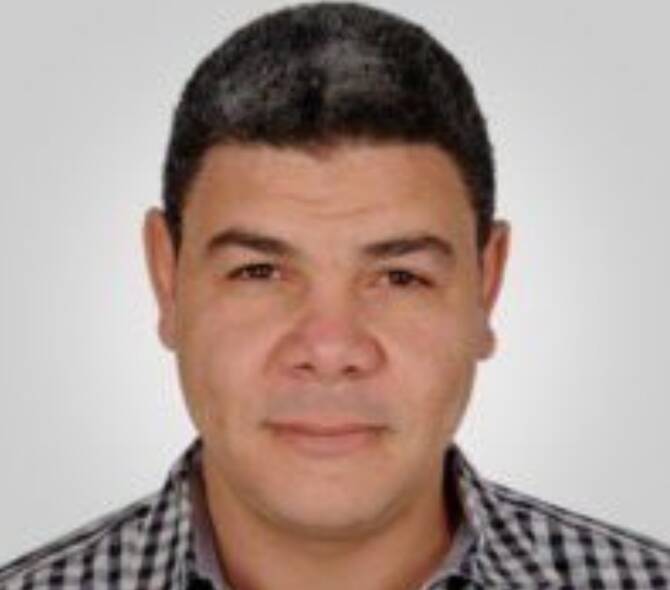
Man pleads not guilty to hate crimes in attack on Colorado demonstration for Israeli hostages

Mohamed Sabry Soliman was indicted earlier this week on 12 hate crime counts in the June 1 attack. (X@EricLDaugh)
Short Url
Updated 27 June 2025
Follow

Man pleads not guilty to hate crimes in attack on Colorado demonstration for Israeli hostages

  • Mohamed Sabry Soliman was indicted earlier this week on 12 hate crime counts in the June 1 attack
  • Soliman’s attorney, David Kraut, entered the not guilty plea on Soliman’s behalf during a quick hearing

DENVER: A man accused of hurling Molotov cocktails at a group of people who were demonstrating in Boulder, Colorado, in support of Israeli hostages pleaded not guilty Friday to federal hate crime charges.

Mohamed Sabry Soliman was indicted earlier this week on 12 hate crime counts in the June 1 attack. He is accused of trying to kill eight people who were hurt by the Molotov cocktails and others who were nearby.

Soliman’s attorney, David Kraut, entered the not guilty plea on Soliman’s behalf during a quick hearing.

Magistrate Judge Kathryn Starnella noted that lawyers had acknowledged that a plea agreement in the case was possible later.

Soliman, wearing a khaki jail uniform, entered the courtroom smiling and holding an envelope in his handcuffed hands. His right hand and arm were wrapped in a thick bandage as they were when he appeared in court last week, when an investigators testified that Soliman had burned himself as he threw the second of two Molotov cocktails at the group.

He listened to a translation of the hearing provided by an Arabic interpreter through headphones. He did not speak during the hearing.

Investigators say Soliman told them he intended to kill the roughly 20 participants at the weekly demonstration on Boulder’s Pearl Street pedestrian mall. But he threw just two of his over two dozen Molotov cocktails while yelling “Free Palestine.”

Soliman, who is also being prosecuted in state court for attempted murder and other charges, told investigators he tried to buy a gun but was not able to because he was not a “legal citizen.”

He posed as a gardener, wearing a construction vest, to get close to the group before launching the attack, according to court documents. He was also indicted for using fire and an explosive to attack the group and for carrying an explosive, which were included in the hate crime counts.

Federal authorities say Soliman, an Egyptian national, has been living in the US illegally with his family.

Soliman is being represented in state and federal court by public defenders who do not comment on their cases to the media.

Prosecutors say the victims were targeted because of their perceived or actual national origin.

At a hearing last week, Kraut, Soliman’s defense attorney, urged Starnella not to allow the case to move forward. Kraut said the alleged attack was not a hate crime. He said it was motivated by opposition to Zionism, the movement to establish and sustain a Jewish state in Israel.

An attack motivated by someone’s political views is not considered a hate crime under federal law.


Bangladesh sends record 750,000 workers to Saudi Arabia in 2025

Updated 56 min 35 sec ago
Follow

Bangladesh sends record 750,000 workers to Saudi Arabia in 2025

  • Latest data shows 16% surge of Bangladeshis going to the Kingdom compared to 2024
  • Bangladesh authorities are working on sending more skilled workers to Saudi Arabia

DHAKA: Bangladesh sent over 750,000 workers to Saudi Arabia in 2025, marking the highest overseas deployment to a single country on record, its labor bureau said on Friday.

Around 3.5 million Bangladeshis live and work in Saudi Arabia, sending home more than $5 billion every year. They have been joining the Saudi labor market since the 1970s and are the largest expatriate group in the Kingdom.

Last year, Saudi Arabia retained its spot as the top destination for Bangladeshi workers, with more than two-thirds of over 1.1 million who went abroad in 2025 choosing the Kingdom.

“More than 750,000 Bangladeshi migrants went to Saudi Arabia last year,” Ashraf Hossain, additional director-general at the Bureau of Manpower, Employment and Training, told Arab News.

“So far, it’s the highest number for Bangladesh, in terms of sending migrants to Saudi Arabia or any other particular country in a single year.”

The latest data also showed a 16 percent increase from 2024, when about 628,000 went to the Kingdom for work, adding to the largest diaspora community outside Bangladesh.

Authorities have focused on sending more skilled workers to Saudi Arabia in recent years, after the Kingdom launched in 2023 its Skill Verification Program in Bangladesh, which aims to advance the professional competence of employees in the Saudi labor market.

Bangladesh has also increased the number of certification centers, allowing more candidates to be verified by Saudi authorities.

“Our focus is now on increasing safe, skilled and regular migration. Skilled manpower export to Saudi Arabia has increased in the last year … more than one-third of the migrants who went to Saudi Arabia did so under the Skill Verification Program by the Saudi agency Takamol,” Hossain said.

“Just three to four months ago, we had only been to certify 1,000 skilled workers per month. But now, we can conduct tests with 28 (Saudi-approved) centers across the country, which can certify around 60,000 skilled workforces (monthly) for the Kingdom’s labor market.”

On Thursday, the BMET began to provide training in mining, as Bangladesh aims to also start sending skilled workers for the sector in Saudi Arabia.

“There are huge demands for skilled mining workers in Saudi Arabia as it’s an oil-rich country,” Hossain said.

“We are … trying to produce truly skilled workers for the Saudi labor market.”

In October, Saudi Arabia and Bangladesh signed a new employment agreement, which enhances worker protection, wage payments, as well as welfare and health services.

It also opens more opportunities in construction and major Vision 2030 projects, which may create up to 300,000 new jobs for Bangladeshi workers in 2026.