- Netanyahu and Katz called the report’s findings “malicious falsehoods designed to defame” the military
- Palestinian witnesses say Israeli troops have opened fire at crowds on the roads heading toward the sites
JERUSALEM: Israeli Prime Minister Benjamin Netanyahu and Defense Minister Israel Katz emphatically rejected a report in the left-leaning Israeli daily Haaretz on Friday, which claimed Israeli soldiers were ordered to shoot at Palestinians approaching aid sites inside Gaza.
They called the report’s findings “malicious falsehoods designed to defame” the military.
More than 500 Palestinians have been killed and hundreds more wounded while seeking food since the newly formed Gaza Humanitarian Foundation began distributing aid in the territory about a month ago, according to Gaza’s Health Ministry.
Palestinian witnesses say Israeli troops have opened fire at crowds on the roads heading toward the sites. Reacting to the Haaretz piece, Israel’s military confirmed that it was investigating incidents in which civilians had been harmed while approaching the sites. It rejected the article’s allegations “of deliberate fire toward civilians.”
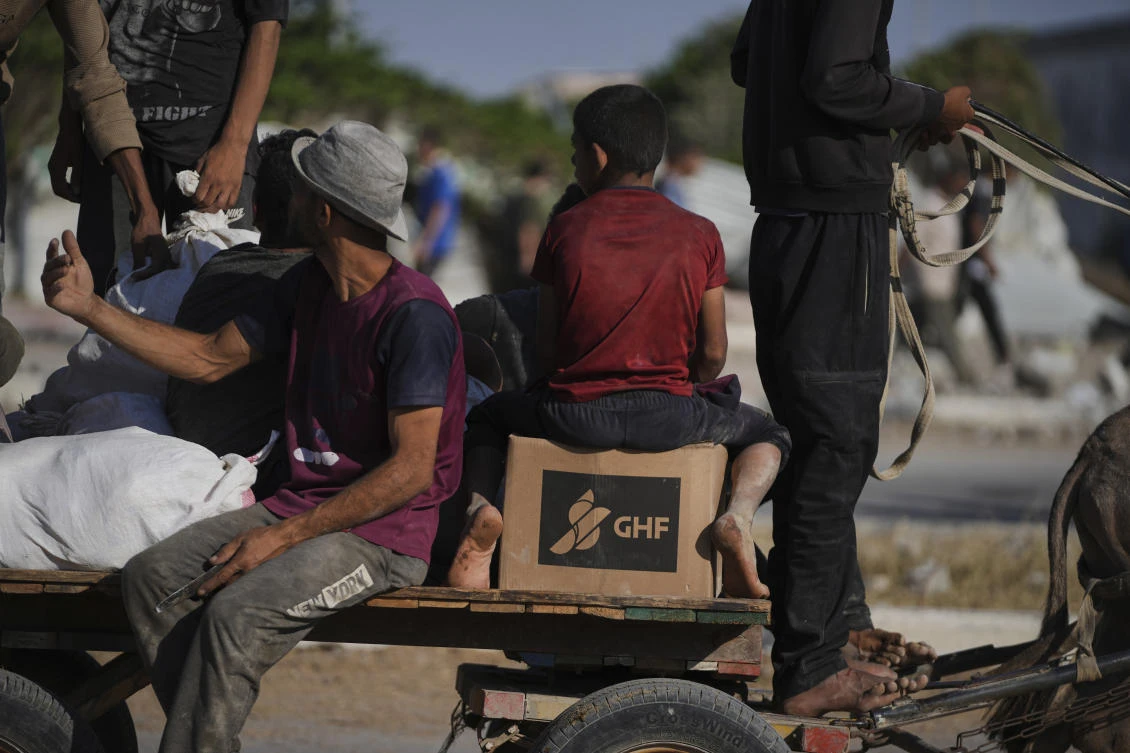
The foundation, which is backed by an American private contractor, has been distributing food boxes at four locations, mainly in the far south of Gaza, for the past month.
“GHF is not aware of any of these incidents but these allegations are too grave to ignore and we therefore call on Israel to investigate them and transparently publish the results in a timely manner,” the group said in a social media post.
Palestinians trying to find food have frequently encountered chaos and violence on their way to and on arrival at the aid sites.
Tens of thousands are desperate for food after Israel imposed a 2 1/2 month siege on Gaza, blocking all food, water and medicine from entering the territory pending the setup of the GHF sites.
The bodies of eight people who died Friday had come to Shifa Hospital from a GHF site in Netzarim, although it was not immediately clear how they died, Dr. Mohamed Abu Selmyiha, the hospital’s director, told The Associated Press.
A GHF spokesperson challenged the report, saying they did not know of any incidents at or near their sites Friday.
Twenty other bodies his hospital received Friday came from airstrikes across north Gaza, he said.
Thousands of Palestinians walk for hours to reach the hubs, moving through Israeli military zones where witnesses say Israeli troops regularly open fire with heavy barrages to control the crowds. The Israeli military says it has only fired warning shots.
Mohammad Fawzi, a displaced man from Rafah, told the AP that he was only able to get empty boxes, not food, from the aid site in the Shakoush area in Rafah when he trekked there early Thursday morning.
“We’ve been shot at since 6 a.m. up until 10 a.m. just to get aid and only some people were able to receive it. There are martyrs and injured people. The situation is difficult,” he said.
The group Doctors Without Borders on Friday condemned the distribution system as “a slaughter masquerading as humanitarian aid” and called for it to be immediately shut down.
More than 6,000 people have been killed and more than 20,000 injured in Gaza since the ceasefire collapsed on March 18. Since the war began, more than 56,000 people have been killed and 132,000 injured, according to the health ministry.
The Gaza Health Ministry doesn’t distinguish between civilians and combatants, but has said that women and children make up more than half the 56,000 dead. Israel says it only targets militants and blames civilian deaths on Hamas, accusing the militants of hiding among civilians, because they operate in populated areas.
The Israel-Hamas war started following the Hamas-led attack in southern Israel on Oct. 7, 2023, when some 1,200 people were killed and around 250 taken hostage. About 50 of them still remain in captivity in Gaza.
The latest deaths include six people killed and 10 wounded in Israeli strikes on a group of citizens near the Martyrs Roundabout in the Bureij Camp in central Gaza Strip, officials at Awda Hospital in Nuseirat said Friday.
The United Nations chief meanwhile urged leaders to show “political courage” and agree to a ceasefire like the one forged between Israel and Iran.
Secretary-General António Guterres also urged a return to the UN’s long-tested distribution system for aid in Gaza, where he said Israeli military operations have created “a humanitarian crisis of horrific proportions..”
“The search for food must never be a death sentence,” Guterres stressed to UN reporters Friday.