Pakistan approves 10% gas price hike for industry, power plants under IMF conditions

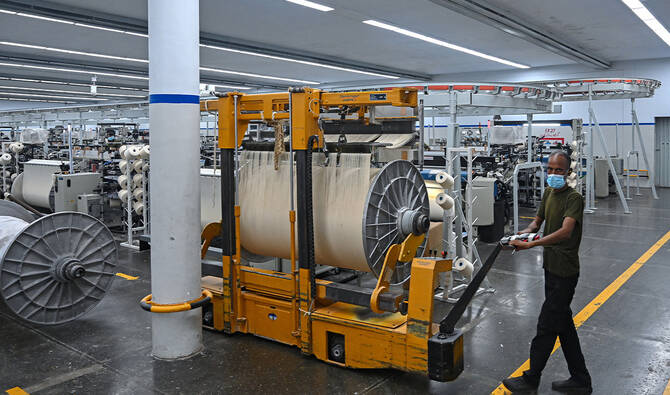
In this picture taken on July 20, 2023, a worker shifts a fabric roll at the Kohinoor Textile Mills in Lahore, Pakistan. (AFP/File)
Short Url
Updated 27 June 2025
Follow

Pakistan approves 10% gas price hike for industry, power plants under IMF conditions

  • ECC spares households in gas price hike, with only fixed charges adjusted to recover costs
  • It also approves grant for defense ministry to cover shortfall in salaries, allowances and dues

KARACHI: Pakistan on Friday approved a 10 percent increase in natural gas prices for industrial users and power plants starting next month, in line with reforms mandated by the International Monetary Fund (IMF) to ensure cost recovery and tariff rationalization, an official statement said.

The decision was taken by the Economic Coordination Committee (ECC) of the Cabinet, chaired by Finance Minister Muhammad Aurangzeb.

While prices for bulk consumers and gas-fired power plants will rise, household consumers will be shielded from the increase.

“To protect household consumers, gas prices will remain unchanged, with only fixed charges revised,” the Finance Division said in a statement released after the meeting. “However, prices for bulk consumers, industrial units and power plants will be increased by an average of 10 percent.”

The statement said the revised pricing structure, submitted by the Petroleum Division, complies with regulatory obligations under the OGRA Ordinance and meets structural benchmarks under Pakistan’s ongoing loan program with the IMF.

It also supports a shift from cross-subsidies to direct, targeted assistance for low-income consumers.

DEFENSE GRANT

The ECC also approved a Rs15.8 billion ($55.3 million) supplementary grant for the Ministry of Defense to cover a shortfall in salaries, allowances and pending dues.

The funding includes disbursements under the prime minister’s compensation package for martyrs of the recent Pakistan-India war fought last month.

In a separate decision, the committee gave in-principle approval to launch a risk coverage scheme for small farmers and underserved regions by August 14.

The program is expected to bring 750,000 new borrowers into the formal credit system and unlock a Rs300 billion ($1.05 billion) agricultural loan portfolio over three years (FY2026-28).

The statement said the total budgetary support for the scheme, covering risk coverage and bank operating costs, is estimated at Rs37.5 billion ($131.25 million), to be disbursed between FY2027 and FY2031.

The government has directed relevant ministries to incorporate additional safeguards before the official rollout.

Qatar, Pakistan resolve to boost strategic, economic cooperation at Doha talks

Updated 24 February 2026
Follow

Qatar, Pakistan resolve to boost strategic, economic cooperation at Doha talks

  • Both countries urge dialogue on Afghanistan amid renewed border tensions between Islamabad and Kabul
  • Discussions focus on bilateral trade and investment, energy, defense, manpower and labor and culture

ISLAMABAD: Pakistan and Qatar on Tuesday agreed to deepen their strategic and economic cooperation during high-level talks between Prime Minister Shehbaz Sharif and his Qatari counterpart Sheikh Mohammed bin Abdulrahman bin Jassim Al Thani, Sharif’s office said.

Sharif visited Qatar along with a high-level delegation on the invitation of Qatari emir Sheikh Tamim bin Hamad Al Thani. The Pakistani premier also held meetings with Qatar’s trade and defense ministers to discuss cooperation in various domains.

The visit came at a time when Pakistan is seeking closer economic engagement with Gulf partners amid its broader push to stabilize the economy and attract investment, while maintaining security and defense cooperation with key regional states.

During their meeting in Doha, PM Sharif and Qatar’s Sheikh Mohammed discussed bilateral relations and exchanged views on regional and international developments, according to the Pakistan prime minister’s office.

“They reaffirmed the strong brotherly relations between Pakistan and Qatar and expressed satisfaction at the growing momentum in political, economic and institutional ties,” Sharif’s office said.

“Discussions focused on enhancing cooperation in the fields of trade and investment, energy, defense, manpower and labor and culture, with both sides stressing the importance of their task force to accelerate cooperation in all these areas.”

Pakistan and Qatar maintain strong trade and investment ties. In 2022, the office of Qatar’s emir said the Qatar Investment Authority planned to invest $3 billion in Pakistan, targeting sectors including transport, aviation, education, health, media, technology and labor.

Nearly 300,000 Pakistanis live and work in Qatar, according to Pakistan’s foreign office, with many employed in health, education, engineering and public services, as well as construction and transport. The two countries engage through forums such as the Bilateral Political Consultations and the Joint Ministerial Commission.

Sharif said he had productive discussions with Qatar’s emir, Sheikh Tamim bin Hamad Al Thani, on how the two sides could transform their brotherly ties into mutually beneficial economic relationships. 

“We also took stock of the regional situation,” he said on X. “Pakistan and Qatar will continue to work together for peace and stability in the region and beyond.”

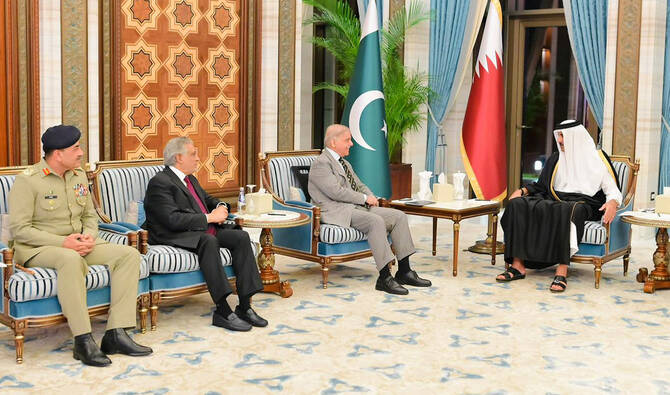
Prime Minister Shehbaz Sharif (second right) meets the Qatari Emir Qatar’s emir Sheikh Tamim bin Hamad Al Thani (left) in Doha, Qatar, on February 24, 2026. (PID)

DIALOGUE WITH AFGHANISTAN

Earlier, Sharif and Qatar’s Deputy PM Sheikh Saoud Al-Thani discussed the situation in Afghanistan and called for dialogue to support regional stability.

The meeting took place amid renewed tensions after Islamabad carried out airstrikes last week on what it described as Tehreek-e-Taliban Pakistan (TTP) targets inside Afghanistan. Kabul said the strikes killed civilians and vowed to respond to what it called a violation of its sovereignty.

“Regional developments were also discussed, in particular the situation in Iran and Afghanistan,” Sharif’s office said in a statement. “Both sides emphasized the importance of dialogue, de-escalation and collective efforts to promote peace and stability in the region.”

This was the second time in less than six months that Pakistan conducted airstrikes in Afghanistan. The last strikes triggered heavy, weeklong clashes between the neighbors along their border before Qatar and Turkiye mediated a ceasefire between them in Oct. last year.

Separately, Sharif held meetings with Qatar’s State Minister for Trade Dr. Ahmed bin Mohammed Al-Sayed and a delegation of the Qatar Businessmen Association (QBA), highlighting Pakistan’s investment-friendly reforms.

He invited QBA members to explore opportunities in infrastructure, logistics, energy, agriculture, technology and export-oriented manufacturing, his office said.