

German lawmakers vote to suspend family reunions for many migrants

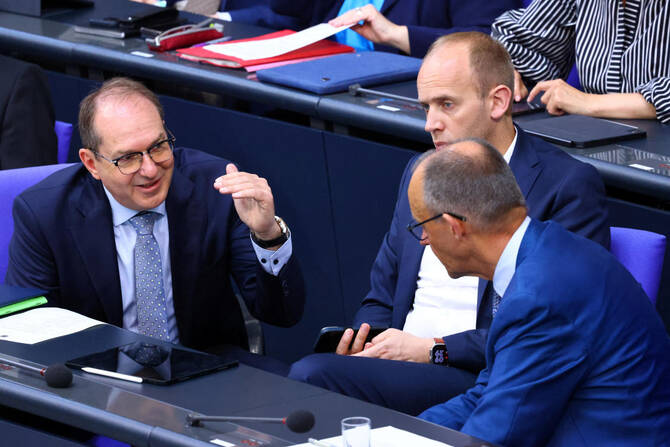
German Interior Minister Alexander Dobrindt speaks with Chancellor Friedrich Merz on the day the Bundestag, votes on a draft bill to suspend family reunification for two years for people granted subsidiary protection status to relieve pressure on Germany's reception and integration systems, in Berlin, Jun. 27, 2025. (Reuters)
Short Url
Updated 27 June 2025
Follow

German lawmakers vote to suspend family reunions for many migrants

  • The bill approved Friday is the first legislation on migration since Merz took office
  • It will suspend rules dating to 2018 that allowed up to 1,000 close relatives per month to join the migrants granted limited protection

BERLIN: German lawmakers voted Friday to suspend family reunions for many migrants, part of a drive by the new conservative-led government for a tougher approach to migration.

Parliament’s lower house voted 444-135 to suspend the possibility of family reunions for two years for migrants who have “subsidiary protection,” a status that falls short of asylum.

At the end of March, more than 388,000 people living in Germany had the status, which was granted to many people fleeing Syria’s civil war.

New Chancellor Friedrich Merz made tougher migration policy a central plank of his campaign for Germany’s election in February. Just after he took office in early May, the government stationed more police at the border and said some asylum-seekers trying to enter Europe’s biggest economy would be turned away.

The bill approved Friday is the first legislation on migration since Merz took office. It will suspend rules dating to 2018 that allowed up to 1,000 close relatives per month to join the migrants granted limited protection, with authorities making case-by-case decisions on humanitarian grounds rather than granting an automatic right for reunions.

Interior Minister Alexander Dobrindt told lawmakers that the change would result in 12,000 fewer people being able to come to Germany each year and “break a business model” for smugglers.

People often know they won’t get full recognition as refugees, “but they set off for Germany because it is known that, even without asylum recognition ... you can have your family follow,” Dobrindt said. “That is a significant pull effect and we are removing this pull effect today.”

Dobrindt said “our country’s capacity for integration simply has a limit.”

Liberal opposition lawmakers decried the government’s approach. Marcel Emmerich, of the Greens, described the legislation as “an attack on the core of every society, on a truly central value — the family.”

“Anyone who wants integration must bring families together,” he said.

The far-right, anti-migration Alternative for Germany described the move as a very small step in the right direction.

German governments have for years faced pressure to curb migration as shelters across the country filled up. The administration of Merz’s predecessor, Olaf Scholz, already had taken some measures including the introduction of checks on all Germany’s borders.

Asylum applications declined from 329,120 in 2023 to 229,751 last year and have continued to fall this year.


Costa Rica’s Grynspan pledges reform in bid for UN chief job

Updated 3 sec ago
Follow

Costa Rica’s Grynspan pledges reform in bid for UN chief job

GENEVA: Rebeca Grynspan is upbeat about her chances of becoming the next head of the United Nations, which she insists must become more agile in tackling the world’s crises.
The Costa Rican former vice president said she wanted to rebuild global trust in the United Nations if she becomes its next secretary-general.
“We are very optimistic. I think that I am more than a viable candidate,” Grynspan said on Friday, her last working day before stepping aside as head of the UN trade and development agency UNCTAD to focus on her campaign.
The second term of current UN chief Antonio Guterres expires at the end of the year.
“My profile is right for this moment. I know the UN enough to reform it and enough to defend it,” she told the UN correspondents’ association ACANU.
“I have a lot of experience in my political life, taking decisions under a lot of stress and in complex situations. I have been in the highest positions in the UN.”
It is Latin America’s turn next for the top UN job and two other candidates are running: former Chilean president Michelle Bachelet, and Rafael Grossi, the Argentinian head of the International Atomic Energy Agency.
Founded in 1945, the UN has never had a woman secretary-general.
Grynspan, an economist, is not looking to be chosen on that basis.
“I don’t need any favors to be elected for the secretary-general; I just need people not to discriminate me for being a woman,” the 70-year-old said.
“If the competition will be fair, with no biases, I will make it. I have the CV; I have the merits.”

- Rebuilding trust -

Last month, Guterres warned that the UN was facing financial collapse and could run out of cash by July, with member states neither paying in full nor or time.
“The UN has to change,” said Grynspan.
There are far greater capacities in civil society and the private sector than in 1945, “and we need to be able to harness that: we don’t have to do everything in the UN.”
As for peace and security, “prevention and mediation are essential. But they need agility and flexibility from the structures of the UN. And I don’t think we have that right now.”
US President Donald Trump has slashed funding to some UN agencies and has repeatedly questioned the UN’s relevance and attacked its priorities, setting up his own “Board of Peace.”
“The UN is unique because it’s the only legitimate, universal organization,” said Grynspan.
“We need to rebuild trust with the member states. We need to regain the belief that the UN is useful to solve problems,” she said, vowing to bring her personal qualities to the task.
“I am able to reach to people not only with logic, but also with inspiration, optimism and hope,” she said.
“We need more of that too, because we need to connect again much more with people. We will need to conquer the hearts and minds again.”

- Leadership style -

The UNCTAD chief said her leadership style revolved around being “direct, honest, and evidence-based... There have to be reasons, not only emotions.”
Grynspan recounted that her parents, who were from Poland, “barely survived” World War II. Her maternal grandparents were killed in the Holocaust.
Her parents went “with nothing” to Costa Rica, a country that “allowed them to have a good life.”
“Costa Rica has taught me a lot. It’s a country that I not only love dearly, but I admire,” she said.
“I am not an impetuous person. I think things through. I have the serenity not to lose it under tension and under pressure. I consult. I hear. And I am brave. I take risks.”
rjm/ceg