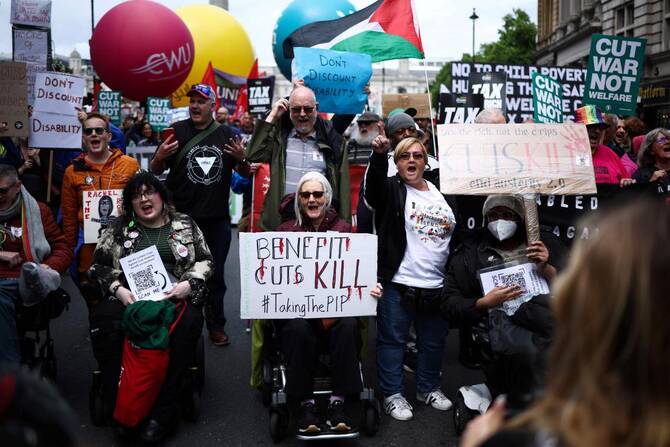

LONDON: The UK government backed down Friday on controversial plans to slash disability and sickness benefits after a major rebellion by MPs, in a blow to Prime Minister Keir Starmer’s authority.
The climbdown is the third U-turn that Starmer has been forced into in less than a month, leading to questions about his political acumen and direction of the ruling Labour party.
Only days after Starmer insisted he would plow ahead with the reforms, the government confirmed concessions had been made to 126 rebel MPs who had threatened to scupper the proposed changes.
The turnaround comes just before Starmer marks the first anniversary of what has been a rocky return to power for Labour after 14 years in opposition to the Conservatives.
A spokesperson for Number 10 said the government had “listened to MPs who support the principle of reform but are worried about the pace of change for those already supported by the system.”
It said a revised package of measures would preserve the welfare system for those “who need it, by putting it on a sustainable footing.”
The backtrack means the Universal Credit and Personal Independence Payment (Pip) Bill, which contains the welfare reforms, will likely make it through a parliamentary vote due on Tuesday.
“It’s always best to concede and then get it through in some way, shape or form. This is sort of damage limitation,” political scientist Steven Fielding said.
The concessions, due to be set out in parliament later on Friday, include a “staggered approach” to the reforms, care minister Stephen Kinnock said.
This means that the narrower eligibility criteria proposed will only apply to new claimants, not those already receiving the benefit payments.
Starmer’s government had hoped to make savings of £5.0 billion ($6.9 billion) as a result of the changes that have now been partly abandoned, meaning finance minister Rachel Reeves will need to find them elsewhere.
It has been a bumpy 12 months in office for Starmer during which Reeves has struggled to generate growth from a sluggish UK economy.
On June 9, the government declared it had reversed a policy to scrap a winter heating benefit for millions of pensioners, following widespread criticism, including from its own MPs.
Less than a week later Starmer announced a national enquiry focused on a UK child sex exploitation scandal that had attracted the attention of US billionaire Elon Musk.
Starmer had previously resisted calls for an enquiry into the so-called “grooming gangs” – that saw girls as young as 10 raped by groups of men mostly of South Asian origin – in favor of a series of local probes.
The prime minister has a massive majority of 165 MPs, meaning he should be able to force whatever legislation he wants through parliament.
But many of his own MPs complain of a disconnect between Starmer’s leadership, which is focused on combatting the rise of the far-right Reform UK party, and Labour’s traditional center-left principles.
“Labour is meant to stand for fairness, and those two flagship mistakes are all about being unfair,” Fielding said of winter fuel and the disability cuts.
The furors are also overshadowing Labour’s tightening of employment rights, and investment in housing and green industries, he added.
A YouGov poll of more than 10,000 Britons released this week found that while Labour is losing voters to Reform, it is also forfeiting supporters to the Liberal Democrats and the Greens on the left.
“They’ve been making so many unforced errors,” said Fielding, a politics professor at Nottingham University.
“I think there is now being a very reluctant recalibration of things.”