

Pakistan army chief urges civil servants to uphold integrity in state governance structure

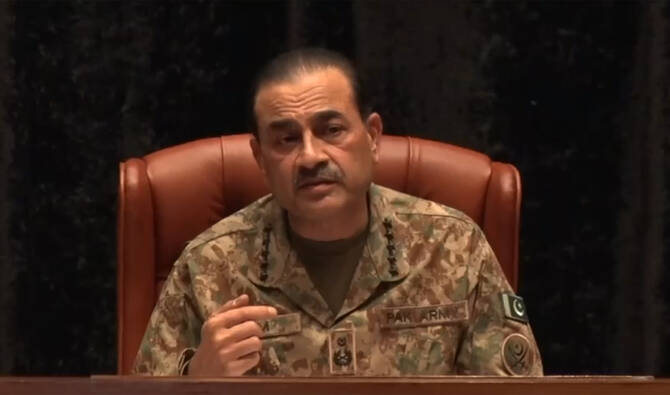
The screengrab taken from a video released by the Pakistan military’s media wing, on June 27, 2025, shows Chief of Army Staff Field Marshal Asim Munir addressing the probationary officers of the 52nd Common Training Program (CTP) of Pakistan’s Civil Services Academy at the Army Auditorium in Rawalpindi. (ISPR)
Short Url
Updated 27 June 2025
Follow

Pakistan army chief urges civil servants to uphold integrity in state governance structure

  • Development comes after defense minister described civil-military hybrid system as ‘co-ownership of the power structure’
  • Field Marshal Asim Munir stresses inter-institutional cohesion, unified purpose to advance Pakistan’s strategic objectives

ISLAMABAD: Pakistan’s Army Chief Field Marshal Asim Munir has urged young civil servants of the country to uphold integrity in the state governance structure to achieve national security imperatives and overcome internal and external challenges, the Pakistani military said on Friday.

The statement came after the army chief’s meeting with probationary officers of the 52nd Common Training Program (CTP) of Pakistan’s Civil Services Academy at the Army Auditorium in Rawalpindi, according to the Inter-Services Public Relations (ISPR), the military’s media wing.

These probationary officers remained attached with the formations of Pakistan Army at peace time locations and operational areas of Azad Kashmir, and Khyber Pakhtunkhwa and Balochistan provinces, and gained “rich experience” of the three services during various interactions and visits.

In his address, the field marshal spoke on a range of critical issues, including national security as well as internal and external challenges, and the pivotal role of the Pakistani armed forces in preserving regional peace and national stability.

“The Chief of Army Staff further highlighted the indispensable role of a capable, transparent, and service-driven civil bureaucracy within the architecture of state governance,” the ISPR said in a statement. “He urged the young officers to embody the highest standards of integrity, professionalism, and patriotic commitment in the fulfillment of their responsibilities to the nation.”

The development comes a week after Pakistan’s defense minister Khawaja Asif described the country’s governance as a “hybrid model” in which military and civilian leaders share power — an open secret in political circles but a rare public admission by a serving official that took on added significance amid the army chief’s solo visit to the United States this month and an unprecedented meeting with President Donald Trump.

Asif acknowledged the military’s prestige had “skyrocketed” after Pakistan’s four-day conflict with India last month, calling it a “blessing in disguise,” but rejected that this would erode democratic authority or give the army unchecked control.

“No, it doesn’t worry me,” he told Arab News, when asked if Pakistan’s history of direct and indirect military rule made him uneasy about the army’s stronger image.

“This is a hybrid model. It’s not an ideal democratic government … So, this arrangement, the hybrid arrangement, I think [it] is doing wonders,” Asif said, adding that the system was a practical necessity until Pakistan was “out of the woods as far as economic and governance problems are concerned.”

The defense chief argued the long-running political instability and behind-the-scenes military influence in earlier decades had slowed democratic development, but the current arrangement had improved coordination.

Pakistan’s military has played a central role in national affairs since independence in 1947, including periods of direct rule after coups in 1958, 1977 and 1999, when General Pervez Musharraf toppled then-Prime Minister Nawaz Sharif, the elder brother of current Prime Minister Shehbaz Sharif. Musharraf ruled until 2008 when elections restored civilian governance. Even under elected governments, however, the army is widely considered the invisible guiding hand in politics and in shaping foreign policy, security strategy, and often key aspects of governance.

The ISPR said the army chief’s interaction with the young civil servants was part of a “broader national initiative aimed at strengthening institutional synergy and deepening mutual understanding” between Pakistan’s civil and military leadership, according to the ISPR.

“He (Field Marshal Munir) underscored the imperative of inter-institutional cohesion, mutual respect, and unified national purpose in advancing Pakistan’s strategic and developmental objectives,” it said.

The CTP participants appreciated the opportunity to gain insight into the Pakistan Army leadership’s strategic vision, operational readiness and its multifaceted contributions to national resilience and development, the ISPR added.


Pakistan likely to import around 7 million cotton bales this year as local production nearly halves

Updated 5 sec ago
Follow

Pakistan likely to import around 7 million cotton bales this year as local production nearly halves

  • Pakistan produced 5.3 million cotton bales by mid-December against 10 million targeted, government data shows
  • While the imports may ensure smooth supply of raw material, they may put pressure on foreign exchange reserves

KARACHI: Pakistan is likely to import around 7 million cotton bales this year owing to a decline of nearly half the annual target set by the Federal Committee on Agriculture (FCA), industry stakeholders said on Tuesday.

Pakistan’s cotton production stood at 5.3 million bales each weighing 170 kilograms as of Dec. 15, according to state-run Pakistan Central Cotton Committee (PCCC) data. The FCA had set a target of 10.2 million bales in April.

Karachi Cotton Brokers Forum (KCBF) Chairman Naseem Usman Osawala sees the country’s cotton production declining by 46 percent this season, compared to the FCA target.

“The country is expected to produce about 5.5 million bales this year,” he told Arab News, adding Pakistan would have to import around 7 million bales to meet requirement of its textile industry which consumes about 12 million bales a year.

The country had sown cotton over 2.002 million hectares, which was down by 11 percent from the targeted 2.26 million hectares.

Muhammad Waqas Ghani, head of research at Karachi-based JS Global Capital brokerage firm, said the South Asian country is likely to miss its cotton output target of 10 million bales.

“At the current rate of arrival, the output can reach 7 million bales at its best,” he added.

Cotton is a raw material for Pakistan’s largest textile industry and was the worst hit crop by climate-induced floods earlier this year.

Osawala said Pakistan’s cotton production has been falling because of an increasing number of sugar mills being established in the country’s cotton-producing regions.

Courts in Pakistan have been issuing significant rulings to bar the establishment of sugar mills in the designated cotton belt areas of the Punjab province. In 2018, the Supreme Court ordered relocation of three sugar mills from cotton-producing districts in southern Punjab to protect the crop.

Since cotton prices are low in the international market, textile millers would go for more imports, according to the KCBF chairman.

On Dec. 22, the price of cotton in the New York market stood at as much as 65.85 cents per pound, 1.64 cents lower than last year, according to the PCCC data.

Osawala said Pakistan’s increasing textile imports are also “hurting local cotton production.”

According to the Pakistan Bureau of Statistics’ (PBS) July-November data, the country had imported raw cotton, synthetic fiber, synthetic and artificial silk yarn and worn clothing worth $2.82 billion, 5 percent more than the imports during the same period last year.

Speaking of the impact of Pakistan’s falling cotton production, Kamran Arshad, chairman of All Pakistan Textile Mills Association (APTMA), said the millers would have to import “a lot of cotton” this year.

“I think approximately 7-7.5 million bales will have to be imported this year,” he said.

The textile and apparel sector is Pakistan’s largest exporter, accounting for more than half of the country’s overall exports and contributing around 8.5 percent of the gross domestic product (GDP) by employing nearly 40 percent of the industrial labor force. But high energy costs and outdated infrastructure among other factors continue to slow growth and leave the country trailing regional peers.

In the last fiscal year, Pakistan imported as much as 6.2 million cotton bales each weighing 220 kilograms, mostly from Brazil and the United States, according to KCBF Chairman Arshad.

Shankar Talreja, head of research at Karachi-based Topline Securities, said Pakistan is likely to import cotton worth $1.2 billion this year “considering the requirement.”

“The full-year import of cotton is likely to remain over $1 billion,” Talreja said.

Economic experts say while importing more cotton would ensure smooth supply of raw material to Pakistan’s textile sector, it may put pressure on the country’s foreign exchange reserves that rose to $15.9 billion last week after the International Monetary Fund (IMF) released a $1.2 billion tranche under Pakistan’s $7 billion loan program.