Ketamine ‘epidemic’ among UK youth raises alarm

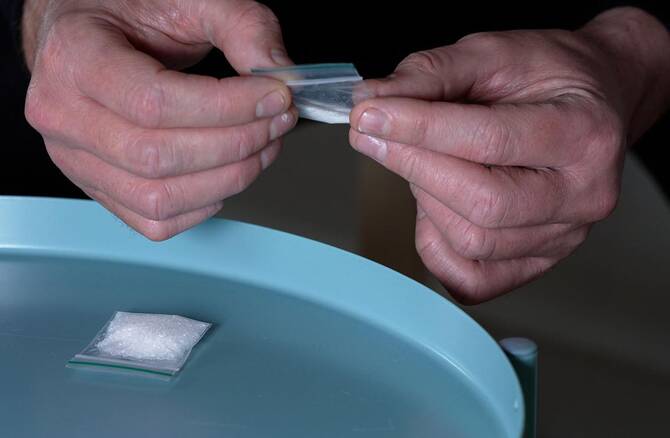
The first time Barney Casserly used ketamine at a UK music festival he thought he had found “nirvana.” (AFP)
Short Url
Updated 27 June 2025
Follow

Ketamine ‘epidemic’ among UK youth raises alarm

  • The first time Barney Casserly used ketamine at a UK music festival he thought he had found “nirvana“

LONDON: The first time Barney Casserly used ketamine at a UK music festival he thought he had found “nirvana.” Five years later he died in agony, leaving behind devastated parents and friends.
“I would never, ever have imagined that this would happen to us as a family,” said his mother, Deborah Casserly, still grieving for Barney who died in April 2018, aged 21.
Ketamine, an affordable recreational drug that induces a sense of detachment from reality, has reached unprecedented levels of popularity among young people in the UK, with some experts even calling it an “epidemic.”
The extent of the crisis prompted the government in January to seek advice from an official advisory body on whether to reclassify ketamine as a Class A substance.
That would bring it in line with other drugs such as heroin, cocaine and ecstasy, meaning supplying ketamine could carry terms of up to life imprisonment.
In the consulting room of doctor Niall Campbell, a leading specialist in addiction treatment at Priory Hospital, Roehampton, Casserly, 64, showed pictures of her son — a smiling young man with dark hair and bright eyes.
Tearfully, she recalled how her son’s life fell apart as his ketamine addiction took hold.
Barney was just 16 when he went to the Reading music festival in southern England and used ketamine for the first time, writing about it in ecstatic terms in his journal.
But he swiftly became addicted to the drug, a white crystalline powder that is crushed and then sniffed. Alternatively it can be swallowed in liquid form.
“His usage moved from being used in a party context to being used at home alone... a tragic, sad, desperately lonely experience,” said his mother.
His family sent him to private rehabs but he relapsed, would use every day, and was in an “excruciating amount of pain.”
“He would spend long parts of the day in the bath, in hot water... because the cramps were so bad. He was not able to sleep properly at night because he was constantly getting up to urinate,” said his mother.
Barney suffered from ulcerative cystitis, also known as “ketamine bladder,” which is when “the breakdown products of ketamine basically cause the bladder to rot,” said Campbell.
“Mum, if this is living, I don’t want it,” said Barney on April 7, 2018. The next morning his mother found him dead in his bed.
An anaesthetic drug invented in 1962, ketamine is used for both human and veterinary medicine often as a horse tranquillizer.
“Some people love that dissociative, detached from reality, kind of effect” the drug brings, said Campbell.
Users “go right down into what we call a K hole, which is just to the point of collapsing and being unconscious.”
In the year ending March 2024, an estimated 269,000 people aged 16 to 59 had reported using ketamine, a government minister said.
And among young people aged 16-24 “the misuse of ketamine... has grown in the last decade” by 231 percent, said junior interior minister Diana Johnson, in her letter asking for advice from the Advisory Council on the Misuse of Drugs.
There were 53 deaths in England and Wales in 2023, according to the Office for National Statistics.
“It’s really commonplace now, it’s everywhere,” said Laiden, a London drug dealer using an assumed name.
“It’s a cheap drug with a strong effect on people and people aren’t concerned about selling it to youngsters,” added Laiden.
Ketamine costs between £20 and £30 ($27.50 and $41) a gram while cocaine, which remains his top seller, is around £100 a gram, he said.
“This epidemic is having a huge effect on the nation,” said Campbell.
Ketamine is very addictive and “by the time they get to see us, the party’s over. They’re not out in the nightclubs. They’re sitting on their own at home, secretly doing this stuff, killing themselves,” he added.
But others argue that ketamine can have healing benefits.
Married therapists Lucy and Alex da Silva run a psychedelic therapy wellness center in London, and use ketamine prescribed by doctors in lozenge form to treat depression and trauma.
“We want people to see what the healing benefits of ketamine, when it’s controlled in the right way, can do,” said Lucy da Silva.
But she agreed there was “a need for education around the dangers of street ketamine and the lives that it’s taking.”


What Bangladesh’s election means for India, China and Pakistan ties

Bangladesh Nationalist Party supporters gather for a rally ahead of the upcoming national election, in Sylhet on Jan. 22, 2026.
Updated 08 February 2026
Follow

What Bangladesh’s election means for India, China and Pakistan ties

  • Bangladeshis will vote on Feb. 12, almost two years after the 2024 student-led uprising
  • After nearly 2 years of tensions, experts expect a thaw with India under elected government

DHAKA: As Bangladesh prepares to hold its first elections since the 2024 ouster of Sheikh Hasina, its longest-serving prime minister, the outcome will define Dhaka’s relations with the most important regional powers — China, India, and Pakistan.

Nearly 128 million Bangladeshis will head to the polls on Feb. 12 to bring in new leadership after an 18-month rule of the current caretaker administration.

The interim government, led by Nobel laureate Muhammad Yunus, took control following a student-led uprising that ended 15 years in power of Hasina and her Awami League party.

The two main parties out of the 51 competing for power are the Bangladesh Nationalist Party and Jamaat-e-Islami. The Awami League, which for decades has had close ties with India, was excluded from the election ballot over its role in the deadly crackdown on the 2024 student-led protests, in which 1,400 people were killed.

While Bangladesh’s relationship India has deteriorated since the fall of Hasina, who has been in self-exile in New Delhi, the period of diplomatic strain is expected to ease when the new government takes office.

“Whoever comes to power in Bangladesh, due to domestic pressure in the country, relationships with India need a resetting,” Humayun Kabir, former ambassador to the US, told Arab News.

“It’s anticipated that India will also engage with the new government, but they will protect their interests, and we also have to do the same. It’s most likely that the India-Bangladesh relationship will be normalized under the new, elected, government.”

Since 2024, India has suspended key transshipment access that allowed Bangladeshi exports to go via Indian ports and airports. It also put on hold most normal visa services for Bangladeshis, who were among its largest groups of medical tourists.

From Hasina’s heavy pro-India orientation, the interim government has tried to rebalance Bangladesh’s foreign policy toward the two other key regional players — China and Pakistan — who at the same time are India’s main rivals. 

If New Delhi regains its importance, it should not deal a blow to the newly expanded relations with Pakistan, with whom Bangladesh has recently increased exchanges, especially economic, and last month resumed direct flights — after a 14-year gap.

Since the relations have been expanded under the caretaker government, Prof. Delwar Hossain from the International Relations Department at Dhaka University forecast that they would only further improve, no matter who comes to power, and there is no likelihood of a sudden change.

“For Pakistan, any political coalition — whether BNP or Jamaat — will be positive. The BNP has a long history of having good relations with Pakistan during their rule ... Jamaat also has a strong and very positive influence in Pakistan,” he said.

“For Pakistan, the new regime or new government is not the issue. The issue is what the (India) policy of the new government would be and to what extent it would actually support Pakistan’s view.”

Both the BNP and Jamaat have repeatedly said they wanted friendly relations with India, and Hossain expected that they would, at the same time, continue the balanced approach introduced by the caretaker administration.

“India is a reality as a neighbor. At the same time, India is also showing interest in mending relations or adopting a more cooperative approach after the vote, with the government that will be elected ... I think there will be pragmatism from both sides,” he said.

“I don’t see there is a long-term threat to Bangladesh-India relations ... When China and Pakistan were trying to create a trilateral cooperative system or some kind of coalition — China, Bangladesh and Pakistan — we have seen that Bangladesh opted out. It seems that Bangladesh is going to continue its policy of maintaining a balance among these great powers.”

Bangladesh’s relations with China have not changed since the ouster of Hasina, whose government signed several economic agreements with Beijing. Yunus’s administration has continued this cooperation, and China was among the very few countries he officially visited during his term.

During the visit, he secured about $2.1 billion in Chinese investments, loans and grants, including funding for infrastructure like Mongla Port and a special economic zone in Chattogram — Bangladesh’s largest port. China has also eased visa rules for Bangladeshi businesspeople, medical travelers and tourists.

According to Munshi Faiz Ahmed, Bangladesh’s former ambassador to Beijing, China’s importance for Bangladesh cannot be substituted by any other country, especially as over the past few years it has emerged not only as its key investor, but also the largest trade partner.

In the fiscal year 2024-25, Bangladesh’s trade with China was over $21.3 billion, according to National Board of Revenue data. With India, it was about $11.5 billion.

The trade — especially import — dependence on Beijing started long before the regime change. In terms of trade volume, China overtook India already in 2018.

“Even when people thought that we had very close relations with India, our relations with China continued to grow in terms of trade and commerce ... Our trade with China has surpassed India’s, and China is a much bigger investor in Bangladesh’s development projects,” Ahmed said.

“Bangladesh will continue to cooperate with China for a long time to come because what China can provide, no other country can.”