Renters struggle to survive in Portugal housing crisis

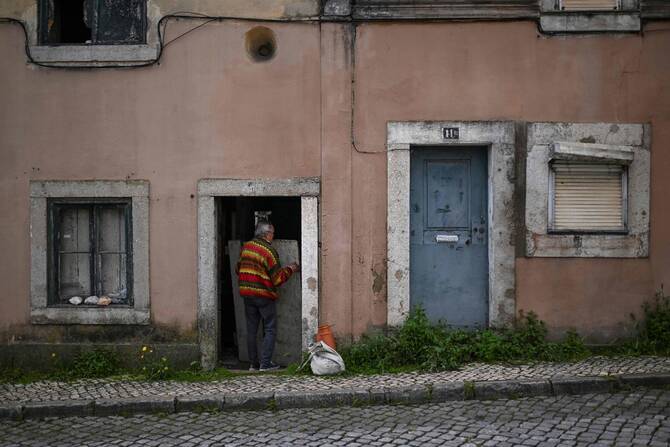
An 80 year old retired kitchen assistant, uses a board to block the entrance of the abandoned house where he lives, in Belem, Lisbon. (AFP)
Short Url
Updated 27 June 2025
Follow

Renters struggle to survive in Portugal housing crisis

  • Housing prices in Portugal have jumped 124 percent since 2015, well above the EU average of 53 percent, according to Eurostat
  • The current government has made tackling the crisis a priority

LISBON: With sky-high rents beyond his modest pension, Antonio Lemos has no choice but to live in an abandoned house in Lisbon without electricity or running water as Portugal’s perennial housing crisis spirals.
The former kitchen assistant, 80, has never found a stable home since foreign investors bought his apartment and has placed his hopes on a charitable institution to find a solution.
“How can you pay a rent of 400 or 500 euros for a room?,” asked Lemos, whose monthly pension barely amounts to 500 euros ($580). “Age is catching up, and I’m scared.”
Successive governments of all political stripes have tried and failed to solve the problem, according to Luis Mendes, a researcher at the University of Lisbon’s Institute for Geography and Territorial Organization.
“Year after year, real estate breaks new records,” Mendes told AFP.
The market spike began during the eurozone financial crisis in 2011, when the country attempted to resuscitate its stricken economy by attracting foreign capital through so-called “golden visas.”
The scheme offered visas to foreigners who invested in real estate and tax advantages to retirees or globe-trotting digital nomads but is viewed as having contributed to the problem.
Housing prices in Portugal have jumped 124 percent since 2015, well above the EU average of 53 percent, according to Eurostat.
The current center-right government has made tackling the crisis a priority, but in the first three months of 2025 prices spiked by more than 16 percent, according to the Portuguese national statistics institute.
Falling interest rates and public guarantees for young people’s mortgages, a measure introduced by the government last year, has driven the latest increase.
A group campaigning for the right to housing has called for protests this weekend in a dozen cities.

Similar to neighboring Spain, public housing only represents two percent of households and many properties are converted into short-term holiday lets in the popular tourist destination.
Renters like Carlos are bearing the brunt.
The municipal gardener, who declined to give his surname, has been living for five years in a freight container surrounded by building sites in the Portuguese capital.
A basic mattress, a handful of personal belongings and some birds in a cage to keep him company make up the interior of his humble abode.
The 55-year-old used to live with his mother, but after her death the lease was canceled and he found himself homeless overnight.
“I have found nothing at less than 800 euros. To have a salary and not be able to pay rent is unacceptable!” Carlos, whose income reaches around 1,000 euros, told AFP.
In a country where more than 70 percent of the population own their home, the new center-right government that emerged victorious from May’s snap election intends to build almost 60,000 new social homes.
It also plans to simplify public aid for renters, convert vacant public buildings and offer fiscal advantages in a bid to accelerate renovation and construction.
But for Mendes, “it is not with more homes that this crisis will be solved” because it risks “overheating the market.”
The Lisbon renters’ association has criticized “the illusion of supply as the only solution” and singled out a “lack of regulation and political courage.”
The European Commission has suggested Portugal regulate rents to protect the most affected groups of people or introduce more controls for short-term tourist lets.


Farmers block Paris streets to protest planned free trade agreement with South American nations

Updated 12 sec ago
Follow

Farmers block Paris streets to protest planned free trade agreement with South American nations

  • The protest piles yet more pressure on President Emmanuel Macron and his government, a day before EU member states are expected to vote on the trade accord

PARIS: French farmers blocked roads into Paris and landmarks such as the Arc de Triomphe on Thursday, in protest against a sweeping trade deal the EU is due to sign with South American nations. 

Farmers from the right-wing Coordination Rurale union called for the protests in Paris amid fears the planned free trade agreement with the Mercosur bloc will flood the EU with cheap food imports.

They also protested high costs and excessive local regulations and demanded an end to a government policy of culling herds of cows in response to a highly contagious cattle disease, which they consider unwarranted.

“We are between resentment and despair. We have a feeling of abandonment, with Mercosur being ‌an example,” Stephane Pelletier, ‌a senior member of the Coordination Rurale union, told Reuters beneath ‌the Eiffel Tower.

The farmers overran police checkpoints to enter the city, driving along the Champs Elysees avenue and blocking the road around the Arc de Triomphe before dawn, before gathering in front of the National Assembly.

National Assembly President Yael Braun-Pivet was booed and jostled when she stepped outside of the assembly’s gates to talk with the Coordination Rurale protesters.

Dozens of tractors obstructed highways leading into the capital ahead of the morning rush hour, including the A13 leading into Paris from the western suburbs and Normandy, causing 150 km of traffic jams, the transport minister said.

Farmers from the FNSEA and young farmers’ unions joined them later at the Eiffel Tower in a calm demonstration.

“We’re going ‌to import products from the rest of the world that don’t ‍meet our standards — that’s not possible, that’s unacceptable. ‍So we’re staying mobilized, we’re carrying on,” Arnaud Rousseau, president of the FNSEA farm union, told reporters, ‍referring to the Mercosur deal.

The protest piles yet more pressure on President Emmanuel Macron and his government, a day before EU member states are expected to vote on the trade accord. Without a majority in parliament, any policy misstep by Macron risks a perilous vote of no confidence in the chamber.

France has long been a stiff opponent of the trade deal.

Even though Paris has won significant last-minute concessions, the trade deal is a political hot potato for the government, with municipal elections in March and the far-right polling strongly ahead of the 2027 elections to replace Macron.

“This treaty is still not acceptable,” government spokesperson Maud Bregeon told France Info radio.

French Farm Minister Annie Genevard said on Wednesday that, even if EU members backed the accord, France would continue to fight against it in the European Parliament, whose approval will also be required for the agreement to enter into force. 

This week, the European Commission proposed making €45 billion of EU funding available to farmers earlier in the bloc’s next seven-year budget and agreed to cut import duties on some fertilizers in a bid to win over countries wavering in their support for Mercosur. 

The deal is backed by countries such as Germany and Spain, and the Commission appeared closer to winning Italy’s backing. 

Rome’s support for the deal would mean the EU had the votes needed to approve ‌the trade accord even without French support.

A vote on the accord is expected on Friday.