

Tibetans face up to uncertain future as Dalai Lama turns 90

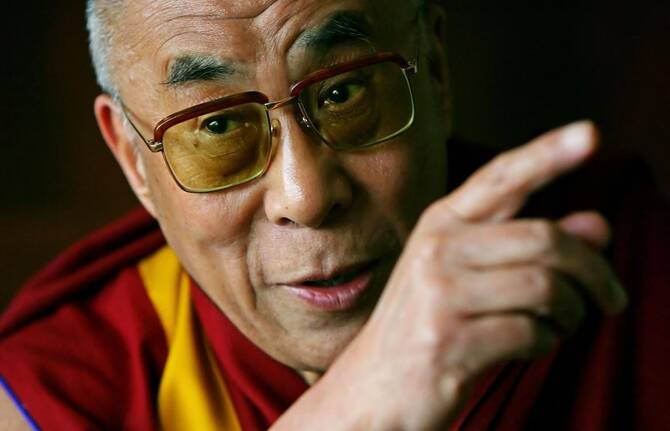
The Dalai Lama has been lauded by his followers for his tireless campaign for greater autonomy for Tibet, a vast high-altitude plateau in China about the size of South Africa. (AFP)
Short Url
Updated 27 June 2025
Follow

Tibetans face up to uncertain future as Dalai Lama turns 90

  • The charismatic Nobel Peace Prize-winning Buddhist will reveal if there will be another Dalai Lama after him
  • The Dalai Lama has been lauded by his followers for his tireless campaign for greater autonomy for Tibet

DEHRADUN, India: Tibetans in exile celebrate the 90th birthday of spiritual leader the Dalai Lama next week, an occasion overshadowed by uncertainty about the future of the role and what it means for their movement.

The charismatic Nobel Peace Prize-winning Buddhist – who Tibetans say is the 14th reincarnation of the 600-year-old post – will reveal if there will be another Dalai Lama after him.

The inevitable change ahead brings wider concerns for Tibetans over the struggle to keep their identity alive after generations in exile, following a failed 1959 uprising against Chinese rule.

There is widespread support among Tibetans in exile for the Dalai Lama role to remain, said Dawa Tashi, once jailed in Tibet for his criticism of Beijing.

The Dalai Lama has said the institution will continue only if there is popular demand.

“I strongly believe the reincarnation of the 14th Dalai Lama will continue,” said Tashi, of the India-based Tibetan Center for Human Rights and Democracy.

“This hope is not only shared by Tibetans inside and outside Tibet, but by thousands who are connected to the Dalai Lama across the world,” he said.

The leader, who turns 90 on July 6, and thousands of other Tibetans have lived in exile in India since Chinese troops crushed the uprising in the Tibetan capital Lhasa.

The Dalai Lama has been lauded by his followers for his tireless campaign for greater autonomy for Tibet, a vast high-altitude plateau in China about the size of South Africa.

The Dalai Lama handed over political authority in 2011 to an exiled government chosen democratically by 130,000 Tibetans globally.

At the same time, he warned that the future of his spiritual post faced an “obvious risk of vested political interests misusing the reincarnation system.”

Many Tibetans in exile fear China will name a successor to bolster its control over Tibet.

The Dalai Lama has said that if there is a successor it will come from the “free world” outside China’s control.

The Dalai Lama has long said he does not seek full independence for Tibet.

Beijing says the territory is an integral part of China and that the Dalai Lama “has no right to represent the Tibetan people.”

Whatever the Dalai Lama decides about his role, “the freedom movement must continue regardless,” said Kunga Tashi, a 23-year-old Tibetan software engineer in India’s tech hub Bengaluru.

“The Chinese government and even Tibetans still equate the Dalai Lama with the freedom struggle,” he said. “And that is why his reincarnation feels like a turning point.”

The Dalai Lama, recognized worldwide in his red robes and wide smile, lives an austere monastic life in India’s Himalayan hill town of McLeod Ganj. He has said he wants to live until 113.

Penpa Tsering, the sikyong or head of the government which is also based in McLeod Ganj, said that senior Buddhist elders, or lamas, will meet the Dalai Lama on July 2.

The same day they will open the grand meeting of religious leaders, during which a video message by the Dalai Lama will be broadcast.

No details of its message have been released.

The Dalai Lama’s translator of nearly four decades, Thupten Jinpa, believes that “the continuity of the institution will remain,” meaning that, in time, there “will be a new Dalai Lama.”

“Today, many young Tibetans prioritize personal success over collective struggle,” said Geshema Tenzin Kunsel, a nun in her 50s from Dolma Ling Nunnery, near McLeod Ganj.

“In his absence, I fear what our future might look like.”

Tibetans who spoke to AFP say they will keep up their campaign no matter what happens in the coming weeks.

“While we haven’t yet achieved our goal of returning to a free Tibet, we’ve come further than anyone could have imagined – and that’s because of His Holiness (the Dalai Lama),” said Sonam Topgyal, 26, a university student in New Delhi.

Nepal-based Sakina Batt, 35, a former civil servant with the Tibetan administration, is part of Tibet’s minority Muslim population.

She too believes that the reincarnation process should “continue as it has for generations, preserving its sacred tradition without interruption.”

But she also said that it depended on the people, not just one leader.

“The future of Tibetans depends on unity and resilience,” she said. “It’s ultimately up to us to shape our own destiny.”


Toxic smog blankets New Delhi, disrupting travel and plunging air quality to hazardous levels

Updated 2 sec ago
Follow

Toxic smog blankets New Delhi, disrupting travel and plunging air quality to hazardous levels

  • Dense toxic smog has blanketed New Delhi, pushing air pollution levels to their worst levels in weeks and disrupting travel
  • On Monday, more than three dozen flights were canceled and hospitals saw an increase in patients with breathing difficulties and eye irritation
NEW DELHI: Dense toxic smog blanketed India’s national capital Monday, pushing air pollution levels to their worst levels in weeks, disrupting travel and causing authorities to impose the strictest containment measures.
More than 40 flights were canceled and several dozens delayed. Over 50 trains arriving and departing from New Delhi were delayed by several hours, authorities said.
Healthcare experts warned residents to avoid all outdoor activities as hospitals reported an influx of patients with breathing difficulties and eye irritation.
“New Delhi is a gas chamber right now. Air purifiers can help only a bit, so it’s high time the government comes up with some permanent solutions” said Naresh Dang, a physician at Max Healthcare.
Delhi’s air pollution levels have remained at what the federal government calls a “severe” level for the last two days, which the government says can cause respiratory effects to healthy people and seriously affect the health of people with heart or lung disease.
On Sunday, official index readings were over 450 at several monitoring stations, up from 430 on Saturday and the highest so far this winter season, as per data from Central Pollution Control Board. On Monday, it stood at 449. Readings below 50 are considered good. During periods of severe air pollution, the government advises people to avoid going outdoors as much as possible and wear N95 masks when going outside. Children, pregnant women, elderly and people with pre-existing respiratory or cardiovascular conditions are at higher risk and officials advise them to be extra cautious.
“I have never seen this kind of pollution ever. Last year I came to Delhi, it was polluted. This year it is more polluted. I can feel the smoke while I breathe the air,” said Tiam Patel, a tourist.
To stem pollution, Indian authorities have banned construction activities and restricted use of diesel generators and cars. Water sprinklers have been deployed to control the haze. Schools and offices are allowing many students and workers to stay home.
But environmentalists say that the country’s air pollution crisis requires long-term changes.
New Delhi and its surrounding region, home to more than 30 million people, routinely rank among the world’s most polluted. India has six of the world’s 10 most polluted cities, and New Delhi is the most polluted national capital, according to a report from Switzerland-based air quality monitoring database IQAir earlier this year.
Air quality worsens in New Delhi every winter as farmers burn crop residue in nearby states and cooler temperatures trap the smoke, which mixes with pollution from vehicles, construction activity and industrial emissions. Pollution levels often reach 20 times higher than the World Health Organization’s safe limit.
But Vimlendu Jha, a Delhi based environmentalist, said that the air is not healthy even at other times of year.
“Delhi’s air doesn’t get cleaner at all, we only see it visibly from October to December, but the reality is that it remains polluted through the year,” he said.
Earlier this month, residents of New Delhi staged protests to express frustration and anger about the government’s failure to address pollution.
A study last year by medical journal Lancet linked long term exposure to polluted air to 1.5 million additional deaths every year in India.
“Deaths related to air pollution are not being counted. And the reason why its not being counted is because there are no systematic mechanisms to do so,” said Shweta Narayan, a campaign lead at the Global Climate and Health Alliance.
Indian authorities in October carried out a controversial cloud-seeding experiment over smog-choked New Delhi to induce rainfall and clear the city’s toxic air. The experiment ended without rainfall.