

Lawmakers scrap ‘revenge’ tax provision from Trump’s big bill after Treasury requests its removal

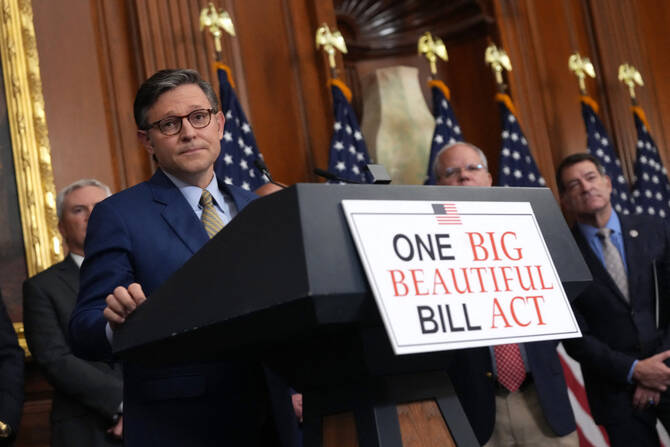
US Speaker of the House Mike Johnson speaks to the media after the House narrowly passed a bill forwarding President Donald Trump's agenda at the US Capitol on May 22, 2025 in Washington, DC. (AFP)
Short Url
Updated 27 June 2025
Follow

Lawmakers scrap ‘revenge’ tax provision from Trump’s big bill after Treasury requests its removal

  • Critics warned that Section 899 of the bill "will hurt the US more than it helps"
  • Global Business Alliance said the section could lead to 700,000 US jobs lost

WASHINGTON: Congressional Republicans agreed to remove the so-called revenge tax provision from President Donald Trump’s big bill Thursday after Treasury Secretary Scott Bessent asked members of Congress to do so earlier in the day.
The Section 899 provision would allow the federal government to impose taxes on companies with foreign owners, as well as investors from countries judged as charging “unfair foreign taxes” on US companies.
The measure was expected to lead many companies to avoid investing in the US out of concern that they could face steep taxes.
Bessent said in an X post that he made the request to lawmakers after reaching an agreement with other countries on the Organization for Economic Co-operation and Development Global Tax Deal. He said that after “months of productive dialogue,” they would “announce a joint understanding among G7 countries that defends American interests.”
After he made the request, Senate Finance Committee Chairman Mike Crapo, R-Idaho, and House Ways and Means Committee Chairman Jason Smith, R-Missouri, said “we will remove proposed tax code Section 899” from the bill and “Congressional Republicans stand ready to take immediate action if the other parties walk away from this deal or slow walk its implementation.”
The removal of the provision will provide “greater certainty and stability for the global economy and will enhance growth and investment in the United States and beyond,” Bessent said in his post.
An analysis by the Global Business Alliance, a trade group representing international companies such as Toyota and Nestlé, estimates that the provision would cost the US 700,000 jobs and $100 billion annually in lost gross domestic product.


Global Business Alliance infographic. (X: @GlobalBiz)

The Global Business Alliance was among several groups that signed a letter addressed to Senate Majority Leader John Thune of South Dakota and Senate Finance Committee Chairman Mike Crapo of Idaho, warning of the consequences of Section 899.
The removal of the provision adds a wrinkle to Republicans’ plans to try to offset the cost of the massive package. The non-partisan Congressional Budget Office estimates that the bill would spike deficits by at least $2.4 trillion over the next decade.
Republicans are rushing to finish the package this week to meet the president’s Fourth of July deadline for passage.
Earlier Thursday, the Senate parliamentarian advised that a Medicaid provider tax overhaul central to the spending bill does not adhere to the chamber’s procedural rules, delivering a crucial blow to Republicans, who are counting on big cuts to Medicaid and other programs to offset trillions of dollars in Trump tax breaks.



Nobel laureate Machado says US helped her leave Venezuela, vows return

Updated 6 sec ago
Follow

Nobel laureate Machado says US helped her leave Venezuela, vows return

  • Machado emerged on a hotel balcony in Oslo to cheering supporters early Thursday
  • “We did get support from the United States government to get here,” Machado said

OSLO: Nobel Peace laureate Maria Corina Machado said on Thursday that the United States helped her get to Norway from hiding in Venezuela, expressing support for US military action against her country and vowing to return home.
Machado, who vanished in January after challenging the rule of President Nicolas Maduro, emerged on a hotel balcony in Oslo to cheering supporters early Thursday after several days of confusion over her whereabouts.
“We did get support from the United States government to get here,” Machado told a press conference when asked by AFP about whether Washington had helped.
The Wall Street Journal reported that she wore a wig and a disguise on the high-risk journey, leaving her hide-out in a Caracas suburb on Monday for a coastal fishing village, where she took a fishing skiff across the Caribbean Sea to Curacao.
The newspaper said the US military was informed to avoid the boat being targeted by airstrikes. Once on the island, she took a private jet to Oslo early on Wednesday.
Machado thanked those who “risked their lives” to get her to Norway but it was not immediately clear how or when she will return to Venezuela, which has said it would consider her a fugitive if she left.
“Of course, the risk of going back, perhaps it’s higher, but it’s always worthwhile. And I’ll be back in Venezuela, I have no doubt,” she added.
Machado has been hailed for her fight for democracy but also criticized for aligning herself with US President Donald Trump, to whom she has dedicated her Nobel, and for inviting foreign intervention in her country.

- Military build-up -

The United States has launched a military build-up in the Caribbean in recent weeks and deadly strikes on what Washington says are drug-smuggling boats.
“I believe every country has the right to defend themselves,” Machado told reporters Thursday.
“I believe that President Trump’s actions have been decisive to reach the point where we are right now, in which the regime is weaker than ever, because the regime previously thought that they could do anything,” she continued.
Late Wednesday, Trump said the United States had seized a “very large” oil tanker near Venezuela, which Caracas denounced as “blatant theft.”
Maduro maintains that US operations are aimed at toppling his government and seizing Venezuela’s oil reserves.
Machado first appeared on a balcony of the Grand Hotel in the middle of the night, waving and blowing kisses to supporters chanting “libertad” (“freedom“) below.
On the ground, she climbed over metal barriers to get closer to her supporters, many of whom hugged her and presented her with rosaries.
She said she has missed much of her children’s lives while hiding, including graduations and weddings.

- ‘ Political risk’ -

Machado won the Peace Prize for “her struggle to achieve a just and peaceful transition from dictatorship to democracy.”
She has accused Maduro of stealing Venezuela’s July 2024 election, from which she was banned — a claim backed by much of the international community.
She last appeared in public on January 9 in Caracas, where she protested Maduro’s inauguration for his third term.
The decision to leave Venezuela and join the Nobel festivities in Oslo comes at both personal and political risk.
“She risks being arrested if she returns even if the authorities have shown more restraint with her than with many others, because arresting her would have a very strong symbolic value,” said Benedicte Bull, a professor specializing in Latin America at the University of Oslo.
While Machado is the ” undisputed” leader of the opposition, “if she were to stay away in exile for a long time, I think that would change and she would gradually lose political influence,” Bull said.
In her acceptance speech read by one of her daughters Wednesday, Machado denounced kidnappings and torture under Maduro’s tenure, calling them “crimes against humanity” and “state terrorism, deployed to bury the will of the people.”