

National Assembly passes $62 billion Pakistan budget for next fiscal year

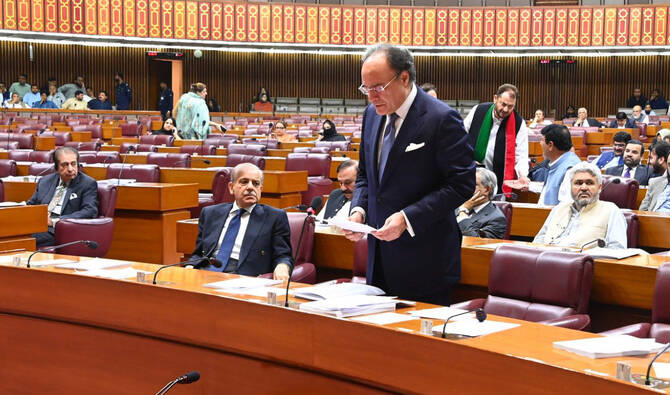
Pakistan Finance Minister Muhammad Aurangzeb speaks during the parliamentary session at the National Assembly of Pakistan in Islamabad on June 26, 2025. (Photo courtesy: Facebook/NA)
Short Url
Updated 27 June 2025
Follow

National Assembly passes $62 billion Pakistan budget for next fiscal year

  • Budget reflects Pakistan’s attempt to balance security concerns with fiscal reform efforts under $7 billion IMF loan program
  • Government has aimed to reduce fiscal deficit to 3.9% of GDP for next year’s budget, increase defense spending by over 20%

ISLAMABAD: The lower house of Pakistan’s parliament passed the federal budget for the next fiscal year on Thursday, which has a total outlay of Rs17.57 trillion [$62 billion] and projects economic growth at 4.2%, state-run media reported.

The federal government unveiled the federal budget on June 10, which reflects a 7% decrease in overall spending compared to the current fiscal year. The largest portion of the budget – Rs8.21 trillion ($29 billion), or nearly half of total expenditures – will go toward debt servicing, continuing to strain Pakistan’s fiscal space.

Another salient feature of the budget is Pakistan’s move to increase defense spending by more than 20% in the 2025-26 fiscal year to Rs2.55 trillion ($9.04 billion). Islamabad seeks to bolster military capabilities following Pakistan’s worst confrontation with India in nearly three decades in May.

“The National Assembly has passed the federal budget for the next fiscal year, with a total outlay of 17,573 billion rupees, focusing on sustainable and inclusive economic growth,” state broadcaster Radio Pakistan reported.

The House passed the budget with certain amendments, giving effect to the federal government’s proposals for the financial year set to begin from July 1.

The bill was read out in the National Assembly and approved clause by clause before the session was adjourned until 11 am, Friday.

Pakistan remains under a $7 billion IMF loan program approved last year, and the budget reflects an attempt to balance security concerns with ongoing fiscal reform efforts.

The government has aimed to reduce the fiscal deficit to 3.9% of the GDP for the next year’s budget. While it has projected a growth of 4.2% for the upcoming year, Pakistan’s economy grew just 2.6% in 2024/25, falling short of its 3.6% target due to weak agriculture and industrial output. Inflation has been projected for next year’s budget at 7.5%.

The Federal Board of Revenue (FBR), Pakistan’s main tax authority, has been tasked with collecting Rs14.1 trillion of the projected Rs19.3 trillion in gross revenue in the budget, marking a 19% year-on-year increase.

While announcing the budget on June 10, Finance Minister Muhammad Aurangzeb had announced plans to grow IT exports to $25 billion over the next five years and forecast a rise in workers’ remittances to $38 billion by the end of the current fiscal year.


JazzCash signs deal with Binance in UAE to explore regulated crypto adoption in Pakistan

Updated 12 sec ago
Follow

JazzCash signs deal with Binance in UAE to explore regulated crypto adoption in Pakistan

  • MoU focuses on awareness and development of compliant virtual-asset solutions in Pakistan
  • Pakistan introducing licensing regime for crypto firms as it formalizes digital-asset oversight

ISLAMABAD: Pakistani financial-technology platform JazzCash has signed a memorandum of understanding with global cryptocurrency exchange Binance in the United Arab Emirates to explore cooperation on virtual-asset use and education in Pakistan, the company said on Wednesday.

The agreement sets a framework for discussions on awareness campaigns and future digital-asset products that would comply with Pakistan’s emerging crypto regulations. The move signals growing engagement between global blockchain companies and Pakistani fintechs as authorities shift toward formal licensing of the sector.

Pakistan has spent the past year drafting rules to regulate the fast-expanding market for digital coins and tokens, requiring virtual-asset service providers to obtain government approval. Officials say the transition is aimed at curbing money-laundering and terror financing risks, boosting transparency and encouraging responsible innovation.

“JazzCash has always championed technologies that expand financial access while promoting secure and inclusive participation in the digital economy," JazzCash Chief Executive Officer Murtaza Ali said. 

“By entering into this exploratory MoU with Binance, we are advancing our efforts to understand how global digital-asset trends can support Pakistan’s evolving regulatory landscape. We aim to engage responsibly, support regulatory progress, and advance opportunities that build trust, transparency and innovation for our customers.”

The MoU does not establish a commercial partnership, but marks one of the most high-profile engagements between Pakistan’s fintech sector and a global crypto exchange as the country moves toward regulated digital-asset adoption.

Binance welcomed the cooperation, framing it as part of Pakistan’s shift toward regulated digital-asset activity.

"With regulatory frameworks like [Pakistan Virtual Assets Regulatory Authority] PVARA paving the way, this collaboration represents a significant step toward expanding financial inclusion and empowering more people to access the benefits of blockchain technology in a secure and compliant environment," Binance Chief Marketing Officer Rachel Conlan said.

Earlier this month, Binance executives met Pakistani finance officials to discuss digital-payments reform, blockchain-skills training and the potential for Web3-linked jobs. Pakistan also set up the Pakistan Crypto Council and formed PVARA this year to license and supervise crypto-asset service providers.