KAUST develops new cooling technology to improve efficiency and lifespan of solar panels

1 / 2
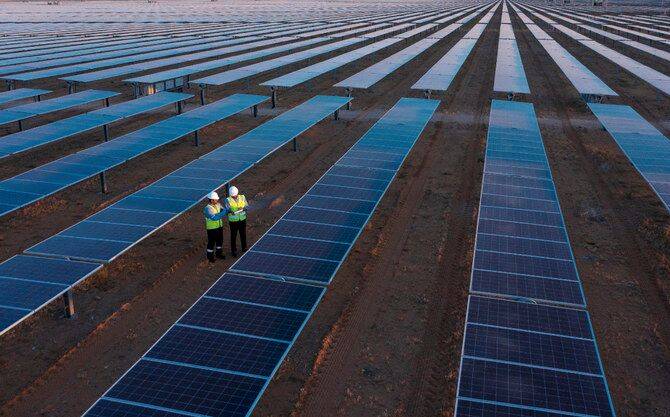
KAUST researchers have discovered new cooling technology to enhance the efficiency of solar cells and prolong their lifespan. (Supplied/KAUST)
2 / 2
A solar farm in Sakaka, northern Saudi Arabia. (Supplied/ACWA Power)
Short Url
Updated 26 June 2025
Follow

KAUST develops new cooling technology to improve efficiency and lifespan of solar panels

  • New technology has the potential to cut down the maintenance cost of solar cells
  • Experiments were conducted in cold and rainy regions of the US to test effectiveness in different climate conditions

RIYADH: The King Abdullah University of Science and Technology has made a notable research breakthrough, developing a new composite material that improves the efficiency and lifespans of the cells used in solar panels through cooling.

The new technology has the potential to cut down the maintenance cost of solar cells, according to the Saudi Press Agency. Results of the study, carried out in partnership with the King Abdulaziz City for Science and Technology, were published in the journal Materials Science and Engineering.

The study targeted the issues of commercial solar panels, which only convert around 20 percent of sunlight into electricity, while the remainder is absorbed as heat or reflected away. Other problems include high temperatures, which reduce the efficiency and performance of the cells, shortening their lifespan and demanding more frequent replacement.

This means that cooling is essential, yet traditional cooling systems such as fans and pumps consume electrical energy; passive cooling, on the other hand, requires no electricity.

Prof. Chiaochiang Gan, lead researcher at KAUST, explained that the nanomaterials used in the passive cooling process are thin substances that can be applied to multiple systems that demand cooling, such as solar cells and agricultural greenhouses, without affecting their performance.

He said that the study, conducted through the Center of Excellence for Renewable Energy and Storage Technologies, led to the creation of a material that absorbs moisture from the air at night and releases it during the day.

Covering solar cells with this material, when deployed in coastal areas of Saudi Arabia for weeks, helps keep them cool.

The passive cooling technology also helps reduce the cost of generating electricity from these cells by 18 percent.

Experiments were also conducted in cold and rainy regions of the US to test its effectiveness in different climate conditions; the results proved the technology effective in all environments.

Preliminary studies also show that other applications for the material include light-emitting devices, which typically suffer from reduced efficiency at higher temperatures.

Abdullah Al-Muqbil, researcher at the Institute of Microelectronics and Semiconductors, director of the Optics and Electronics Center of Excellence at KACST, and co-author of the study, noted that these findings also open up potential for application in lighting and laser technologies.

The research team at KAUST achieved a record-breaking performance in solar cell efficiency due to their specialized designs, showcasing the diverse expertise at the university, according to SPA.

The Center of Excellence for Renewable Energy and Storage Technologies is one of four research centers of excellence run by KAUST. It aims to support the Kingdom’s national goals in fields such as artificial intelligence, food security, renewable energy and storage technologies and smart health.


Foreign ministers chair Saudi-Omani coordination council meeting in Muscat

Updated 23 December 2025
Follow

Foreign ministers chair Saudi-Omani coordination council meeting in Muscat

MUSCAT: Saudi Foreign Minister Prince Faisal bin Farhan met with Oman’s Foreign Minister Sayyid Badr bin Hamad Al-Busaidi on Monday.

They reviewed bilateral relations between their nations and ways to enhance and develop them across various fields. Additionally, they discussed regional and international developments.

The ministers co-chaired the third meeting of the Saudi-Omani Coordination Council in the Omani capital, Muscat, with the participation of the heads of the Council’s subsidiary committees and the two heads of the Council’s General Secretariat teams.

The meeting comes as an affirmation of the keenness of Saudi and Omani leaders to strengthen ties and advance them toward greater prosperity for both nations.

In his remarks during the meeting, Prince Faisal affirmed that gathering builds on the previous council meeting, held last year in AlUla, and on its positive and fruitful outcomes within the framework of the approved recommendations and initiatives. 

He stressed the importance of continuing the work of the council’s subsidiary committees to complete the necessary procedures to implement the remaining initiatives, and of the General Secretariat’s role in follow-up and in addressing any challenges that may hinder implementation.

He also underscored the importance of developing and enhancing trade relations, stimulating investment, and strengthening cooperation between the public and private sectors.

He also praised the ongoing work to establish and launch the Coordination Council’s electronic platform, which aims to connect all committee work and initiatives to facilitate follow-up on the Council’s progress. 

Al-Busaidi affirmed in his remarks the qualitative progress in relations between the two countries and the notable development witnessed across numerous sectors toward achieving economic integration and enhancing intra-trade and joint investments. 

The Omani foreign minister also highlighted deeper cooperation in the security and judicial fields, as well as the cultural and tourism sectors, noting the advanced and continuous political cooperation, consultation, and coordination on regional and international issues.