

China hosts SCO defense ministers from Russia, Iran, India, Pakistan amid global unrest

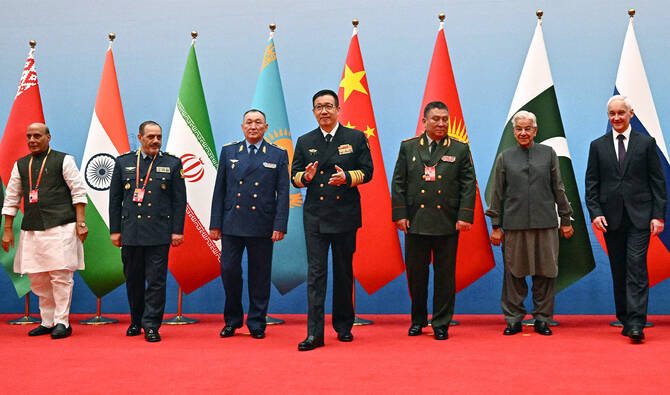
(L-R) India's Defence Minister Rajnath Singh, Iran's Defence Minister Amir Nasirzadeh, Kazakhstan's Defence Minister Dauren Kossanov, China's Defence Minister Dong Jun, Kyrgyzstan's Defence Minister Ruslan Mukambetov, Pakistan's Defence Minister Khawaja Muhammad Asif, and Russia's Defence Minister Andrei Belousov gather for a group photo during the Defence Ministers' Meeting of the Shanghai Cooperation Organization (SCO) Member States in Qingdao, in eastern China's Shandong province on June 26, 2025. (AFP)
Short Url
Updated 26 June 2025
Follow

China hosts SCO defense ministers from Russia, Iran, India, Pakistan amid global unrest

  • Chinese defense minister calls for ‘robust actions to jointly safeguard the environment for peaceful development’
  • Dong Jun warns ‘hegemonic, domineering and bullying acts’ have been severely undermining the global order

QINGDAO, China: China hosted defense ministers from Iran and Russia for a meeting in its eastern seaside city of Qingdao on Thursday against the backdrop of war in the Middle East and a summit of NATO countries in Europe that agreed to boost military spending.

Beijing has long sought to present the 10-member Shanghai Cooperation Organization (SCO) as a counterweight to Western-led power blocs and has pushed to strengthen collaboration between its member countries in politics, security, trade and science.

The Qingdao meeting of the organization’s top defense officials comes as a fledgling ceasefire between Israel and Iran holds after 12 days of fighting between the arch-foes.

It is also being held the day after a summit of North Atlantic Treaty Organization (NATO) leaders in The Hague, where members agreed to ramp up their defense spending to satisfy US President Donald Trump.

Chinese Defense Minister Dong Jun framed Thursday’s meeting of officials in Qingdao, home to a major Chinese naval base, as a counterweight to a world in “chaos and instability.”

“As momentous changes of the century accelerate, unilateralism and protectionism are on the rise,” Dong said as he welcomed defense chiefs from Russia, Iran, Pakistan, Belarus and elsewhere on Wednesday, according to state news agency Xinhua.

“Hegemonic, domineering and bullying acts severely undermine the international order,” he warned.

He urged his counterparts to “take more robust actions to jointly safeguard the environment for peaceful development.”

India’s Defense Minister Rajnath Singh, also in attendance in Qingdao, said SCO members should “collectively aspire to fulfil the aspirations and expectations of our people as well as tackle today’s challenges.”

“The world we live in is undergoing a drastic transformation. Globalization, which once brought us closer together, has been losing momentum,” he said in comments posted by his office on X.

And meeting Dong on the sidelines of the summit, Russian Defense Minister Andrei Belousov hailed ties between the two countries as being “at an unprecedentedly high level.”

“Friendly relations between our countries maintain upward dynamics of development in all directions,” he said.

China has portrayed itself as a neutral party in Russia’s war with Ukraine, although Western governments say its close ties have given Moscow crucial economic and diplomatic support.


Islamabad hits back after Indian minister blames Pakistan army for ‘ideological hostility’

Updated 10 sec ago
Follow

Islamabad hits back after Indian minister blames Pakistan army for ‘ideological hostility’

  • Jaishankar tells a public forum most of India’s problems with Islamabad stem from Pakistan’s military establishment
  • Pakistan condemns the remarks, accusing India of waging a propaganda drive to deflect from its destabilizing actions

ISLAMABAD: Pakistan accused India on Sunday of running a propaganda campaign to malign its state institutions, a day after Indian External Affairs Minister Subrahmanyam Jaishankar attributed what he described as Pakistan’s “ideological hostility” toward New Delhi to the country’s powerful army.

Addressing a public forum in New Delhi, Jaishankar said most of India’s problems with Pakistan stemmed from its military establishment, which he argued had cultivated and sustained an entrenched animosity toward India.

His remarks came months after a brief but intense military confrontation between the nuclear-armed neighbors, during which both sides exchanged artillery and missile fire and deployed drones and fighter jets.

Responding to the comments, Pakistan’s Foreign Office spokesperson Tahir Andrabi called them “highly inflammatory, baseless and irresponsible.”

“Pakistan is a responsible state and its all institutions, including armed forces, are a pillar of national security, dedicated to safeguarding the sovereignty and territorial integrity of the country,” Andrabi said in a statement. “The May 2025 conflict vividly demonstrated Pakistan armed forces’ professionalism as well as their resolve to defend the motherland and the people of Pakistan against any Indian aggression in a befitting, effective yet responsible manner.”

“The attempts by Indian leadership to defame Pakistan’s state institutions and its leadership are a part of a propaganda campaign designed to distract attention from India’s destabilising actions in the region and beyond as well as state-sponsored terrorism in Pakistan,” he said, adding that such “incendiary rhetoric” showed the extent of India’s disregard for regional peace and stability.

Andrabi said that rather than making “misleading remarks about the armed forces of Pakistan,” India should confront the “fascist and revisionist Hindutva ideology that has unleashed a reign of mob justice, lynchings, arbitrary detentions and demolition of properties and places of worship.”

He warned that the Indian state and its leadership had become hostage to “this terror in the name of religion.”

India and Pakistan have fought three wars since independence in 1947. They have also engaged in countless border skirmishes and major military standoffs, including the 1999 Kargil conflict.

The four-day conflict in May 2025 ended with a US-brokered ceasefire, after Washington said both sides had expressed willingness to pursue dialogue.

Pakistan said it was ready to discuss all outstanding issues, but India declined talks.


-End