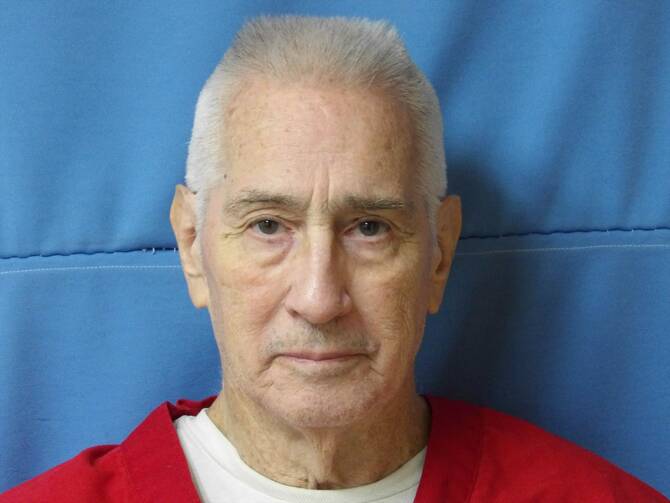
PARCHMAN, Mississippi: The longest-serving man on Mississippi’s death row was executed Wednesday, nearly five decades after he kidnapped and killed a bank loan officer’s wife in a violent ransom scheme.
Richard Gerald Jordan, a 79-year-old Vietnam veteran with post-traumatic stress disorder, was put to death by lethal injection at the Mississippi State Penitentiary in Parchman. The time of death was 6:16 p.m.
Jordan was one of several on the state’s death row who sued the state over its three-drug execution protocol, claiming it is inhumane.
The execution was the third in the state in the last 10 years; previously the most recent one was carried out in December 2022.
Jordan’s execution came a day after a man was put to death in Florida, in what is shaping up to be a year with the most executions since 2015.
Jordan, whose final appeals were denied without comment Wednesday afternoon by the US Supreme Court, was sentenced to death in 1976 for killing and kidnapping Edwina Marter.
Mississippi Supreme Court records show that in January of that year, Jordan called the Gulf National Bank in Gulfport and asked to speak with a loan officer. After he was told that Charles Marter could speak to him, he hung up. He then looked up the Marters’ home address in a telephone book and kidnapped Edwina Marter.
According to court records, Jordan took her to a forest and fatally shot her before calling her husband, claiming she was safe and demanding $25,000.
Edwina Marter’s husband and two sons had not planned to attend the execution. Eric Marter, who was 11 when his mother was killed, said beforehand that other family members would attend.
“It should have happened a long time ago,” Eric Marter told The Associated Press before the execution. “I’m not really interested in giving him the benefit of the doubt.”
“He needs to be punished,” Marter said.
As of the beginning of the year, Jordan was one of 22 people sentenced in the 1970s who were still on death row, according to the Death Penalty Information Center.
His execution ended a decades-long court process that included four trials and numerous appeals. On Monday the Supreme Court rejected a petition that argued he was denied due process rights.
“He was never given what for a long time the law has entitled him to, which is a mental health professional that is independent of the prosecution and can assist his defense,” said lawyer Krissy Nobile, director of Mississippi’s Office of Capital Post-Conviction Counsel, who represented Jordan. “Because of that his jury never got to hear about his Vietnam experiences.”
A recent petition asking Gov. Tate Reeves for clemency echoed Nobile’s claim. It said Jordan suffered severe PTSD after serving three back-to-back tours, which could have been a factor in his crime.
“His war service, his war trauma, was considered not relevant in his murder trial,” said Franklin Rosenblatt, president of the National Institute of Military Justice, who wrote the petition on Jordan’s behalf. “We just know so much more than we did 10 years ago, and certainly during Vietnam, about the effect of war trauma on the brain and how that affects ongoing behaviors.”
Marter said he does not buy that argument: “I know what he did. He wanted money, and he couldn’t take her with him. And he — so he did what he did.”


![]()


Mississippi executes the longest-serving man on the state’s death row for 1976 killing
Short Url
https://arab.news/jfs54
Mississippi executes the longest-serving man on the state’s death row for 1976 killing
- Jordan was one of several on the state’s death row who sued the state over its three-drug execution protocol, claiming it is inhumane
Russia plans a nuclear power plant on the moon within a decade
MOSCOW: Russia plans to put a nuclear power plant on the moon in the next decade to supply its lunar space program and a joint Russian-Chinese research station as major powers rush to explore the earth’s only natural satellite.
Ever since Soviet cosmonaut Yuri Gagarin became the first human to go into space in 1961, Russia has prided itself as a leading power in space exploration but in recent decades it has fallen behind the United States and increasingly China.
Russia’s ambitions suffered a massive blow in August 2023 when its unmanned Luna-25 mission smashed into the surface of the moon while attempting to land, and Elon Musk has revolutionized the launch of space vehicles — once a Russian speciality.
Russia’s state space corporation, Roscosmos, said in a statement that it planned to build a lunar power plant by 2036 and signed a contract with the Lavochkin Association aerospace company to do it.
Roscosmos said the purpose of the plant was to power Russia’s lunar program, including rovers, an observatory and the infrastructure of the joint Russian-Chinese International Lunar Research Station.
“The project is an important step toward the creation of a permanently functioning scientific lunar station and the transition from one-time missions to a long-term lunar exploration program,” Roscosmos said.
Roscosmos did not say explicitly that the plant would be nuclear but it said the participants included Russian state nuclear corporation Rosatom and the Kurchatov Institute, Russia’s leading nuclear research institute.
The head of Roscosmos, Dmitry Bakanov, said in June that one of the corporation’s aims was to put a nuclear power plant on the moon and to explore Venus, known as earth’s “sister” planet.
The moon, which is 384,400 km (238,855 miles) from our planet, moderates the earth’s wobble on its axis, which ensures a more stable climate. It also causes tides in the world’s oceans.
Ever since Soviet cosmonaut Yuri Gagarin became the first human to go into space in 1961, Russia has prided itself as a leading power in space exploration but in recent decades it has fallen behind the United States and increasingly China.
Russia’s ambitions suffered a massive blow in August 2023 when its unmanned Luna-25 mission smashed into the surface of the moon while attempting to land, and Elon Musk has revolutionized the launch of space vehicles — once a Russian speciality.
Russia’s state space corporation, Roscosmos, said in a statement that it planned to build a lunar power plant by 2036 and signed a contract with the Lavochkin Association aerospace company to do it.
Roscosmos said the purpose of the plant was to power Russia’s lunar program, including rovers, an observatory and the infrastructure of the joint Russian-Chinese International Lunar Research Station.
“The project is an important step toward the creation of a permanently functioning scientific lunar station and the transition from one-time missions to a long-term lunar exploration program,” Roscosmos said.
Roscosmos did not say explicitly that the plant would be nuclear but it said the participants included Russian state nuclear corporation Rosatom and the Kurchatov Institute, Russia’s leading nuclear research institute.
The head of Roscosmos, Dmitry Bakanov, said in June that one of the corporation’s aims was to put a nuclear power plant on the moon and to explore Venus, known as earth’s “sister” planet.
The moon, which is 384,400 km (238,855 miles) from our planet, moderates the earth’s wobble on its axis, which ensures a more stable climate. It also causes tides in the world’s oceans.
Latest updates


© 2025 SAUDI RESEARCH & PUBLISHING COMPANY, All Rights Reserved And subject to Terms of Use Agreement.