

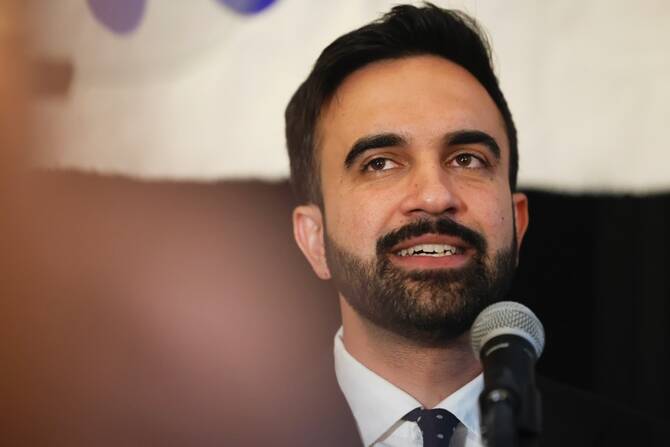

NEW YORK: When he announced his run for mayor back in October, Zohran Mamdani was a state lawmaker unknown to most New York City residents.
On Tuesday evening, the 33-year-old marked his stunning political ascension when he declared victory in the Democratic primary from a Queens rooftop bar after former New York Gov. Andrew Cuomo conceded.
While the race’s ultimate outcome has yet to be confirmed by a ranked choice count scheduled for July 1, here’s a look at the one-time rapper seeking to become the city’s first Muslim and Indian American mayor, and its youngest mayor in generations.
Mamdani’s mother is a famous filmmaker
Mamdani was born in Kampala, Uganda, to Indian parents and became an American citizen in 2018, shortly after graduating college.
He lived with his family briefly in Cape Town, South Africa, before moving to New York City when he was 7.
Mamdani’s mother, Mira Nair, is an award-winning filmmaker whose credits include “Monsoon Wedding,” “The Namesake” and “Mississippi Masala.” His father, Mahmood Mamdani, is an anthropology professor at Columbia University.
Mamdani married Rama Duwaji, a Syrian American artist, earlier this year. The couple, who met on the dating app Hinge, live in the Astoria section of Queens.
Mamdani was once a fledgling rapper
Mamdani attended the Bronx High School of Science, where he cofounded the public school’s first cricket team, according to his legislative bio.
He graduated in 2014 from Bowdoin College in Maine, where he earned a degree in Africana studies and cofounded his college’s Students for Justice in Palestine chapter.
After college, he worked as a foreclosure prevention counselor in Queens helping residents avoid eviction, the job he says inspired him to run for public office.
Mamdani also had a notable side hustle in the local hip hop scene, rapping under the moniker Young Cardamom and later Mr. Cardamom. During his first run for state lawmaker, Mamdani gave a nod to his brief foray into music, describing himself as a “B-list rapper.”
“Nani,” a song he made in 2019 to honor his grandmother, even found new life — and a vastly wider audience — as his mayoral campaign gained momentum. His critics, meanwhile, have seized on lyrics from “Salaam,” his 2017 ode to being Muslim in New York, to argue his views are too extreme for New Yorkers.
Early political career
Mamdani cut his teeth in local politics working on campaigns for Democratic candidates in Queens and Brooklyn.
He was first elected to the New York Assembly in 2020, knocking off a longtime Democratic incumbent for a Queens district covering Astoria and surrounding neighborhoods. He has handily won reelection twice.
The Democratic Socialist’s most notable legislative accomplishment has been pushing through a pilot program that made a handful of city buses free for a year. He’s also proposed legislation banning nonprofits from “engaging in unauthorized support of Israeli settlement activity.”
Mamdani’s opponents, particularly Cuomo, have dismissed him as woefully unprepared for managing the complexities of running America’s largest city.
But Mamdani has framed his relative inexperience as a potential asset, saying in a mayoral debate he’s “proud” he doesn’t have Cuomo’s “experience of corruption, scandal and disgrace.”
Viral campaign videos
Mamdani has used buzzy campaign videos — many with winking references to Bollywood and his Indian heritage — to help make inroads with voters outside his slice of Queens.
On New York’s Day, he took part in the annual polar plunge into the chilly waters off Coney Island in a full dress suit to break down his plan to “freeze” rents.
As the race was entering the final stretch, Mamdani walked the length of Manhattan, documenting the roughly 13-mile trip by posting photos and videos of his interactions along the way.
In TikTok videos, he’s even appealed to voters of color by speaking in Spanish, Bangla and other languages.
Progressive promises
Mamdani has offered a more optimistic vision, in contrast to candidates like Cuomo, who have largely focused on crime and law and order issues.
His campaign has been packed with big promises aimed at lowering the cost of living for everyday New Yorkers, from free child care, free buses, a rent freeze for people living in rent-regulated apartments and new affordable housing — much of it by raising taxes on the wealthy.
The big promises have, unsurprisingly, endeared him to the Democratic Party’s liberal wing.
Mamdani secured endorsements from two of the country’s foremost progressives, US Rep. Alexandria Ocasio-Cortez, of New York, and Sen. Bernie Sanders of Vermont.
Pro-Palestinian views
Mamdani’s outspoken support for Palestinian causes was a point of tension in the mayor’s race as Cuomo and other opponents sought to label his defiant criticism of Israel as antisemitic.
The Shia Muslim has called Israel’s military campaign in Gaza a “genocide” and said the country should exist as “a state with equal rights,” rather than a “Jewish state.” That message has resonated among pro-Palestinian residents, including the city’s roughly 800,000 adherents of Islam — the largest Muslim community in the country.
During an interview on CBS’s “The Late Show” on the eve of the election, host Stephen Colbert asked Mamdani if he believed the state of Israel had the right to exist. He responded: “Yes, like all nations, I believe it has a right to exist — and a responsibility also to uphold international law.”
Mamdani’s refusal to condemn calls to “globalize the intifada” on a podcast — a common chant at pro-Palestinian protests — drew recriminations from Jewish groups and fellow candidates in the days leading up to the election.
In his victory speech Tuesday, he pledged to work closely with those who don’t share his views on controversial issues.
“While I will not abandon my beliefs or my commitments, grounded in a demand for equality, for humanity, for all those who walk this earth, you have my word to reach further, to understand the perspectives of those with whom I disagree, and to wrestle deeply with those disagreements,” Mamdani said.


