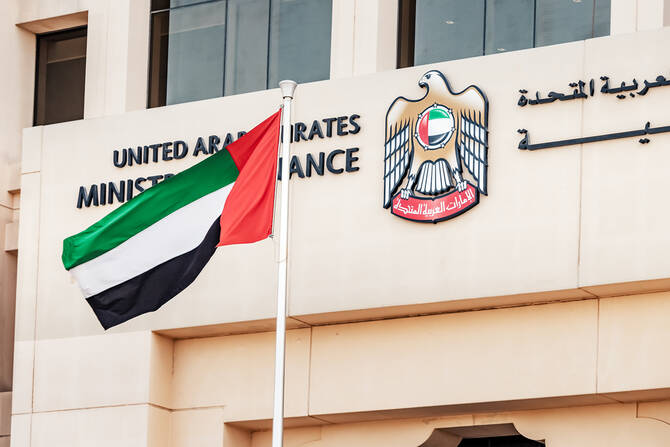

RIYADH: The UAE’s long-term foreign-currency rating has been affirmed at “AA-” with a stable outlook by Fitch, reflecting the country’s consolidated government debt, strong net external asset position, and high gross domestic product per capita.
The US-based rating agency noted that this outlook benefits from Abu Dhabi’s sovereign net foreign assets — amounting to 157 percent of the UAE’s gross domestic product in 2024 — which rank among the highest of all Fitch-rated sovereigns.
The agency noted the ongoing regional geopolitical risks, but it assumes the conflict involving Israel, the US, and Iran will be contained and short-lived.
The report comes as Israel and Iran agreed to a ceasefire brokered by the US, which took effect on June 24, following 12 days of conflict that raised fears of a broader regional escalation.
In its commentary, Fitch Ratings stated: “A regional conflagration would pose a risk to Abu Dhabi’s hydrocarbon infrastructure and to Dubai as a trade, tourism and financial hub,”

Fitch estimated the UAE’s consolidated fiscal surplus stood at 7.1 percent of GDP in 2024, following a level of 8.6 percent in 2023. Shutterstock
It emphasized that “the UAE’s ratings could absorb some short-term disruptions given large fiscal and external buffers.”
Fitch’s assessment follows S&P Global’s recent assignment of “AA/A‑1+” with a stable outlook for its foreign and local currency sovereign credit ratings to the UAE, citing the country’s strong fiscal and external positions.
The agency also noted that the UAE’s sizable asset cushion would help shield it from oil price volatility and regional geopolitical tensions.
Fitch estimated the UAE’s consolidated fiscal surplus stood at 7.1 percent of GDP in 2024, following a level of 8.6 percent in 2023, with surpluses in Abu Dhabi and Dubai and budget deficits in Ras Al Khaimah and Sharjah.
It projected a fiscal breakeven oil price of $45–$50 per barrel in 2025 and 2026, excluding investment income, which Fitch attributed partly to “rising oil production volumes and the significant share of spending by GREs (government-related entities).”
“We forecast the consolidated surplus at 5.3 percent of GDP in 2025 and 5.9 percent in 2026. Narrower deficits in Sharjah and higher oil production levels in Abu Dhabi will mitigate the forecast drop in oil prices from $79.5 per barrel in 2024 to $65/bbl in 2025 and 2026,” Fitch said.
It added: “Dubai will retain a budget surplus.”
With regard to the federal government’s budget, Fitch stated that it remains below 4 percent of GDP and is primarily focused on core services.

Despite moderate direct debt, Fitch views the UAE’s economy as highly leveraged. Shutterstock
The report emphasized that the federal budget must remain balanced by law, leaving limited scope for borrowing or adjustment. From 2026 onward, corporate tax revenue is expected to help offset reduced grants from Abu Dhabi.
Despite moderate direct debt, Fitch views the UAE’s economy as highly leveraged. “We estimate overall contingent liabilities from GREs of the emirates and the FG in 2023 at about 62 percent of UAE 2023 GDP,” the report said, though it acknowledged that many state-owned entities are financially sound.
Fitch forecasts UAE GDP to grow by 5.2 percent in 2025, supported by a 9 percent increase in oil production from Abu Dhabi and strong non-oil growth of over 4 percent, driven by investment and population expansion. However, it warned of risks from “lower oil prices and global growth uncertainties.”
Earlier this month, the UAE Central Bank’s Quarterly Economic Review for December 2024 reported that the country’s GDP reached 1.77 trillion dirhams ($481.4 billion) in 2024, growing 4 percent. Non-oil sectors contributed 75.5 percent of the total — highlighting continued economic diversification.
The central bank maintained its real GDP growth forecast at 4 percent for 2024, with an anticipated acceleration to 4.5 percent in 2025 and 5.5 percent in 2026.
On governance, Fitch said the UAE maintains an ESG Relevance Score of “5[+]” for political stability, rule of law, and institutional quality.
The agency credited the UAE’s “record of domestic political stability, strong institutional capacity, effective rule of law and a low level of corruption,” referencing World Bank Governance Indicators, where the country ranks in the 70th percentile.