

Gaza rescuers say Israeli forces killed 20 including six waiting for aid

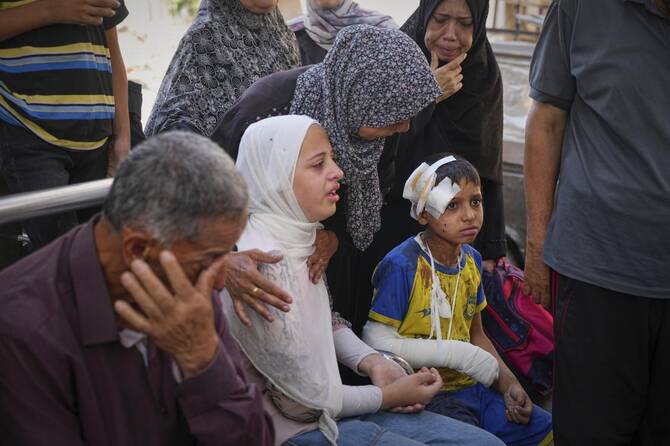
Hamam Al-Farani sits next to his sister, in white, along with other family members as the body of their father Alaa, killed in an Israeli army strike that also injured the boy, is prepared for burial at Shifa hospital in Gaza City, on Tuesday, June 24, 2025. (AP)
Short Url
Updated 25 June 2025
Follow

Gaza rescuers say Israeli forces killed 20 including six waiting for aid

  • The health ministry says that since late May, more than 500 people have been killed near aid centers seeking scarce supplies

GAZA CITY: Gaza’s civil defense agency said Israeli fire killed at least 20 people on Wednesday, including six who were waiting to collect food aid in the war-ravaged Palestinian territory.

The latest in a string of deadly incidents near aid distribution sites came after the United Nations had condemned the “weaponization of food” in the Gaza Strip, where a US- and Israeli-backed foundation has largely replaced established humanitarian organizations.

Civil defense spokesman Mahmud Bassal told AFP that six people were killed and 30 others wounded “following Israeli fire targeting thousands of civilians waiting for aid” in an area of central Gaza where Palestinians have gathered each night in the hope of collecting food rations.

Bassal said the crowd was hit by Israeli “bullets and tank shells.”

Contacted by AFP, the Israeli military said it was “looking into” the report.

Pressure grew Tuesday on the privately run aid group Gaza Humanitarian Foundation (GHF), which was brought into the Palestinian territory at the end of May to replace United Nations agencies but whose operations have been marred by chaotic scenes and neutrality concerns.

The UN agency for Palestinian refugees, UNRWA, called the US- and Israeli-backed system an “abomination” that has put Palestinians’ lives at risk, while a spokesman for the UN human rights office, Thameen Al-Kheetan, condemned the “weaponization of food” in the territory.

Despite easing its aid blockade in May, Israel continues to impose restrictions.

The health ministry says that since late May, more than 500 people have been killed near aid centers seeking scarce supplies. The civil defense agency said Israeli forces killed 46 people waiting for aid on Tuesday.

The GHF has denied responsibility for deaths near its aid points.

Bassal, the civil defense spokesman, said Israeli air strikes on central and northern Gaza early Wednesday killed at least 14 people.

A pre-dawn strike on a house in the central Nuseirat refugee camp killed six people including a child, with eight others killed in two separate strikes on houses in Deir el-Balah and east of Gaza City, Bassal said.

Israeli restrictions on media in the Gaza Strip and difficulties in accessing some areas mean AFP is unable to independently verify the tolls and details provided by rescuers and authorities in the Palestinian territory.

The war was triggered by Hamas’s October 2023 attack on Israel, which resulted in the deaths of 1,219 people, mostly civilians, according to an AFP tally based on official figures.

Israel’s retaliatory military campaign has killed at least 56,077 people, also mostly civilians, according to the Gaza health ministry. The United Nations considers its figures reliable.


Egypt urges support for Lebanese army as Hezbollah disarmed

Updated 7 sec ago
Follow

Egypt urges support for Lebanese army as Hezbollah disarmed

  • Abdelatty praised “the success of the Lebanese army in completing the first phase of the plan“
  • “This achievement reflects the efficiency of the military institution and requires intensifying international support to complete the remaining phases of the plan”

CAIRO: Egypt on Tuesday urged the international community to better support Lebanon’s armed forces as the country moves forward with a plan to disarm the militant group Hezbollah and bring all weapons under state control.
Speaking at a preparatory meeting in Cairo ahead of next month’s Paris conference in support of the Lebanese army, Egypt’s Foreign Minister Badr Abdelatty praised “the success of the Lebanese army in completing the first phase of the plan.”
“This achievement reflects the efficiency of the military institution and requires intensifying international support to complete the remaining phases of the plan,” Abdelatty said.
Lebanon’s government last year committed to disarming Hezbollah, which was badly weakened in a recent war with Israel, and tasked the army with drawing up a plan to do so.
Lebanon has since received promises of support, amid a shortage of equipment, personnel and technical capabilities needed to carry out the army’s mission.
Though its capabilities are limited, the military has worked to dismantle Hezbollah facilities and tunnels and confiscate weapons in the last few months.
It declared in January the completion of the first phase of its plan, which tackled the area south of the Litani river, located around 30 kilometers (20 miles) north of Israel.
Lebanon’s military now intends to tackle the area north of the river as the second phase of its plan, having said last week that it would need at least four months to finish the job.
Abdelatty said Tuesday’s meeting aimed “to enable the Lebanese state to ensure that all weapons are held exclusively by the state.”
The meeting brought together Lebanon’s top security chiefs, including Army Commander General Rodolphe Haykal and Internal Security Forces Director-General Major General Raed Abdallah.
They were joined by representatives of the Quintet Committee on Lebanon, among them Qatar’s state minister for foreign affairs Mohammed bin Abdulaziz Al-Khulaifi, French envoy Jean-Yves Le Drian and Saudi Arabia’s envoy to Beirut Prince Yazid bin Farhan, along with senior officials from the United States.
At a separate meeting with Le Drian, Abdelatty stressed the need for what he described as a comprehensive international approach to the crisis in Lebanon.
“There is no path to restoring stability except by obliging Israel to immediately halt its aggression” and “fully withdraw from occupied Lebanese territories,” he said.
Israel, which accuses Hezbollah of rearming, has criticized the army’s progress as insufficient, and has kept up regular strikes on Lebanon despite a November 2024 ceasefire that sought to end more than a year of hostilities with the group.