

Saudi Arabia’s transformation boosts investor confidence

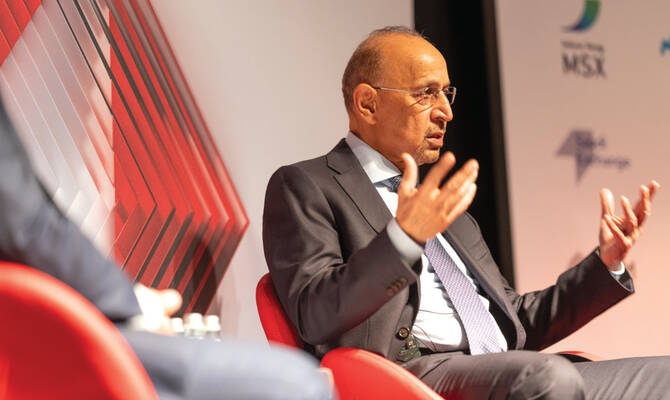
Minister of Investment of Saudi Arabia Khalid Al-Falih speaks at HSBC’s fourth GCC Exchanges Conference in London last week.
Short Url
Updated 24 June 2025
Follow

Saudi Arabia’s transformation boosts investor confidence

More than 300 global institutional investors met with all seven bourses from the GCC and over 100 GCC corporates at HSBC’s GCC Exchanges Conference in London last week. The event comes as global economic uncertainty reshapes capital flows, with global investors exploring new opportunities in the Gulf for long-term, reform-driven growth, and maturing capital markets.

Now in its fourth year, the conference focused on the region’s resilience. Saudi Arabia was a main feature of the first two days of the conference, where guest speakers included Minister of Investment of Saudi Arabia Khalid bin Abdulaziz Al-Falih, and Deputy Market Institutions at Saudi Arabia’s Capital Market Authority Raed Alrashed Alhumaid.

Having registered a 3.4 percent year-on-year increase in GDP in Q1, Saudi Arabia’s non-oil growth is tracking ahead of already strong initial estimates. Discussions focused on plans for the Kingdom’s services and non-oil manufacturing sectors, as well as efforts to continue liberalizing financial market infrastructure.

Faris AlGhannam, chief executive and board member, HSBC Saudi Arabia, said: “The resilient activity in Saudi Arabia’s private and public markets, as well as the breadth of sectors coming to market, is a reflection of investors’ confidence in the Kingdom’s long-term potential despite testing markets.”

Mohammed Al-Rumaih, chief executive, Saudi Exchange, said: “The global investor appetite for the Saudi capital market continues to deepen, driven by the Kingdom’s ongoing economic transformation. At the Saudi Exchange, we remain committed to enabling access, enhancing market infrastructure, and fostering transparency to support diversified capital formation across sectors. The strong engagement witnessed this year at the GCC Exchanges Conference further reflects the growing international confidence in the Saudi market and its central role in the Kingdom’s national transformation roadmap.”

Although domestic market liquidity and oil-dependency have been traditional constraints for equity investors, HSBC analysts predict that the combination of IPOs and secondary listings from the Kingdom as well as the removal of foreign ownership limits could lift Saudi Arabia’s weight in emerging market benchmarks.

Saudi Arabia led listing activity in the region during the first quarter, despite a slowdown in issuances globally, with 12 IPOs across sectors such as real estate, healthcare, financial services, and retail.

AlGhannam added: “Global investors are recalibrating for resilience and the GCC’s balance sheet strength and sophisticated financial markets ecosystem make it a capital magnet.”

This year, for the first time, HSBC brought together emerging markets macro strategists with GCC attendees, as EM investors dial up their exposure to the Gulf’s capital markets driven by strong GDP projections relative to the broader EM pool.


Schneider Electric launches academy in Saudi Arabia to build future-ready talent

Updated 04 February 2026
Follow

Schneider Electric launches academy in Saudi Arabia to build future-ready talent

Schneider Electric has announced the launch of the Energy Tech Academy Middle East and Africa in Saudi Arabia, a regional capability platform dedicated to skilling, upskilling, and knowledge sharing.

The launch comes at a critical moment as the Kingdom accelerates energy transition, industrial localization, and human capability development under Vision 2030. The academy reinforces the Kingdom’s leadership role in building future-ready talent while supporting industrial and energy transformation across the wider Middle East and Africa region.

The Energy Tech Academy Middle East and Africa is not a traditional training center; it is a regional platform translating Schneider Electric’s global energy technology expertise into applied capability for Saudi Arabia and the broader region. Anchored in Riyadh, the academy is designed to serve as a benchmark for skills development and enablement across the MEA.

The launch reflects Schneider Electric’s long-term commitment to investing in people and capabilities, and to supporting national priorities across energy, industry, and digital infrastructure.

Mohamed Shaheen, cluster president of Schneider Electric Saudi Arabia and Yemen, said: “This launch reflects our long-term commitment to Saudi Arabia and to building capability that lasts. After more than 40 years in the Kingdom, we continue to invest where impact matters most: in people. Launching the Energy Tech Academy Middle East and Africa from Riyadh underscores our belief that sustainable transformation is built on local capability and trusted partnerships.”

The academy directly supports Saudi Arabia’s focus on human capability development, localization, and Saudi-made outcomes by enabling the skills behind advanced energy systems, industrial automation, and digital infrastructure. Capabilities developed through the academy will support Saudi manufacturing, national projects, and resilient supply chains, while also strengthening regional industrial ecosystems.

“The Energy Tech Academy Middle East and Africa is designed to enable real outcomes,” said Walid Sheta, zone president for the MEA at Schneider Electric. “By equipping talent with future-ready skills across electrification, automation, and digital intelligence, we are strengthening Saudi and regional capability to design, operate, and lead the energy and industrial systems of the future.”

The launch event in Riyadh brought together senior government representatives, industry partners, customers, and Schneider Electric’s leadership, highlighting the importance of cross-sector collaboration in aligning education, skills development, and labor market needs.

Designed as a long-term platform, the Energy Tech Academy Middle East and Africa will continue to evolve through partnerships, programs, and continuous capability development, reinforcing Saudi Arabia’s role as a regional hub for skills, knowledge, and industrial enablement.