

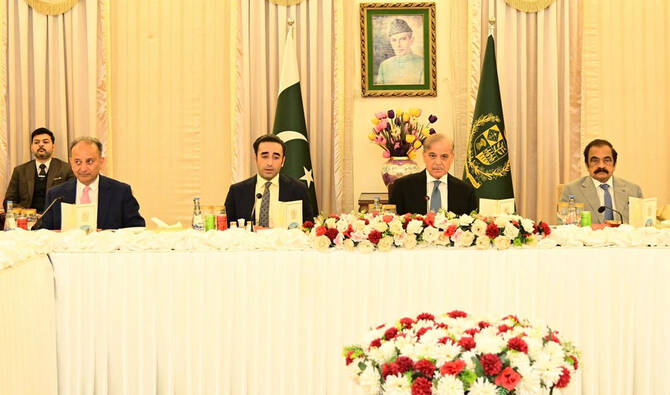

ISLAMABAD: Prime Minister Shehbaz Sharif on Tuesday hosted a dinner in honor of a Pakistani delegation, led by former foreign minister Bilawal Bhutto-Zardari, that presented Islamabad’s stance on recent crisis with India before key world capitals.
Pakistan and India engaged in a four-day military conflict last month that saw the two neighbors attack each other with drones, missiles and artillery in their worst fighting in decades.
The conflict had raised fears of a full-blown war between the nuclear-armed neighbors who agreed to a United States-brokered ceasefire on May 10, with the conflict killing nearly 70 people on both sides.
Bhutto-Zardari led Pakistan’s mission to the US, United Kingdom and Europe to apprise the world powers of Indian unilateral actions, including the suspension of a World Bank-brokered water-sharing treaty with Pakistan.
“The delegation presented the events from Pahalgam to the Indus Waters Treaty [suspension] in the right perspective and in a good manner,” Sharif said. “I hope that with the guidance, cooperation and suggestions of all of you, we will overcome all internal and external challenges.”
Other members of the Pakistani delegation included Sherry Rehman, Musadik Malik, Hina Rabbani Khar, Bushra Anjum Butt, Faisal Sabzwari, Khurram Dastgir and Jalil Abbas Jilani.
On Monday, Bhutto-Zardari said Islamabad had defeated New Delhi on the “battlefield, in diplomacy, and in the war of narratives.”
“India has two options: share water fairly or we will deliver water to us from all six rivers [of the Indus basin],” Bhutto-Zardari said, while addressing the lower house of Pakistan parliament.
“The attack on Sindhu [Indus river] and India’s claim that the IWT has ended and it’s in abeyance, firstly, this is illegal, as the IWT is not in abeyance, it is binding on Pakistan and India but the threat itself of stopping water is illegal according to the UN charter.”
His comments followed a statement from Indian interior minister Amit Shah in which he said they would take the water that was flowing to Pakistan to the Indian state of Rajasthan by constructing a canal.
“Pakistan will be starved of water that it has been getting unjustifiably,” Shah told Times of India newspaper.
The IWT grants Pakistan rights to the Indus basin’s western rivers — Indus, Jhelum, and Chenab — for irrigation, drinking, and non-consumptive uses like hydropower, while India controls the eastern rivers — Ravi, Beas, and Sutlej — for unrestricted use but must not significantly alter their flow. India can use the western rivers for limited purposes such as power generation and irrigation, without storing or diverting large volumes, according to the agreement.
Islamabad is also exploring a legal challenge to India’s decision to hold the treaty in abeyance under international law.
Last month’s conflict between Pakistan and India was triggered by a militant attack in Indian-administered Kashmir’s Pahalgam town.
India accused Pakistan of backing the assault that killed 26 tourists on April 22 and suspended the Indus Waters Treaty, which ensures water for 80 percent of Pakistani farms, among a slew of punitive measures.
Islamabad denied the allegation and offered to join a credible, international probe into the Kashmir attack, followed by its own set of diplomatic measures against New Delhi.


