

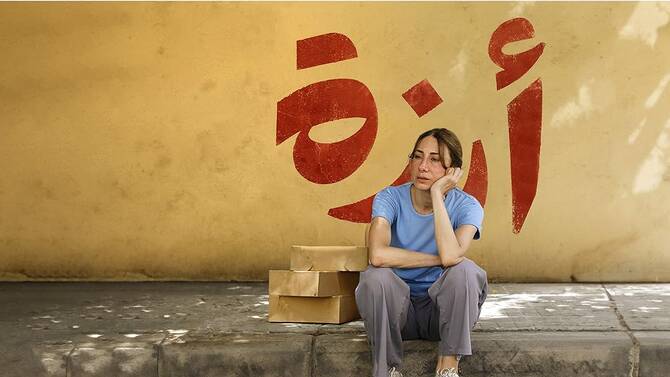
Review: Toronto Arab Film Festival screens searing ‘Arze’

Lebanese film “Arze” is directed by Mira Shabib. (Supplied)
Short Url
Updated 24 June 2025
Follow

Review: Toronto Arab Film Festival screens searing ‘Arze’

DUBAI: The Toronto Arab Film Festival, running from June 20- 29, screened the scathing yet poignant Lebanese film “Arze,” directed by Mira Shabib.

The ambitious “Arze” — which means "cedar" in Arabic — follows the story of Arze, a single mother supporting her teenage son and love-struck sister through a homemade pie delivery business. In an effort to improve their lives, she steals and sells her sister’s jewelry to buy a scooter for her son to use for deliveries. But when the scooter is stolen, mother and son embark on a frantic journey across Beirut to recover it.


On the surface, “Arze” tells a story that resonates deeply with many Lebanese families caught in financial limbo. It explores the emotional toll of such hardship, with questions arising as to whether one should leave the country or give up remnants of a once-comfortable life to survive Lebanon’s shifting socio-economic landscape.

Beneath the family drama lies sharp satire. Even the film’s title that references the cedar tree, a national symbol of Lebanese identity, carries layered meaning. Like the character herself, that identity appears fragmented, constantly lost amid the country’s sectarian divides. This is where the film truly shines: Arze, portrayed with emotional depth by Diamand Abou Abboud, dons various religious symbols and disguises to navigate Beirut’s fractured neighborhoods.


Shabib excels in exposing the farce of sectarianism, insinuating that Lebanon’s religious divisions are not deeply rooted but socially constructed and performative. Arze’s ability to blend into different communities simply by changing her appearance highlights how fragile and superficial these boundaries truly are.

In this sense, the film excels in its portrayal of a fourth main character: Beirut itself. Through Shabib’s lens, we are taken on a tour of a city so diverse it borders on overwhelming. Yet this diversity, rather than being a source of division, becomes a stage for a pointed critique, one that targets society’s fixation on appearances and its preference for the performative over lived reality.


Lebanese filmmaker turns archival footage into a love letter to Beirut

Updated 28 February 2026
Follow

Lebanese filmmaker turns archival footage into a love letter to Beirut

LONDON: Lebanese filmmaker Lana Daher’s debut feature “Do You Love Me” is a love letter of sorts to Beirut, composed entirely of archival material spanning seven decades across film, television, home videos and photography.

The film premiered at the 82nd Venice International Film Festival in September and has since traveled to several regional and international festivals.

Pink Smoke (2020) by Ben Hubbard. (Supplied)

With minimal dialogue, the film relies heavily on image and sound to reconstruct Lebanon’s fragmented history.

“By resisting voiceover and autobiography, I feel like I had to trust the image and the shared emotional landscape of these archives to carry the meaning,” Daher said.

A Suspended Life (Ghazal el-Banat) (1985) by Jocelyne Saab. (Supplied)

She explained that in a city like Beirut “where trauma is rarely private,” the socio-political context becomes the atmosphere of the film, with personal memory expanding into a collective experience — “a shared terrain of emotional history.”

Daher said: “By using the accumulated visual representations of Beirut, I was, in a way, rewriting my own representation of home through images that already existed."

Whispers (1980) by Maroun Bagdadi. (Supplied)

Daher, with editor Qutaiba Barhamji, steered clear of long sequences, preferring individual shots that allowed them to “reassemble meaning” while maintaining the integrity of their own work and respecting the original material, she explained.

The film does not feature a voice-over, an intentional decision that influenced the use of sound, music, and silence.

The Boombox (1995) by Fouad Elkoury. (Supplied)

“By resisting the urge to fill every space with dialogue or score, we created room for discomfort,” Daher said, adding that silence allows the audience to sit with the image and enter its emotional space rather than being guided too explicitly.

 The film was a labor of love, challenging Daher personally and professionally.

“When you draw from personal memory, you’re not just directing scenes, you’re revisiting parts of yourself and your childhood,” she said. “There’s vulnerability in that.”