Myanmar woman arrested for Suu Kyi ‘happy birthday’ post: local media

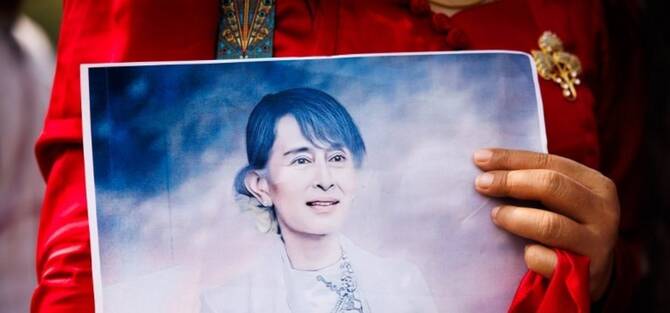
Person holds a photo of Aung San Suu Kyi uring a gathering at the United Nations in 2024 in Bangkok, Thailand. (AFP)
Short Url
Updated 24 June 2025
Follow

Myanmar woman arrested for Suu Kyi ‘happy birthday’ post: local media

  • The Democratic Voice of Burma (DVB) reported on Monday that Hinn Yin Phyu was an MRTV employee who had been arrested after posting a “happy birthday” message for Suu Kyi, citing sources close to the detained woman

YANGON: A Myanmar woman arrested by the junta for “spreading propaganda” is being detained over a Facebook post celebrating the 80th birthday of jailed democratic leader Aung San Suu Kyi, local media said.
Suu Kyi was the figurehead of Myanmar’s decade-long democratic thaw, becoming de facto leader as it opened up from military rule, but she has been incarcerated since February 2021 when the generals snatched back power in a coup.
She is serving a 27-year sentence on charges rights groups dismiss as fabricated and on Thursday marked her birthday behind bars while her son urged followers to publish messages declaring their support.
Myanmar’s junta said in a statement over the weekend it had arrested two Facebook users for “inciting and spreading propaganda on social media with the intention to destroy state stability.”
One of those detained — Hinn Yin Phyu — was arrested at accommodation for employees of state media station MRTV in the capital Naypyidaw on Saturday, the statement said, without providing details of her posts.
The Democratic Voice of Burma (DVB) reported on Monday that Hinn Yin Phyu was an MRTV employee who had been arrested after posting a “happy birthday” message for Suu Kyi, citing sources close to the detained woman.
“May you live long and be free from illness, may you be free from the suffering caused by separation from your loved ones throughout your life, and may you only meet good people,” said the now-deleted post, according to DVB.
Despite being blocked in a digital crackdown accompanying the coup, Facebook remains Myanmar’s most popular social media platform.
State notices announcing arrests over social media use are commonplace but usually provide scant detail of alleged transgressions.
A spokesman for Myanmar’s junta could not be reached for comment on the arrest.
Suu Kyi won the 1991 Nobel Peace Prize as she refused to enter exile to escape her first period of incarceration by Myanmar’s military.
As she guided the country through its democratic interlude her reputation was tarnished on the international stage after she defended the military for their crackdown on the Rohingya Muslim minority.
When the generals toppled her government it sparked a protest movement that security forces swiftly crushed in the streets.
Since then the country has descended into civil war as pro-democracy activists formed guerrilla units to fight back, alongside ethnic armed organizations that have been battling the military in Myanmar’s fringes for decades.


Is the United States after Venezuela’s oil?

Updated 6 sec ago
Follow

Is the United States after Venezuela’s oil?

  • Companies from the US have pumped Venezuelan crude from the first discoveries there in the 1920s
  • Venezuela exports about 500,000 barrels per day on the black market, mainly to China and other Asian countries

CARACAS: As US forces deployed in the Caribbean have zoned in on tankers transporting sanctioned Venezuelan oil, questions have deepened about the real motivation for Donald Trump’s pressure campaign on Caracas.
Is the military show of force really about drug trafficking, as Washington claims? Does it seek regime change, as Caracas fears? Could it be about oil, of which Venezuela has more proven reserves than any other country in the world?
“I don’t know if the interest is only in Venezuela’s oil,” Brazil’s leftist President Luiz Inacio Lula da Silva, who has offered to mediate in the escalating quarrel, said last week.
The US president himself has accused Venezuela of taking “all of our oil” and said: “we want it back.”
What we know:

- Oil ties -

Companies from the United States, now the world’s leading oil producer, have pumped Venezuelan crude from the first discoveries there in the 1920s.
Many US refineries were designed, and are still geared, specifically for processing the kind of heavy crude Venezuela has in spades.
Until 2005, Venezuela was one of the main providers of oil to the United States, with some monthly totals reaching up to 60 million barrels.
Things changed dramatically after socialist leader Hugo Chavez took steps in 2007 to further nationalize the industry, seizing assets belonging to US firms.

- And now? -

Down from a peak of more than three million barrels per day (bpd) in the early 2000s, Venezuela today produces about a million barrels per day — roughly two percent of the global total.
US firm Chevron extracts about 10 percent of the total under a special license.
Chevron is the only company authorized to ship Venezuelan oil to the United States — an estimated 200,000 barrels per day, according to a Venezuelan oil sector source.
The South American country’s domestic industry has declined sharply due to corruption, under-investment and US sanctions in place since 2019.
Analysts say the high investment required to rebuild Venezuela’s crumbling oil rigs would be unappetizing for US firms, given the steady global supply and low prices.
According to Carlos Mendoza Potella, a Venezuelan professor of petroleum economics, Washington’s actions were likely “not just about oil” but rather about the United States “claiming the Americas for itself.”
“It’s about the division of the world” between the United States and its rivals, Russia and China,” he added.
Venezuela exports about 500,000 barrels per day on the black market, mainly to China and other Asian countries, according to Juan Szabo, a former vice president of state oil company PDVSA.

- Blockade -

Trump on December 16 announced a blockade of sanctioned oil vessels sailing to and from Venezuela.
Days earlier, US forces seized the M/T Skipper, a so-called “ghost” tanker transporting over a million barrels of Venezuelan oil, reportedly destined for Cuba.
Washington has said it intends to keep the oil, valued at between $50 and $100 million.
Over the weekend, the US Coast Guard seized the Centuries, identified by monitoring site TankerTrackers.com as a Chinese-owned and Panama-flagged tanker.
An AFP review did not find the Centuries on the US Treasury Department’s sanctions list, but the White House said it “contained sanctioned PDVSA oil” — some 1.8 million barrels of it.
On Sunday, officials said the Coast Guard was pursuing a third tanker, identified by news outlets as the Bella 1 — under US sanctions because of alleged ties to Iran.
The PDVSA insists its exports remain unaffected by the blockade.
This was critical, according to Szabo, as the company only has capacity to store oil for several days if exports stop.

- Impact -

Whatever Trump’s goal with Venezuelan oil, the blockade, if it continues, is likely to scare off shipping companies and push up freight rates.
Szabo expects Venezuela’s oil exports will fall by nearly half in the coming months, slashing critical foreign currency income from Venezuela’s black market sales.
This would asphyxiate the already struggling economy of Venezuela, piling more pressure on Nicolas Maduro.
The Trump administration has tip-toed around explicitly demanding for Maduro to leave.
While Trump has said he does not anticipate “war” with Venezuela, he did say Maduro’s days “are numbered.”
US Homeland Security Secretary Kristi Noem told Fox News on Monday that the oil tanker seizures send “a message around the world that the illegal activity that Maduro’s participating in cannot stand, he needs to be gone.”