

Islamabad says Iran-Israel conflict may trigger ‘refugee exodus’ into Pakistan, Afghanistan

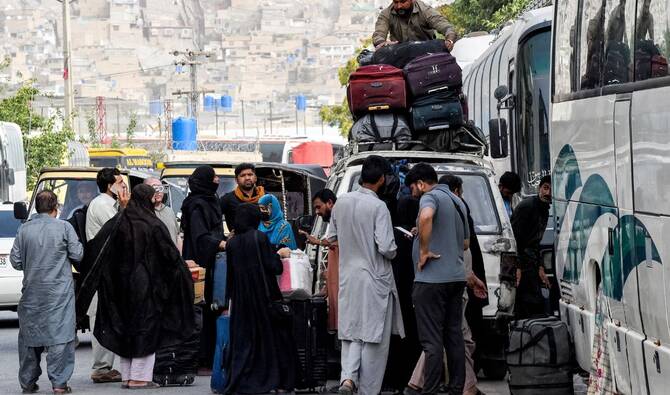
Pakistani nationals who were residing in Iran, arrive with their belongings in Quetta on June 22, 2025. (AFP)
Short Url
Updated 24 June 2025
Follow

Islamabad says Iran-Israel conflict may trigger ‘refugee exodus’ into Pakistan, Afghanistan

  • Pakistan shares a volatile, porous 900-kilometer-long border with Iran in southwestern region
  • Pakistan’s UN envoy says refugee exodus could imperil “already fragile” condition in Afghanistan

ISLAMABAD: Pakistan’s United Nations ambassador on Tuesday raised concerns about the possibility of a “refugee exodus” from Iran into neighboring Pakistan and Afghanistan, as tensions in the Middle East remain high despite the US announcing a ceasefire between Tehran and Israel. 

Pakistan shares a porous 900-kilometer-long border with Iran in its southwestern region, which is prone to militant violence and illicit activities such as smuggling. Analysts have warned that a long-term war between Israel and Iran, which began on June 13 after Tel Aviv attacked Iranian nuclear facilities, can lead to a large number of refugees heading toward Pakistan and other neighboring countries. 

However, hopes of calm returning to the region were spurred on after US President Donald Trump announced early Tuesday that Israel and Iran had agreed to a ceasefire. 

“We are also concerned about the potential destabilizing impact of the situation in Iran following unprovoked Israeli attacks,” Asim Iftikhar Ahmad, Pakistan’s permanent representative to the UN, said during a Security Council session.

“A refugee exodus into neighboring countries— including Afghanistan and Pakistan— could pose significant new challenges,” he said. “This might imperil the already fragile condition in Afghanistan.”

The Pakistani envoy was speaking on the prevalent situation in Afghanistan, including the lack of opportunities for women and the surge in militant attacks in the country. 

Ahmad said Islamabad wished to see a prosperous Afghanistan but warned that Pakistani Taliban fighters were operating from the country. He said that Pakistani Taliban or Tehreek-e-Taliban Pakistan (TTP) with around 6,000 fighters has safe havens close to the border with Pakistan, posing direct threat to Islamabad’s national security. 

“As part of our defensive measures, Pakistan has confiscated a significant cache of modern weapons originally left behind by international forces in Afghanistan,” Ahmad said. 

Afghanistan has repeatedly rejected Pakistan’s allegations that TTP fighters use its soil to launch attacks against Islamabad. Kabul has urged Pakistan to resolve its security challenges internally, without blaming Afghanistan. 

IRAN-ISRAEL CEASEFIRE

Trump announced the “complete and total” ceasefire between Tehran and Tel Aviv through a social media post on Tuesday, with the development taking place after Iran launched a limited missile attack Monday on a US military base in Qatar.

Iran said it was retaliating for the American bombing of its nuclear sites, adding that as long as Israel stopped its attacks early Tuesday morning, it would halt theirs.

Israel did not immediately acknowledge any ceasefire, but there were no reports of Israeli strikes in Iran after 4 am local time. Heavy Israeli strikes continued in Tehran and other cities until shortly before that time.

The US strikes against Iran over the weekend prompted fears of a wider regional conflict. Iran had said the US had crossed “a very big red line” with its risky gambit to strike with missiles and 30,000-pound bunker-buster bombs.

Pakistan has consistently denounced Israel’s military action against Iran and in Gaza, calling on the international community to intervene and impose an immediate end to the conflicts through dialogue and diplomacy. 


Pakistan air chief highlights modernization as PAF marks seven years since India aerial clash

Updated 4 sec ago
Follow

Pakistan air chief highlights modernization as PAF marks seven years since India aerial clash

  • Swift Retort was launched in 2019 after India attempted airstrikes following a Kashmir suicide bombing
  • Air chief’s remarks come amid fierce clashes between Pakistan and Afghanistan over cross-border militancy

ISLAMABAD: Pakistan’s air chief said on Friday the country’s air force had undertaken “comprehensive modernization and indigenization” in recent years, as he addressed a ceremony at Air Headquarters to mark seven years since an aerial confrontation with India.

Operation Swift Retort was launched on Feb. 27, 2019, a day after India attempted airstrikes inside Pakistan following a suicide bombing in Indian-administered Kashmir that killed at least 40 Indian paramilitary troops.

Pakistan responded with aerial strikes across the Line of Control and shot down an Indian fighter jet in a subsequent dogfight, capturing one pilot who was later returned in what Islamabad called a gesture of de-escalation.

“PAF has pursued comprehensive modernization and indigenization to transition into a Next Generation Air Force,” Air Chief Marshal Zaheer Ahmed Baber Sidhu said, according to a statement circulated by the military’s media wing, the Inter-Services Public Relations.

He added that the force had recalibrated its operational doctrine and rapidly inducted advanced combat and support capabilities, including indigenously developed unmanned systems, electronic warfare, space and cyber assets, establishing what he described as a “home-grown multi-domain kill chain.”

Sidhu said Pakistan remained committed to peace but would respond decisively to violations of its sovereignty.

“Pakistan is a responsible country which desires peace with honor,” he continued.

The remarks come amid renewed security tensions on Pakistan’s western frontier.

Islamabad earlier this week launched airstrikes inside Afghanistan targeting what it described as hideouts of Tehreek-e-Taliban Pakistan (TTP) and Daesh militants. Afghan authorities condemned the strikes and subsequently launched their own military response that led to fierce clashes between the two sides overnight.

Pakistan has frequently accused Kabul of allowing militant groups to use Afghan territory to carry out cross-border attacks on Pakistani civilians and security forces, an allegation denied by Afghan officials.

Pakistani authorities said earlier in the day small drones launched from the Afghan side were intercepted and brought down by the country’s air defense systems.

Sidhu said the PAF would continue to maintain a vigilant yet responsible defense posture to safeguard national sovereignty.