

Pakistan stocks, rupee plunge as investors react to US strikes on Iran

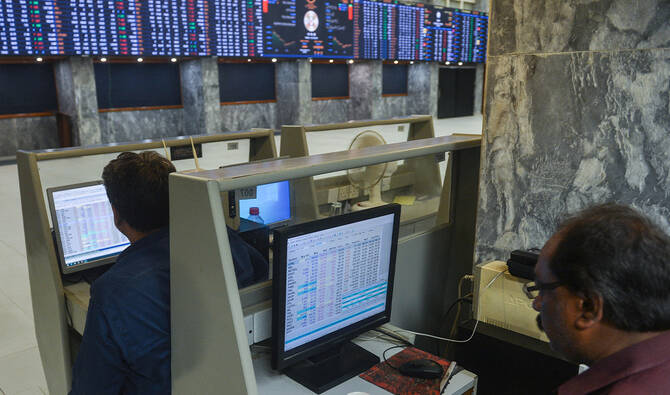
Brokers monitor the latests share prices at the Pakistan Stock Exchange in Karachi on February 14, 2023. (AFP/File)
Short Url
Updated 23 June 2025
Follow

Pakistan stocks, rupee plunge as investors react to US strikes on Iran

  • Benchmark KSE-10 Index dropped more than 3 percent to the lowest in over six weeks
  • Analysts say if there was no further escalation, value buying is expected to come through

KARACHI: Pakistan’s stocks and currency markets tumbled on Monday as investors reacted to the United States’ (US) foray into the Israel-Iran conflict, traders and analysts said.

The benchmark KSE-100 index dropped more than 3 percent to 116,167 points, the lowest in more than six weeks, while the rupee continued to weaken against the US dollar in the seventh consecutive session on Monday.

The index has plunged by nearly 5 percent since June 13 when Israel first hit Iranian military and nuclear targets in Natanz, Isfahan and Fordow, killing top generals and scientists among 78 people.

“Rising geopolitical tensions following a US strike on Iran shook investor confidence, causing the KSE-100 Index to drop by 3.2 percent,” Mohammad Waqas Ghani, head of research at JS Global Capital Ltd., told Arab News, adding that this was the fourth largest single-day decline in terms of points historically.

The attacks on Iran by the US, which followed Israeli strikes, have intensified the war and deepened geopolitical tensions in the Middle East, sending jitters to markets across the globe.

Monday’s 3.2 percent fall was the worst since May 8 when the index had plunged 5.9 percent day-on-day, according to Ghani.

“The spike in global oil prices has further intensified concerns about Pakistan’s external account vulnerabilities,” he added.

Cash-strapped Pakistan, which is trying to revive its debt-ridden economy with the help of International Monetary Fund’s $7 billion program, spent $17 billion on oil imports last year.

Raza Jafri, head of research at Intermarket Securities Ltd., attributed the day’s fall to redemptions at mutual funds and possible margin calls.

“Regional tensions are the main reason behind the weak sentiment,” he said, adding that if there was no further escalation, the value buying was expected to come through.

RUPEE DROP

The ongoing tensions have also impacted the Pakistani currency that lost another 0.06 percent as the greenback closed at Rs283.87, according to State Bank of Pakistan (SBP) data.

The rupee is constantly falling and has devalued 0.3 percent since the start of Iran-Israel conflict.

“The rupee is feeling the heat of this war, very negligibly though,” Zafar Paracha, secretary-general of the Exchange Companies Association of Pakistan, told Arab News.

“This stability in the exchange rate reflects the overall macroeconomic stability the country has achieved.”


UN torture expert decries Pakistan ex-PM Khan’s detention

Updated 12 December 2025
Follow

UN torture expert decries Pakistan ex-PM Khan’s detention

  • Khan’s party alleges government is holding him in solitary confinement, barring prison visits
  • Pakistan’s government rejects allegations former premier is being denied basic rights in prison

GENEVA: Pakistan’s former prime minister Imran Khan is being held in conditions that could amount to torture and other inhuman or degrading treatment, the United Nations’ special rapporteur on torture warned Friday.

Alice Jill Edwards urged Pakistan to take immediate and effective action to address reports of the 73-year-old’s inhumane and undignified detention conditions.

“I call on Pakistani authorities to ensure that Khan’s conditions of detention fully comply with international norms and standards,” Edwards said in a statement.

“Since his transfer to Adiala Jail in Rawalpindi on September 26, 2023, Imran Khan has reportedly been held for excessive periods in solitary confinement, confined for 23 hours a day in his cell, and with highly restricted access to the outside world,” she said.

“His cell is reportedly under constant camera surveillance.”

Khan an all-rounder who captained Pakistan to victory in the 1992 Cricket World Cup, upended Pakistani politics by becoming the prime minister in 2018.

Edwards said prolonged or indefinite solitary confinement is prohibited under international human rights law and constitutes a form of psychological torture when it lasts longer than 15 days.

“Khan’s solitary confinement should be lifted without delay. Not only is it an unlawful measure, extended isolation can bring about very harmful consequences for his physical and mental health,” she said.

UN special rapporteurs are independent experts mandated by the Human Rights Council. They do not, therefore, speak for the United Nations itself.

Initially a strong backer of the country’s powerful military leadership, Khan was ousted in a no-confidence vote in 2022, and has since been jailed on a slew of corruption charges that he denies.

He has accused the military of orchestrating his downfall and pursuing his Tehreek-e-Insaf (PTI) party and its allies.

Khan’s supporters say he is being denied prison visits from lawyers and family after a fiery social media post this month accusing army leader Field Marshal Asim Munir of persecuting him.

According to information Edwards has received, visits from Khan’s lawyers and relatives are frequently interrupted or ended prematurely, while he is held in a small cell lacking natural light and adequate ventilation.

“Anyone deprived of liberty must be treated with humanity and dignity,” the UN expert said.

“Detention conditions must reflect the individual’s age and health situation, including appropriate sleeping arrangements, climatic protection, adequate space, lighting, heating, and ventilation.”

Edwards has raised Khan’s situation with the Pakistani government.