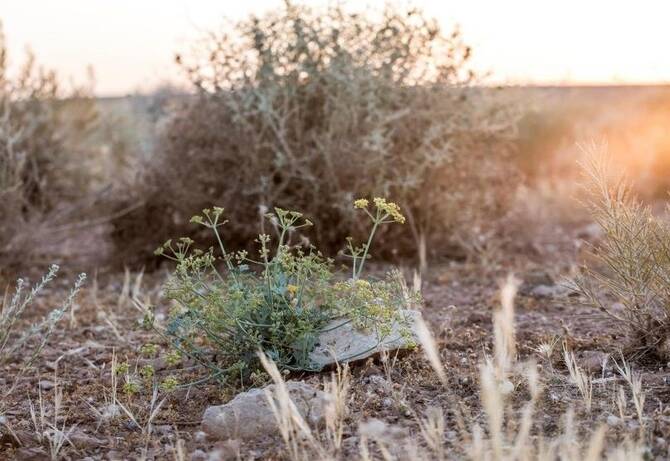
Hazaa plant flourishes in Saudi Arabia’s northern deserts

1 / 2
The Haza plant is rare to spot in the desert, especially since it also grows in rocky environments near water bodies. (SPA)
2 / 2
The Haza has a unique appearance that comes from its long, oval-shaped, gray-green leaves that have sharp points, making it easily recognizable in the wild. (SPA)
Short Url
Updated 24 June 2025
Follow

Hazaa plant flourishes in Saudi Arabia’s northern deserts

  • Due to its ability to handle high levels of drought and salinity, Hazaa has proved its ability to survive in difficult climatic conditions
  • Plant is known for its captivating aroma, and reaches a height of approximately 35 centimeters

RIYADH: Despite the harsh desert climate in Saudi Arabia’s Northern Borders province, native plants have found a way not only to survive but to thrive.

Among the local flora is the Hazaa plant, known scientifically as Ducrosia anethifolia.

The plant is native to the Arabian Peninsula, the Levant, Iran, Afghanistan and Pakistan, and is part of the Apiaceae family of plants, which includes crops and medicinal plants, according to the Saudi Press Agency.

Due to its ability to handle high levels of drought and salinity, Hazaa has proved its ability to survive in difficult climatic conditions.

The plant is known for its captivating aroma, and reaches a height of approximately 35 centimeters.

Haza is “A perennial plant that grows in areas close to valleys,” plant researcher Arwa Al-Otaibi told Arab News.

“After the seasonal floods in the spring period, between April and May, it appears abundantly, and its flowers resemble mint blossoms. It is most widespread in the Northern Borders region, specifically in Arar.”

“Regarding the environment, this plant is heat- and drought-tolerant, adapts well to the climate, and acts as a natural ground cover. It helps reduce desertification and lessens the winds that cause sandstorms. Most importantly, it requires very little water.”

“As for its benefits to humans, according to my mother, this medicinal plant was used extensively in the past. People used it to treat stomach ailments and bloating, to detoxify the body, and it also served as an anti-inflammatory remedy.”

Its unique appearance comes from its long, oval-shaped gray-green leaves that have sharp points, making the plant easily recognizable among other plants in the wild.

Along with its pleasant smell, the plant produces small, light yellow, umbrella-like flowers during the flowering season, with 12 to 18 flowers on each stem.

The Northern Borders region is also home to other plant species, including Reseda alba, Salsola tetrandra shrubs and lavender.


Program to train experts in forest rehabilitation

Updated 4 sec ago
Follow

Program to train experts in forest rehabilitation

  • Forest Ambassadors program is one of several specialized training initiatives designed to equip forestry personnel, relevant authorities, and university students
  • Program focuses on providing trainees with advanced scientific knowledge and skills in fieldwork, data management, and technical report writing

RIYADH: The National Center for Vegetation Cover Development and Combating Desertification continues to strengthen national capabilities to implement environmental initiatives requiring advanced technical skills and scientific expertise in assessing and rehabilitating vegetation resources.

The Forest Ambassadors program is one of several specialized training initiatives designed to equip forestry personnel, relevant authorities, and university students with the knowledge and skills to conduct vegetation inventories, assessments, and prepare technical plans for rehabilitating degraded forest areas.

The program offers a mix of theoretical and practical training, including presentations, educational modules, group discussions, and case studies, according to the Saudi Press Agency.

These components enable participants to conduct vegetation inventories and assessments, identify degradation, determine rehabilitation needs, and develop technical forest management plans.

The program focuses on providing trainees with advanced scientific knowledge and skills in fieldwork, data management, and technical report writing, the SPA reported.

It serves as a model for building highly qualified national cadres capable of applying best scientific practices in forest management and rehabilitation, contributing to the protection of natural resources, advancing the Saudi Green Initiative, and supporting the long-term sustainability of the Kingdom’s vegetation cover.