

In Norway’s Arctic, meteorologists have a first-row seat to climate change

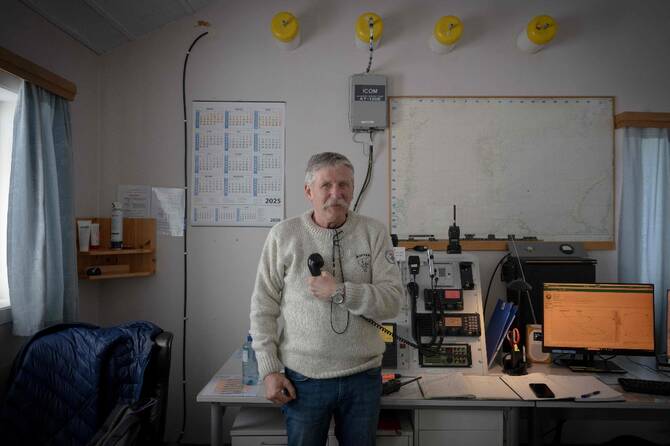
Norwegian meteorologist Trond Robertsen poses in the weather forecast room in the weather station on the North Coast of remote Norwegian territory Bear Island. (AFP)
Short Url
Updated 23 June 2025
Follow

In Norway’s Arctic, meteorologists have a first-row seat to climate change

TROMSO: In the cold of the Norwegian Arctic, meteorologist Trond Robertsen manually recorded precipitation levels for over two decades, witnessing firsthand the effects of climate change.
At 66, Robertsen retired after enduring spartan conditions during missions that totalled eight years on two islands of the Svalbard archipelago: Bjornoya (Bear Island) and Hogen.
To reach the remote Bjornoya, where the only humans are the nine employees of the small weather station, the meteorologists have to fly in by helicopter as they are rotated on a six-month basis.
“The idea is to not stay too long, because it’s a different rhythm, and you are isolated,” Robertsen told AFP.
It is demanding work.
“It’s a 24/7 occupation,” he said. “We are doing it all day, all night.” The team worked shifts to cover all hours of the day, he explained.
Weather observation starts in the early morning at 6:00 am.
“It’s manually done, then you have to go outside and check the bucket that is collecting precipitation,” said Robertsen.
“During wintertime you have to melt the snow and ice into water” to determine how much has fallen.
The data is then transmitted the Norwegian Meteorological Institute in Tromso and Oslo.
“This tiny little observation is actually quite crucial for the weather forecasting systems up north, because observations are so sparse from that area.”
Bjornoya sits in the middle of fishing grounds, and the weather reports published twice a day are closely followed by the fishing boats in the area.

Since his first missions to the Arctic in the 1990s, Robertsen has witnessed the changing climate.
“When I started going up north, there was a lot of ice. In the later years, it’s less ice and fewer polar bears. You can see the climate change,” he said.
Polar bears have been classified as a vulnerable population since 1982 on the IUCN (International Union for Conservation of Nature) Red List of Threatened Species, with the loss of Arctic sea ice the most pressing threat against the species.
However, their precise numbers, are almost impossible to assess.
In winter, employees of station always venture out in pairs and have to be armed due to the presence of polar bears, but according to Robertsen it’s rarer to encounter them today.
In April, during his last mission to the island, Robertsen had an accident while doing carpentry: he slipped and ended up cutting one finger clean off and half of another.
Due to tough weather conditions, he had to wait some 26 hours before being evacuated by helicopter and transported to a hospital.
“It was a heavy snowstorm coming in, only the day after the helicopter came,” he recounted.
Looking back, Robertsen does not regret the years spent under the austere living conditions.
“The Arctic has given me so many experiences and memories so it is a small fee to pay back with my left little finger and part of my ring finger,” he said.


From round fruits to lucky charms: How Filipinos invite prosperous New Year

Updated 31 December 2025
Follow

From round fruits to lucky charms: How Filipinos invite prosperous New Year

  • Lights are lit, doors and windows open to allow good spirits in
  • Sticky rice dishes are served to keep family sticking together

MANILA: With the dining table set with symbolic foods, a bit of noise and rituals to invite good luck, Filipinos are ready to welcome the New Year, carefully observing every tradition and superstition to bring prosperity.

Media noche or the midnight dinner on New Year’s Eve is central to the celebration. Besides traditional meats, there will be sticky rice dishes to keep the family sticking together, and pancit or long rice noodles to represent long life.

There should also be 13 round fruits prepared specifically for the occasion, with 12 representing each month of the year, and the 13th adding extra luck. Because they are round like coins, they are believed to invite abundance, wealth and prosperity.

“We cook bilo-bilo (sticky rice balls) with coconut milk and palitaw (sweet rice cakes). It’s something we simply grew up with,” said Cel Reyes from Mabini in Batangas province, south of Manila.

“It’s sticky, so it symbolizes togetherness, and it is also round. Anything that’s round is prepared also as a symbol of prosperity.”

In Malabon, a coastal city in the northern part of Metro Manila, Priam Nepomuceno’s 86-year-old mother-in-law sets unhulled rice on the table.

“Because of the gold color, it’s believed to bring luck and abundance,” he said. “Grapes are also hung on the door. They’re not meant to be eaten and are kept hanging for the whole year as a symbol of prosperity.”

Some people also jump when the clock strikes 12, believing it will help them grow taller.

In many households, all lights are lit before midnight, with doors and windows open to allow good spirits to enter, while noise from firecrackers and party horns keeps the bad ones at bay.

“By nature, Filipinos are superstitious. We believe in good luck, deities. We give in to faith and luck, and it’s tied to deep spirituality,” said Juanita Galang-Trinidad, an 80-year-old editor from Bulacan province north of Manila.

“We also put 12 coins in varying amounts in our pockets and wear polka dot clothing. Rice, cereal, and salt containers should be full.”

New Year’s celebrations, like Christmas, bring families together, but with extra traditions for good luck. Beyond the midnight feast and keeping round objects on the table and at hand, Filipinos try to pay off debts to avoid financial trouble in the coming year.

On New Year’s Eve, they also avoid serving chicken, as chickens are believed to scratch backward when they eat, symbolically scratching away good fortune.

“We hold on to our traditions despite these growing changes, modernity, in our environment,” Trinidad said.

“We still hold on to our traditions and customs because they identify us as a people, as Filipinos.”