

Pakistan PM summons National Security Committee meeting as Middle East tensions surge

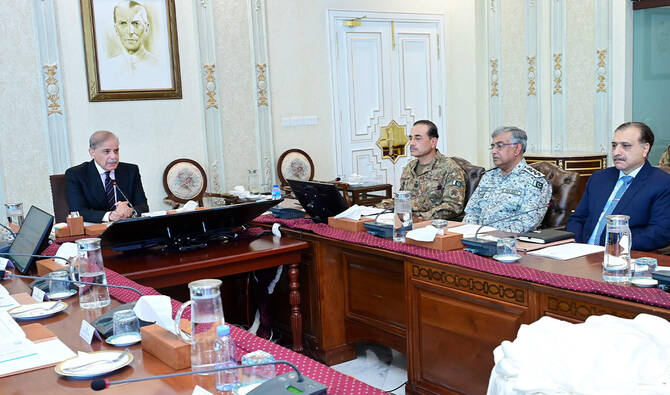
Pakistan's Prime Minister, Shehbaz Sharif (left), chairing National Security Committee in Islamabad, Pakistan, on June 23, 2025. (Government of Pakistan)
Short Url
Updated 23 June 2025
Follow

Pakistan PM summons National Security Committee meeting as Middle East tensions surge

  • Chaired by the prime minister, NSC is the principal decision-making body on Pakistan’s national security matters 
  • Experts warn Pakistan, which shares a porous border with Iran, may face security, economic challenges as conflict worsens

KARACHI: Pakistan’s premier Shehbaz Sharif has summoned a meeting of the National Security Committee (NSC) today, Monday, an official of the Prime Minister House confirmed amid surging tensions in the Middle East following the United States’ (US) involvement in the Iran-Israel military conflict. 

The NSC is the principal decision-making body on Pakistan’s national security matters. Chaired by the prime minister, it comprises the ministers of defense, foreign affairs, finance, interior, information and senior military leadership. 

The meeting will take place a day after US targeted key Iranian nuclear facilities, joining Israel in its military conflict against Iran which began on June 13. Israel had launched strikes against Iran’s nuclear sites and targeted its military leadership, saying its attack intended to prevent Tehran from developing nuclear weapons. Iran insists its nuclear program is for peaceful purposes. 

“This [NSC meeting] is to happen today,” the official confirmed to Arab News, adding that a statement about the meeting will be released as well. 

The development takes place a day after Pakistan’s mission to the United Nations (UN) announced Islamabad, Beijing and Moscow will present a joint resolution at the UN Security Council calling for an immediate and unconditional ceasefire in the Middle East. 

As per a copy of the draft seen by Arab News, the resolution calls for an immediate and unconditional ceasefire and a diplomatic solution to the nuclear issue to reach an agreement acceptable to all parties that “guarantees the exclusively peaceful nature of the Islamic Republic of Iran’s nuclear program in exchange for complete lifting of all multilateral and unilateral sanctions.”

Pakistan has condemned the US strikes against Iran, with its UN Ambassador Asim Iftikhar Ahmad calling on the Security Council on Monday to act “urgently and decisively,” warning against the danger posed to the populations of the region as the war intensifies. 

Experts warn Pakistan, which shares a 900-kilometer porous border with Iran in its southwestern region prone to separatist militancy and cross-border attacks, will face additional security and economic challenges due to the worsening conflict between Tehran and Tel Aviv. 

Financial analysts have warned that surging global oil prices due to the worsening conflict will cause economic setbacks for Pakistan, which relies on expensive fuel imports for its energy demands. Islamabad is grappling with a macroeconomic crisis amid a precarious balance of payment position. 

The crisis also raises questions about how Islamabad will navigate its delicate balancing act between Iran, other Gulf partners, and the US, which remains one of Pakistan’s largest trading partners and a critical source of military and economic assistance. How Pakistan manages these competing ties amid an escalating regional conflict could test its diplomacy in the coming weeks.


Pakistan launches digital tools to trace life insurance claims, tighten motor insurance enforcement

Updated 6 sec ago
Follow

Pakistan launches digital tools to trace life insurance claims, tighten motor insurance enforcement

  • SECP rolls out SMS-based Life Insurance Policy Finder, orders insurers to join Motor Insurance Repository
  • The regulator says centralized data will help authorities verify coverage, reduce long-unclaimed benefits

KARACHI: Pakistan’s securities regulator on Monday announced two digital initiatives aimed at overhauling how insurance data is stored and accessed, in a push to strengthen enforcement, improve transparency and make it easier for citizens to trace insurance coverage.

The Securities and Exchange Commission of Pakistan (SECP) announced in two separate statements it had introduced a nationwide Life Insurance Policy Finder to help families identify policies held by deceased relatives. It also directed all non-life insurers to join a centralized Motor Insurance Repository (MIR).

Both systems, developed with the Central Depository Company (CDC), seek to address longstanding gaps in a sector where weak records, low compliance and limited data-sharing have left motorists, policyholders and beneficiaries without reliable recourse.

“The Securities and Exchange Commission of Pakistan (SECP), in collaboration with the Central Depository Company of Pakistan Limited (CDC) and the Insurance Association of Pakistan (IAP), has introduced the Life Insurance Policy Finder Service,” it said in one of the statements. “This initiative is designed to facilitate the general public in locating life insurance policies of deceased loved ones.”

“The service addresses a long-standing challenge faced by families who remain unaware of life insurance policies held by their deceased relatives,” it added. “This lack of awareness often results in legitimate claims and benefits remaining unclaimed for years.”

The SECP said the initiative aims to strengthen consumer protection, promote transparency and provide structured and secure access to insurance benefits for rightful heirs and beneficiaries.

Under the new policy-finder service, which goes live on Dec. 15, individuals can send the CNIC number of the deceased via SMS to 99833.

If a policy exists, the relevant insurer will contact the beneficiary to verify details and guide them through the claims process. Life insurers and family takaful operators have also been instructed to participate fully and respond to queries within set turnaround times.

Separately, on the motor insurance side, all non-life insurers underwriting vehicle policies are required to sign a service-level agreement with the CDC within 60 days and begin uploading complete and validated policy data to the MIR.

The repository will allow provincial and federal authorities to verify third-party insurance coverage, a requirement that exists on paper but remains loosely enforced nationwide.

The SECP said the measures form part of its broader effort to promote digital transformation, improve compliance and safeguard consumer interest.

“A centralized and validated data repository will allow authorities to verify insurance coverage efficiently, addressing significant gaps in compliance,” it added.