

Pakistan urges UN Security Council to act ‘decisively’ as Iran-Israel conflict intensifies

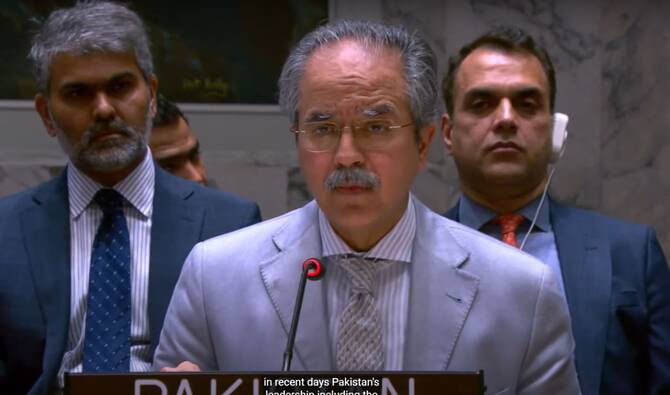
Pakistan’s Permanent Representative to the UN Asim Iftikhar Ahmad addresses a UNSC session on June 23, 2025. (United Nations/ YouTube/ screengrab)
Short Url
Updated 23 June 2025
Follow

Pakistan urges UN Security Council to act ‘decisively’ as Iran-Israel conflict intensifies

  • Middle East tensions surged on Sunday after US carried out airstrikes against Iran’s nuclear facilities
  • Pakistan calls for “peaceful, lasting resolution” to Iran’s nuclear issue via dialogue and diplomacy

ISLAMABAD: Pakistan’s ambassador to the United Nations has urged the Security Council to act “urgently and decisively” to ensure cessation of hostilities in the Middle East, as tensions surge following Washington’s move to join the ongoing conflict between Iran and Israel. 

The international community has intensified its calls for peace in the Middle East after US carried out attacks against Iran’s key nuclear facilities on Sunday, joining Israel in the biggest Western military action against the Islamic Republic since its 1979 revolution.

Pakistan’s UN mission announced on Sunday that Islamabad, Beijing and Moscow will present a joint resolution calling for an immediate and unconditional ceasefire in the Middle East. The announcement was made as the Security Council convened an emergency session to discuss US airstrikes on Iranian nuclear sites. Pakistan has strongly condemned the American strikes, reiterating that Tehran reserves the right to respond under the UN Charter.

“As the body entrusted with the primary responsibility for the maintenance of international peace and security, the Security Council must act urgently and decisively,” Pakistan’s Permanent Representative to the UN Asim Iftikhar Ahmad said during the Security Council emergency meeting. 

He said it was the Security Council’s collective responsibility to reject and condemn attacks against Iran launched since June 13, stating that they were in “clear contravention” of international law and the UN Charter. The Pakistani envoy reaffirmed that it was the Security Council’s obligation to protect civilian lives and properties on both sides. 

Ahmad called for an immediate cessation of hostilities and a “complete ceasefire” in the Middle East. 

“Promote urgent recourse to dialogue and diplomacy, consistent with the purposes and principles of the UN Charter, to find a peaceful and lasting resolution to the Iranian nuclear issue,” the Pakistani ambassador said. 

Iran on Sunday requested for the UN Security Council meeting, calling on the 15-member body “to address this blatant and unlawful act of aggression, to condemn it in the strongest possible terms” following America’s strikes. 

Israel’s UN Ambassador Danny Danon said in a statement on Sunday that the US and Israel “do not deserve any condemnation, but rather an expression of appreciation and gratitude for making the world a safer place.”

UN Secretary-General Guterres branded the US strikes on Iran as a “dangerous escalation in a region already on the edge – and a direct threat to international peace and security.”

Iran’s UN Ambassador Ali Bahreini said Washington had decided to “destroy diplomacy” with its attacks, making it clear that the Iranian military will decide on the “timing, nature and scale” of its response.


Pakistan reports decline in polio cases in 2025

Updated 4 sec ago
Follow

Pakistan reports decline in polio cases in 2025

  • Cases drop to 30 from 74 in 2024, with no new infections recorded since September
  • Authorities plan intensified targeted drives in 2026 to halt remaining transmission

ISLAMABAD: Pakistan reported a sharp decline in polio cases in 2025, with infections falling to 30 from 74 a year earlier, as intensified vaccination campaigns and improved surveillance helped curb the spread of the virus, health authorities said on Wednesday.

No new polio cases have been recorded anywhere in the country since September, said a statement, as Pakistan carried out six polio campaigns, including five nationwide drives, trying to reach children in high-risk areas and improve monitoring of virus circulation.

Despite the decline, the authorities cautioned that poliovirus continues to circulate in some districts, requiring sustained vigilance to prevent a resurgence.

“Targeted interventions, robust community engagement, and ongoing vaccination efforts remain essential to reach every missed child and prevent any resurgence,” the official statement said.

“Frontline health workers, security personnel, and local authorities continue to work in close coordination to maintain high immunity levels and ensure that Pakistan remains on course toward becoming polio-free,” it added.

The most recent nationwide campaign, conducted from Dec. 15 to 21, achieved more than 98 percent coverage across the country, including all four provinces, Azad Jammu and Kashmir, Gilgit-Baltistan and the capital, Islamabad.

Authorities reported an 18 percent reduction in the number of missed children compared with the previous round, with notable improvements in access and operations in southern Khyber Pakhtunkhwa, a longstanding challenge area.

Pakistan’s polio eradication drive relies on close coordination between health workers, security personnel and local authorities, amid ongoing resistance in some communities and access constraints in remote or insecure regions.

Officials said district-specific interventions, including improved microplanning, better deployment of vaccination teams and enhanced community outreach, were being used to address remaining gaps, particularly in parts of southern Khyber Pakhtunkhwa.

The statement said Pakistan plans to intensify targeted efforts in 2026 to interrupt the remaining transmission chains and move closer to eliminating the disease.