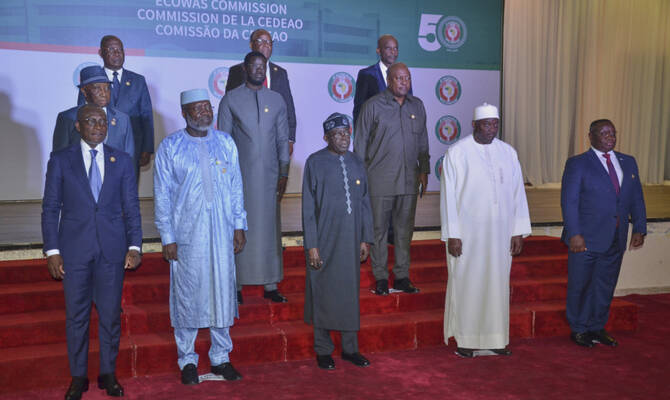
ABUJA: Leaders from the west African bloc ECOWAS on Sunday admitted during talks in the Nigerian capital that the region was in trouble, facing mounting unrest and political instability.
“Our region is at the crossroads,” said Sierra Leone’s Julius Maada Bio as he took over the rotating chairmanship of the Economic Community of West African States (ECOWAS) from Nigeria’s Bola Tinubu.
West Africa is “facing serious challenges, some long-standing, others new and evolving,” he said.
They included “insecurity in the Sahel and coastal states, terrorism, political instability, illicit arms flow and transnational organized crimes.”
It was time to “overhaul our collective security architecture” including intelligence-sharing and rapid response, he added. “The democratic space is under strain in parts of our region — the constitutional order has been disrupted.”
Coups and attempted putsches have rocked nearly half of the original ECOWAS member states in the last decade, straining relations between neighbors.
Three junta-led countries — Mali, Burkina Faso and Niger — quit the bloc earlier this year, setting up their own alliances.
Jihadists exploiting fraying ties between regional countries are gaining ground in the Sahel and Lake Chad region.
They have recently intensified offensives in the Sahel region, staging bloody raids in Mali, incursions into major cities in Burkina Faso and inflicting heavy army losses in Niger.
Summit host Nigeria has also witnessed a spike in attacks in recent weeks, targeting both villagers and military bases.
In his speech, outgoing ECOWAS chair Tinubu spoke of the “stark and consistent challenges that continue to impede our aspirations... violent extremism and other cross-border crimes that have continued to widen” and intensify.
The three Sahel states’ military juntas pledged during the coups that brought them to power to make security a priority.
But, like their predecessors, they are struggling to contain the advance of jihadists, who are threatening neighboring countries on the west African coast more than ever.
Tinubu said that under his leadership ECOWAS “deployed all diplomatic means” to engage the three countries and expressed confidence “that before too long, they may return” to the bloc.
Bringing the three countries back into the ECOWAS fold will be the “biggest test” of the chairmanship of Maada Bio, a former soldier who briefly led a military junta in his own country more than two decades ago, said Ikemesit Effiong, analyst with SBM Intelligence, a Lagos-based African geopolitical risk consulting firm.
The three countries have so far formed a confederation called the Alliance of Sahel States (AES). Earlier this year they announced the creation of a joint 5,000-strong force for joint military operations.
ECOWAS leaders in August 2023 mustered plans to create a military “standby force” aimed at fighting against terrorism and transnational crimes. At the time it was announced, it was aimed at the junta leaders in Niger who had toppled the sitting president.
Tinubu said ECOWAS “must act decisively to operationalize the standby force in the fight against terrorism to serve as an instrument for peace and stability for our region.”
“I am a little bit worried about the slow pace of its activation, which is taking longer than desired,” said Tinubu.
ECOWAS did not give a timeline of when it would become operational.
But the organization has a long history of military interventions having deployed since the 1990s in Liberia, Sierra Leone, Mali, Ivory Coast, the Gambia and Guinea-Bissau.


![]()

West African leaders admit security woes mounting in region
Short Url
https://arab.news/wstwy
West African leaders admit security woes mounting in region
- Coups and attempted putsches have rocked nearly half of the original ECOWAS member states in the last decade, straining relations between neighbors


Latest updates


Recommended


© 2026 SAUDI RESEARCH & PUBLISHING COMPANY, All Rights Reserved And subject to Terms of Use Agreement.