


DUBAI: Amid mounting speculation, the US launched air strikes on three of Iran’s nuclear facilities on Saturday.
The operation aimed to support Israel in its war against Iran — ongoing since June 13 — by crippling Tehran’s uranium enrichment capacity, according to Asharq News.
US President Donald Trump later announced that Iran’s uranium-enrichment abilities had been eliminated, warning Tehran against any “retaliatory response.” Tehran, however, described the damage as “limited” and dismissed any indications of radiation leaks.

US President Donald Trump addresses the nation from the White House in Washington on June 21, 2025, following the announcement that the US bombed nuclear sites in Iran. (POOL / AFP)
The US strikes included 14 bunker-buster bombs, more than two dozen Tomahawk missiles and over 125 military aircraft, in an operation the top US general, General Dan Caine, said was named “Operation Midnight.”
Asharq News reported that the strikes targeted three critical nuclear facilities instrumental in Iran’s nuclear fuel cycle: Fordo, Natanz and Isfahan nuclear complex.
These sites span the entire fuel-enrichment chain — from raw uranium conversion, through enrichment, to the production of fuel and technical components for research reactors.
FASTFACTS:
• The first B-2 bomber was publicly displayed on Nov. 22, 1988, but its first flight was on July 17, 1989.
• The combat effectiveness of the B-2 was proved in the Balkans, where it was responsible for destroying 33 percent of all Serbian targets in the first eight weeks.
• In support of Operation Enduring Freedom, the B-2 flew one of its longest missions to date from Whiteman to Afghanistan and back.
• The B-2 completed its first-ever combat deployment in Iraq, flying 22 sorties and releasing more than 1.5 million pounds of munitions.

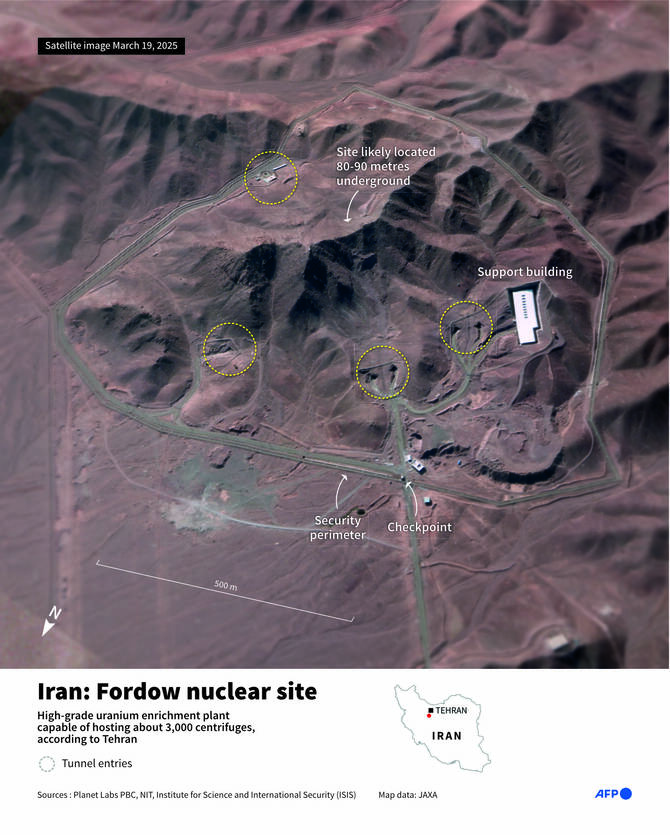
This handout satellite image provided by Maxar Technologies and taken on December 11, 2020 shows an overview of Iran's Fordow Fuel Enrichment Plant (FFEP), northeast of the Iranian city of Qom. (AFP)
Fordo facility
Location and structure: Fordo is 30 kilometers northeast of Qom, embedded within a mountain at an altitude of approximately 1,750 m, with over 80 meters of rock and volcanic shielding — making it one of Iran’s most fortified sites.
Technical role: It houses two underground halls that can hold about 3,000 IR-1 centrifuges, enriching uranium up to 60 percent — a level nearing weapons -grade.
Strategic importance: It is a primary target in any military effort to prevent Iran from achieving nuclear military capability, due to its high capacity and protection.

This handout satellite image courtesy of Maxar Technologies shows Iran's shows Natanz nuclear research center in the central Iranian province of Isfahan. (AFP)
Natanz reactor
Location and structure: Situated near Kashan in central Iran, partially buried under about 8 meters of earth with a 220meter-thick concrete roof, naturally shielded by surrounding mountainous terrain.
Technical role: Contains primary and experimental plants with over 14,000 centrifuges (IR-1, IR-2m, IR-4, IR-6), making it Iran’s main industrial enrichment hub.
Strategic importance: Responsible for producing most of Iran’s low-enriched uranium and plays a key role in centrifuge development.

This handout satellite picture provided by Maxar Technologies and taken on June 22, 2025, shows damage after US strikes on the Isfahan nuclear enrichment facility in central Iran. (AFP)
Isfahan nuclear complex
Location and structure: Located south of Isfahan on an arid plateau away from populated areas, it is neither buried nor heavily fortified.
Technical role: Includes a Uranium Conversion Facility (UCF); a research reactor fuel production plant; and a metallic fuel pelletizing plant, and three research reactors.
Strategic importance: Serves as the backbone of Iran’s nuclear research and production infrastructure, supplying both Natanz and Fordo.
The Pentagon used some of the world’s most advanced aircraft for Saturday’s strikes. The B-2 Spirit is a multi-role bomber capable of delivering both conventional and nuclear munitions.
The bomber represents a major milestone in the US bomber modernization program. The B-2 brings massive firepower to bear anywhere on the globe through seemingly impenetrable defenses.

A B-2 bomber has a range over 11,000 km without refueling, capable of global reach from distant American bases. (Getty Images via AFP)
According to US officials, the bombers that carried out the Iran strikes flew for nearly 37 hours non-stop from its Missouri base, refueling in mid-air multiple times before striking in the early hours of Sunday.
A B-2 bomber offers several key advantages, primarily due to its stealth capabilities and global reach.
• A range over 11,000 km without refueling, capable of global reach from distant American bases.
• Stealth abilities such as flying-wing design and radar-absorbing materials that allow it to evade air defenses.
• It can carry both nuclear and conventional weapons, including the GBU‑57 bunker-buster bomb.
Initial reports quoted by Asharq News indicated that Fordo was hit with the GBU‑57, the most powerful US conventional bunker buster, designed for deeply buried targets like Fordo, which lies 90 meters underground. Fox News reported six bunker-busting bombs were dropped on Fordo, alongside approximately 30 Tomahawk cruise missiles fired at Natanz and Isfahan.

The GBU‑57 ‘Massive Ordnance Penetrator’ was designed by American military engineers to devastate deeply buried bunkers without radioactive fallout. It was the only nonnuclear weapon that could reach Iran’s hardest target.
• Weight: ~13,600 kg
• Length: 6.2 meters.
• Diameter: 0.8 meters.
• Explosive payload: 2,400 kg of high explosives.
• Guidance: GPS + inertial navigation.
* Penetration: Up to 60 meters of reinforced concrete or dense rock.
A Tomahawk cruise missile is a precision weapon that launches from ships, submarines and ground launchers and can strike targets precisely from a great distance, even in heavily defended airspace.

• Range: 1,250–2,500 km depending on variant.
• Speed: Subsonic (~880 km/h).
• Guidance: Inertial navigation, GPS, with some variants using terminal guidance (TERCOM, DSMAC).
• Warhead: ~450 kg conventional explosives.
• Launch platforms: Ships and submarines.
There has been a torrent of responses to the US move against Iran, Asharq News reported. President Trump declared the mission’s success, stating that the Fordo facility was “gone,” and Iran’s primary nuclear enrichment sites “completely and utterly destroyed.” Later on Sunday, US Defense Secretary Pete Hegseth said the strikes were an incredible and overwhelming success that have “obliterated Tehran’s nuclear ambitions.”
For its part, Iran’s Tasnim News Agency quoted an official saying the nuclear sites had been evacuated in advance, and the damage was “not irreparable.” The Atomic Energy Organization of Iran stated there was “no risk of any radiation leak.” Iran emphasized its nuclear industry would not be halted.


