Jordanian king chairs security meeting, affirms national unity amid regional tensions

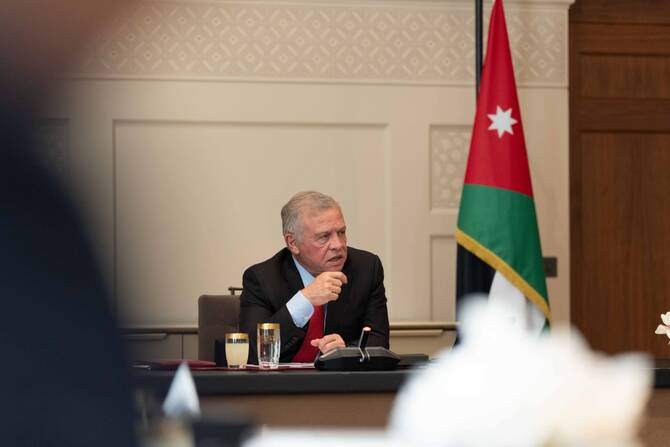
 King Abdullah II of Jordan chairing a meeting on Sunday with officials and security agencies. (Petra)
Short Url
Updated 22 June 2025
Follow

Jordanian king chairs security meeting, affirms national unity amid regional tensions

  • King Abdullah II said that Jordan will not permit any party to exploit regional tensions to undermine the country’s firm stance on key Arab issues
  • The Iran-Israel conflict has escalated following US strikes on Sunday, as Tel Aviv and Tehran exchanged attacks for the 10th day

LONDON: King Abdullah II of Jordan chaired a meeting on Sunday with officials and security agencies to emphasize national unity in the face of regional developments.

King Abdullah urged government institutions to tackle the economic effects of escalating tensions in the Middle East during the meeting at Al-Husseiniya Palace in Amman.

He said that Jordan will not permit any party to exploit regional tensions to undermine the country’s firm stance on key Arab issues. He said that Amman is committed to achieving a ceasefire in the Gaza Strip and the establishment of a Palestinian state, the Petra news agency reported.

He called for increased international efforts to achieve lasting peace in the region and to de-escalate tensions through diplomatic dialogue and negotiations, Petra added.

The Iran-Israel conflict has escalated following US strikes on three nuclear sites inside Iran on Sunday morning. Tel Aviv and Tehran have exchanged attacks over the past 10 days, risking a full-scale war in the Middle East.

The meeting was attended by several key figures, including Prime Minister Jafar Hassan, Foreign Minister Ayman Safadi, Speaker of the House of Representatives Ahmad Safadi, Chairman of the Joint Chiefs of Staff Maj. Gen. Yousef Huneiti, General Intelligence Department Director Maj. Gen. Ahmad Husni, and Public Security Directorate Director Maj. Gen. Obaidallah Maaytah.


Syrian government and SDF agree to de-escalate after Aleppo violence

Updated 23 December 2025
Follow

Syrian government and SDF agree to de-escalate after Aleppo violence

  • Turkiye views the US-backed SDF, which controls swathes of northeastern Syria, as a ⁠terrorist organization and has warned of military action if the group does not honor the agreement

DAMASCUS: Syrian government forces and the Kurdish-led Syrian Democratic Forces agreed to de-escalate on Monday evening in the northern city of Aleppo, after a wave of attacks that both sides blamed on each other left at least two civilians dead and several wounded.
Syria’s state news agency SANA, citing the defense ministry, said the army’s general command issued an order to stop targeting the SDF’s fire sources. The SDF said in a statement later that it had issued instructions to stop responding ‌to attacks ‌by Syrian government forces following de-escalation contacts.

HIGHLIGHTS

• SDF and Syrian government forces blame each other for Aleppo violence

• Turkiye threatens military action if SDF fails integration deadline

• Aleppo schools and offices closed on Tuesday following the violence

The Syrian health ministry ‌said ⁠two ​people ‌were killed and several were wounded in shelling by the SDF on residential neighborhoods in the city. The injuries included two children and two civil defense workers. The violence erupted hours after Turkish Foreign Minister Hakan Fidan said during a visit to Damascus that the SDF appeared to have no intention of honoring a commitment to integrate into the state’s armed forces by an agreed year-end deadline.
Turkiye views the US-backed SDF, which controls swathes of northeastern Syria, as a ⁠terrorist organization and has warned of military action if the group does not honor the agreement.
Integrating the SDF would ‌mend Syria’s deepest remaining fracture, but failing to do ‍so risks an armed clash that ‍could derail the country’s emergence from 14 years of war and potentially draw in Turkiye, ‍which has threatened an incursion against Kurdish fighters it views as terrorists.
Both sides have accused the other of stalling and acting in bad faith. The SDF is reluctant to give up autonomy it won as the main US ally during the war, which left it with control of Daesh prisons and rich oil resources.
SANA, citing the defense ministry, reported earlier that the SDF had launched a sudden attack on security forces ⁠and the army in the Sheikh Maqsoud and Ashrafiyah neighborhoods of Aleppo, resulting in injuries.
The SDF denied this and said the attack was carried out by factions affiliated with the Syrian government. It said those factions were using tanks and artillery against residential neighborhoods in the city.
The defense ministry denied the SDF’s statements, saying the army was responding to sources of fire from Kurdish forces. “We’re hearing the sounds of artillery and mortar shells, and there is a heavy army presence in most areas of Aleppo,” an eyewitness in Aleppo told Reuters earlier on Monday. Another eyewitness said the sound of strikes had been very strong and described the situation as “terrifying.”
Aleppo’s governor announced a temporary suspension of attendance in all public and private schools ‌and universities on Tuesday, as well as government offices within the city center.