

Suicide bombing at Damascus church kills at least 22, UN Syria envoy shares ‘outrage’

1 / 2
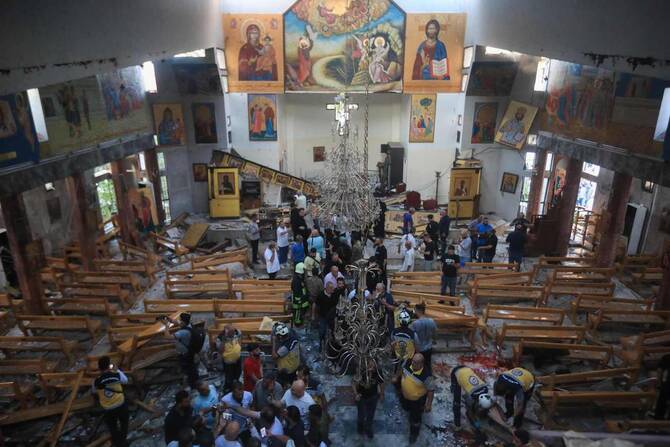
People and rescuers inspect the damage at the site of a reported suicide attack at the Saint Elias church in Damascus’ Dwelaa area on June 22, 2025. (AFP)
2 / 2
People and rescuers inspect the damage at the site of a reported suicide attack at the Saint Elias church in Damascus’ Dwelaa area on June 22, 2025. (AFP)
Short Url
Updated 23 June 2025
Follow

Suicide bombing at Damascus church kills at least 22, UN Syria envoy shares ‘outrage’

  • Incident marks the first suicide bombing inside Damascus since Bashar Assad was toppled in December

DAMASCUS: At least 22 people were killed and more than 50 injured when a suicide bomber blew himself up at the Mar Elias Church in the Dweila neighborhood of Syria’s capital Damascus on Sunday, security sources said.

The incident marks the first suicide bombing inside Damascus since Bashar Assad was toppled in December.

Syria’s interior ministry said the suicide bomber was a member of Daesh. He entered the church, opened fire and then detonated his explosive vest, the ministry added in a statement.

A security source, speaking on condition of anonymity, said two men were involved in the attack, including the one who blew himself up.

Syria’s state news agency had previously cited the health ministry as putting the preliminary casualty toll at nine dead and 13 injured.

A livestream from the site by Syria’s civil defense, the White Helmets, showed scenes of destruction from within the church, including a bloodied floor and shattered church pews and masonry.

Syrian President Ahmed Al-Sharaa, who led the offensive against Assad before taking over in January for a transitional phase, has repeatedly said he will protect minorities during his tenure.

The Syrian foreign ministry said the attack was an attempt to undermine coexistence in the multi-sectarian, multi-ethnic country. Syria considers "this criminal act, which targeted members of the Christian community, a desperate attempt to undermine national coexistence and to destabilise the country", the foreign ministry said in a statement.

Turkiye’s foreign ministry said the “treacherous” attack in Damascus aimed to disrupt efforts to achieve stability and security in Syria.
“Our belief is full that the Syrian administration and its people will maintain their unity and solidarity, and continue with determination the battle with terrorist organization wanting to create chaos in the country,” the ministry said in a statement, adding Turkiye would continue supporting Syria.

United Nations Special Envoy for Syria Geir O. Pedersen “condemned in the strongest possible terms” the attack, according to a statement.

He expressed his “outrage” at what he called a “heinous crime.”

The statement said Pedersen took note that the Syrian interim authorities attributed this attack to Daesh and called for a full investigation and action by the authorities.

Pedersen called on all to unite in “rejecting terrorism, extremism, incitement and the targeting of any community in Syria.” 

He sent his deepest condolences to the families of the victims and his hope for the recovery of those injured.

* With AFP


UN alarm at escalating drone attacks, worsening humanitarian crisis in Sudan’s North Kordofan and Darfur

Updated 8 sec ago
Follow

UN alarm at escalating drone attacks, worsening humanitarian crisis in Sudan’s North Kordofan and Darfur

  • El-Obeid, a strategically vital hub linking Khartoum with Darfur region, remains under siege as Rapid Support Forces seeks to consolidate control over critical corridor
  • Number of displaced people sheltering near town of Tawila has grown to 715,000 since RSF attacks on El-Fasher began to intensify last year, says UN spokesperson

NEW YORK CITY: The UN on Tuesday expressed alarm over continuing drone attacks in North Kordofan state, warning that the violence and worsening humanitarian conditions are compounding civilian suffering across Sudan.

El-Obeid, the capital of the state, has experienced a series of intense attacks by the paramilitary Rapid Support Forces, marked by frequent drone strikes targeting key infrastructure across the city.

Government and other public buildings, including the headquarters of the Legislative Council, a police facility, a telecommunications company and a hospital, have sustained significant damage. Last month, drone attacks targeted the city’s power supply and residential neighborhoods, resulting in civilian casualties, including children.

El-Obeid, a strategically vital hub linking Khartoum with Darfur region, remains under siege as the Rapid Support Forces, which has been engaged in a civil war with the Sudanese Armed Forces since April 2023, seeks to consolidate its control over this critical corridor. Since beginning of this month there have been near-daily drone assaults on the city and surrounding areas, including parts of North Kordofan State.

“We continue to be very concerned by the deteriorating humanitarian situation, notably in North Darfur state, and by reports of continuing drone attacks in North Kordofan state,” UN spokesperson Stephane Dujarric told reporters in New York.

Drone attacks targeted El-Obeid for at least three consecutive days beginning on Feb. 20. One strike hit the University of Kordofan’s campus in the city on Monday, causing significant structural damage.

In North Darfur, escalating violence in the area around the border town of Tine has forced civilians to flee into neighboring Chad, Dujarric said, and is constraining humanitarian access.

Humanitarian movements through the Adre border crossing nevertheless are continuing and UN aid officials are maintaining close contact with the governments of Chad and Sudan to ensure the safe and efficient passage of supplies and personnel, as the Adre crossing remains indispensable for humanitarian operations in Darfur, the UN said.

Elsewhere in North Darfur, the area around the town of Tawila has become one of the region’s largest and fastest-growing displacement hubs, Dujarric said. It is hosting more than 715,000 people displaced by attacks last year on El-Fasher and nearby camps. Prior to this mass influx, Tawila’s population was estimated at about 40,000. Now more than half a million displaced people are sheltering at four major sites just outside the town.

The UN’s Children’s Fund has found that more than half of the people in North Darfur are not receiving the minimum daily water requirement for survival, which is set by the World Health Organization at 7.5 liters per person per day. More than 40 percent of latrines are non-functional, more than 80 percent of families lack soap, and only 8 percent of women and girls reported having access to sufficient menstrual hygiene supplies.

Humanitarian agencies are calling for rapid funding, as well as safe and unhindered access for the delivery of aid and the scaling up water and sanitation services in Tawila to prevent further deterioration of the public health conditions there.

The UN’s 2026 Humanitarian Response Plan for Sudan is seeking $2.9 billion in funding to assist more than 20 million people nationwide.