MEMPHIS, Tennessee: A fire that severely damaged a historic Black church that served as the headquarters for a 1968 sanitation workers’ strike, which brought the Rev. Martin Luther King Jr. to Memphis, was intentionally set, investigators said Wednesday.
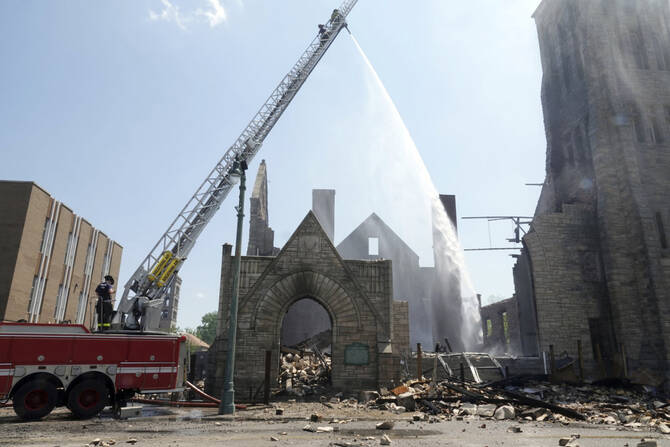
The fire at Clayborn Temple, which was undergoing a yearslong renovation, was set in the interior of the church, the Memphis Fire Department said in a statement. Investigators are searching for a person suspected of being involved with the blaze.
Flames engulfed the downtown church in the early hours of April 28. Later that day Memphis Fire Chief Gina Sweat said the inside of the building was a total loss but there was still hope that some of the facade could be salvaged.
The fire department said on May 14 that the building had been stabilized and investigators would use specialized equipment to study the fire’s cause.
“Clayborn Temple is sacred ground — home to generations of struggle, resilience and creativity,” Anasa Troutman, executive director of Historic Clayborn Temple, said Wednesday. “This act of violence is painful, but it will not break our spirit.”
Located just south of the iconic Beale Street, Clayborn Temple was built in 1892 as the Second Presbyterian Church and originally served an all-white congregation. In 1949 the building was sold to an African Methodist Episcopal congregation and given its current name.
Before the fire it was in the midst of a $25 million restoration project that aims to preserve the architectural and historical integrity of the Romanesque revival church, including the revival of a 3,000-pipe grand organ. The project also seeks to help revitalize the neighborhood with a museum, cultural programing and community outreach.
King was drawn to Memphis in 1968 to support some 1,300 predominantly Black sanitation workers who went on strike to protest inhumane treatment. Two workers had been crushed in a garbage compactor in 1964, but the faulty equipment had not been replaced.
On Feb. 1 of that year, two more men, Echol Cole, 36, and Robert Walker, 30, were crushed in a garbage truck compactor. The two were contract workers, so they did not qualify for worker’s compensation, and had no life insurance.
Workers then went on strike seeking to unionize and fighting for higher pay and safer working conditions. City officials declared the stoppage illegal and arrested scores of strikers and protesters.
Clayborn Temple hosted nightly meetings during the strike, and the movement’s iconic “I AM A MAN” posters were made in its basement. The temple was also a staging point for marches to City Hall, including one on March 28, 1968, that was led by King and turned violent when police and protesters clashed on Beale Street. One person was killed.
When marchers retreated to the temple, police fired tear gas inside and people broke some of the stained-glass windows to escape. King promised to lead a second, peaceful march in Memphis, but he was shot by a sniper while standing on the balcony of the Lorraine Motel on April 4.
After King was assassinated and the strike ended with the workers securing a pay raise, the church’s influence waned. It fell into disrepair and was vacant for years before the renovation effort, which took off in 2017 thanks to a $400,000 grant from the National Park Service.
Clayborn Temple was placed on the National Register of Historic Places in 1979. A memorial to the sanitation workers, named “I AM A MAN Plaza,” opened on church grounds in 2018.
About $8 million had been spent on the renovations before the fire, and the exterior had been fully restored, Troutman said.
She said in a recent interview that two chimneys had to be demolished before investigators from the Bureau of Alcohol, Tobacco, Firearms and Explosives could safely work on the property, but the church organ had been removed before the fire.
As the fire was burning, she said, people went to the “I AM A MAN” memorial and stood at a wall where the names of the striking sanitation workers are listed.
“I watched that wall turn into the Wailing Wall, because people were literally getting out of their cars, walking up to that wall and wailing, staring at the building on fire,” she said.

Fire at historic Black church in Memphis was intentionally set, investigators say
https://arab.news/mqth8
Fire at historic Black church in Memphis was intentionally set, investigators say
- The church was undergoing aenovation when flames engulfed it in the early hours of April 28
- Investigators are searching for a person suspected of being involved with the blaze
Coast Guard is pursuing another tanker helping Venezuela skirt sanctions, US official says
- US oil companies dominated Venezuela’s petroleum industry until the country’s leaders moved to nationalize the sector, first in the 1970s and again in the 21st century under Maduro and his predecessor, Hugo Chávez
WEST PALM BEACH, Florida: The US Coast Guard on Sunday was pursuing another sanctioned oil tanker in the Caribbean Sea as the Trump administration appeared to be intensifying its targeting of such vessels connected to the Venezuelan government.
The pursuit of the tanker, which was confirmed by a US official briefed on the operation, comes after the US administration announced Saturday it had seized a tanker for the second time in less than two weeks.
The official, who was not authorized to comment publicly about the ongoing operation and spoke on the condition of anonymity, said Sunday’s pursuit involved “a sanctioned dark fleet vessel that is part of Venezuela’s illegal sanctions evasion.”
The official said the vessel was flying a false flag and under a judicial seizure order.
The Pentagon and Department of Homeland Security, which oversees the US Coast Guard, deferred questions about the operation to the White House, which did not offer comment on the operation.
Saturday’s predawn seizure of a Panama-flagged vessel called Centuries targeted what the White House described as a “falsely flagged vessel operating as part of the Venezuelan shadow fleet to traffic stolen oil.”
The Coast Guard, with assistance from the Navy, seized a sanctioned tanker called Skipper on Dec. 10, another part of the shadow fleet of tankers that the US says operates on the fringes of the law to move sanctioned cargo. It was not even flying a nation’s flag when it was seized by the Coast Guard.
President Donald Trump, after that first seizure, said that the US would carry out a “blockade” of Venezuela. It all comes as Trump has ratcheted up his rhetoric toward Venezuelan President Nicolás Maduro.
This past week Trump demanded that Venezuela return assets that it seized from US oil companies years ago, justifying anew his announcement of a “blockade” against oil tankers traveling to or from the South American country that face American sanctions.
Trump cited the lost US investments in Venezuela when asked about his newest tactic in a pressure campaign against Maduro, suggesting the Republican administration’s moves are at least somewhat motivated by disputes over oil investments, along with accusations of drug trafficking. Some sanctioned tankers already are diverting away from Venezuela.
US oil companies dominated Venezuela’s petroleum industry until the country’s leaders moved to nationalize the sector, first in the 1970s and again in the 21st century under Maduro and his predecessor, Hugo Chávez. Compensation offered by Venezuela was deemed insufficient, and in 2014, an international arbitration panel ordered the country’s socialist government to pay $1.6 billion to ExxonMobil.
Maduro said in a message Sunday on Telegram that Venezuela has spent months “denouncing, challenging and defeating a campaign of aggression that goes from psychological terrorism to corsairs attacking oil tankers.”
He added: “We are ready to accelerate the pace of our deep revolution!”
Sen. Rand Paul, R-Kentucky, who has been critical of Trump’s Venezuela policy, called the tanker seizures a “provocation and a prelude to war.”
“Look, at any point in time, there are 20, 30 governments around the world that we don’t like that are either socialist or communist or have human rights violations,” Paul said on ABC’s’ “This Week.” ”But it isn’t the job of the American soldier to be the policeman of the world.”
The targeting of tankers comes as Trump has ordered the Defense Department to carry out a series of attacks on vessels in the Caribbean and eastern Pacific Ocean that his administration alleges are smuggling fentanyl and other illegal drugs into the United States and beyond.
At least 104 people have been killed in 28 known strikes since early September. The strikes have faced scrutiny from US lawmakers and human rights activists, who say the administration has offered scant evidence that its targets are indeed drug smugglers and that the fatal strikes amount to extrajudicial killings.
Trump has repeatedly said Maduro’s days in power are numbered. White House chief of staff Susie Wiles said in an interview with Vanity Fair published last week that Trump “wants to keep on blowing boats up until Maduro cries uncle.”
Sen. Tim Kaine, D-Virginia, told NBC’s “Meet the Press” on Sunday that Trump’s use of military to mount pressure on Maduro runs contrary to Trump’s pledge to keep the United States out of unnecessary wars.
Democrats have been pressing Trump to seek congressional authorization for the military action in the Caribbean.
“We should be using sanctions and other tools at our disposal to punish this dictator who is violating the human rights of his civilians and has run the Venezuelan economy into the ground,” Kaine said. “But I’ll tell you, we should not be waging war against Venezuela. We definitely should not be waging war without a vote of Congress.


