

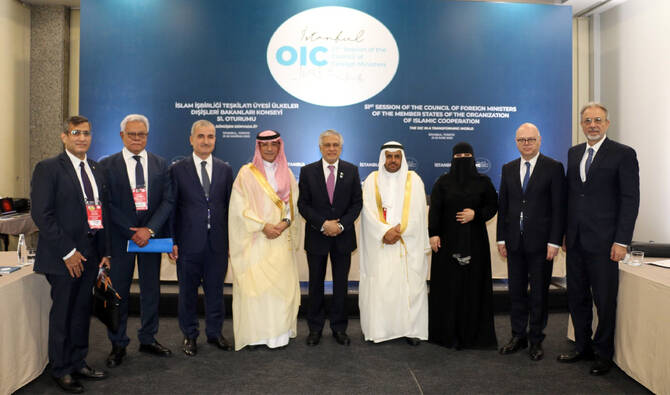

ISLAMABAD: Pakistan’s deputy prime minister has urged the Organization of Islamic Cooperation (OIC) to transform its pronouncements on the disputed Kashmir region into “tangible actions,” the Pakistani foreign office said on Sunday, following a meeting of the OIC Contact Group on Jammu and Kashmir.
The meeting took place on the sidelines of the 51st session of the OIC Council of Foreign Ministers in Istanbul, which came in the backdrop of Israeli military campaign against Iran and Pakistan’s recent military conflict with India.
While Pakistan’s brief standoff with India ended in a ceasefire last month, Israel’s attacks on Iran were followed by US airstrikes on three Iranian nuclear facilities, raising fears of further instability in an already volatile region.
Addressing envoys of OIC member states, Pakistan’s deputy premier and foreign minister, Ishaq Dar, described New Delhi’s actions in Indian-administered Kashmir as a replication of the Israeli designs in Palestine, referring to alleged human rights violations and attempts to change demographics of the disputed Himalayan territory.
“The OIC’s pronouncements on Jammu and Kashmir are a major source of support to the Kashmir cause,” Dar said. “However, in view of the mounting challenges to the Kashmiri struggle, the OIC should transform its pronouncements into tangible actions. The Organization should scale up its efforts for mitigation of the Kashmiri people’s sufferings and finding a just settlement of the Jammu and Kashmir dispute.”
Kashmir has been divided between Pakistan and India since their independence from Britain in 1947. Both countries have fought two of their four wars over the disputed region, which is ruled in part but claimed in its entirety by both India and Pakistan.
The latest conflict between the two neighbors was also triggered by a militant attack in Indian-administered Kashmir’s Pahalgam resort town, which killed 26 tourists on April 22. India blamed the attack on Pakistan, a charge Islamabad denies.
New Delhi has long accused Pakistan of fanning an insurgency on its side of Kashmir. Islamabad denies this and maintains that it only offers moral, political and diplomatic support to the Kashmiris.
Dar said Indian authorities exploited the Pahalgam attack to launch a massive crackdown in Kashmir.
“There are reports that over 2800 Kashmiris were arrested or questioned in the immediate aftermath of the attack,” he said. “The draconian Public Safety Act was slapped on at least 75 of them. The police carried out extensive searches at multiple residences of the locals. Around three dozen houses were razed to ground through the use of explosives.”
The Pakistani deputy PM said the disturbing developments in Indian-administered Kashmir have once again shown that a peaceful settlement of the Kashmir dispute is imperative for a lasting peace in South Asia.
“The region is home to over one-fifth of the world population. It could ill-afford the consequences of irresponsible Indian actions,” he said, urging the OIC and its members to use their influence to urge India to improve the human rights situation, release political prisoners and implement relevant United Nations Security Council resolutions in Indian-administered Kashmir.


