ISLAMABAD: Pakistan on Sunday condemned US airstrikes targeting Iran’s key nuclear facilities, as experts warned that further escalation could push the Middle East toward a wider war with dangerous economic and security consequences for countries like Pakistan.
The strikes, carried out by the US military early Sunday, hit three Iranian nuclear sites at Fordow, Isfahan and Natanz. The attacks came amid Israel’s ongoing campaign against Iran’s nuclear program, which Israeli officials claim is nearing weaponization, an allegation Iran denies, insisting its activities remain peaceful and under international safeguards.
US President Donald Trump warned Tehran against retaliation, saying Washington could target more sites “with precision, speed and skill.” Iran has said it “reserves all options to defend its sovereignty, interest, and people.”
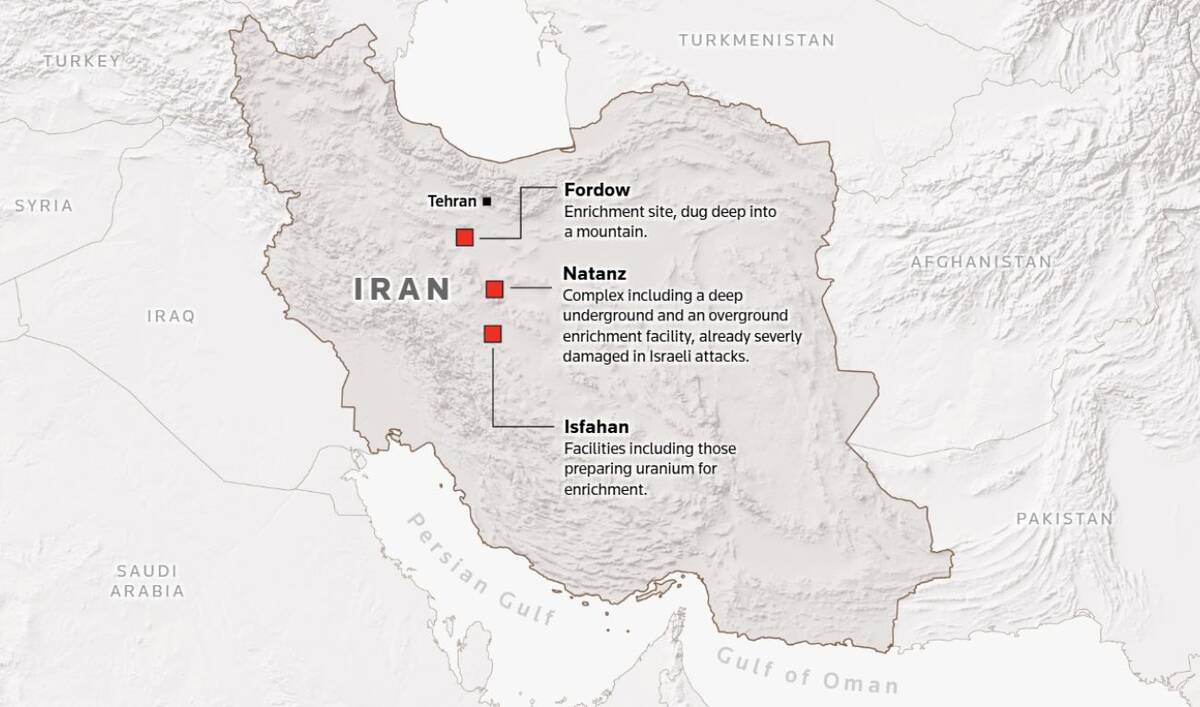
The map outlines main the facilities of Iran's nuclear programme which were targetted by US strikes on June 22, 2025. (Reuters)
In a statement released on Sunday afternoon, Pakistan’s foreign office said it was “gravely concerned at the possible further escalation of tensions in the region” and described the US strikes as a violation of international law.
“Pakistan condemns the US attacks on Iranian nuclear facilities which follow the series of attacks by Israel,” the statement read. “Any further escalation of tensions will have severely damaging implications for the region and beyond.”
Pakistan said Iran had the legitimate right to defend itself under the UN Charter and urged all parties to respect international humanitarian law, protect civilian lives and “immediately bring the conflict to an end.”
“Recourse to dialogue, diplomacy, in line with the principles and purposes of the UN Charter remain the only viable pathway to resolve the crises in the region,” the statement added.
Tensions flared on June 13 when Israel launched airstrikes against what it described as Iran’s military leadership and nuclear infrastructure. Iran, a signatory to the Treaty on the Non-Proliferation of Nuclear Weapons (NPT), has since retaliated with missile attacks on Israeli targets. The United States, Israel’s closest ally, has now directly joined the campaign.
Experts warn the latest US strikes undermine global arms control norms and would have both economic and security implications for Pakistan.
Dr. Rabia Akhtar, an expert on nuclear security, said attacking a safeguarded nuclear program “destroyed the very space diplomacy depends on.”
“If the response to nuclear restraint is pre-emptive force, you normalize the idea that only the bomb ensures sovereignty,” she said.
Syed Ali Zia Jaffery, deputy director at the Center for Security, Strategy and Policy Research at the University of Lahore, said the latest US strikes had dealt a “severe blow” to the Treaty on the Non-Proliferation of Nuclear Weapons (NPT).
“Iran, which is a party to the NPT, might decide to leave that treaty which will be a massive loss for the non-proliferation regime,” Jaffery told Arab News.
He said Tehran now had the right under international law to target US installations in the Middle East and could step up attacks on Israel in response. Jaffery also warned that if Iran were to block the Strait of Hormuz, it would have “serious consequences” for the global economy.
Indeed, a wider Middle East conflict could disrupt oil shipments through the Strait of Hormuz, through which about one-fifth of global oil passes, adding to price pressures for Pakistan, which relies heavily on imported fuel.
“More than 30 percent of the energy transits through the strait and one should expect an astronomical rise in oil prices and other tradables passing through the Strait of Hormuz,” said Pakistan’s former ambassador to Iran, Asif Durrani.
Instability could also spill over Pakistan’s 900-kilometer border with Iran in Balochistan, an area prone to separatist militancy and cross-border attacks by armed groups.
The crisis also raises questions about how Islamabad will navigate its delicate balancing act between Iran, other Gulf partners, and the United States, which remains one of Pakistan’s largest trading partners and a critical source of military and economic assistance. How Pakistan manages these competing ties amid an escalating regional conflict could test its diplomacy in the coming weeks.