
WASHINGTON: A US-led group has asked the Trump administration to step in with an initial $30 million so it can continue its much scrutinized and Israeli-backed aid distribution in Gaza, according to three US officials and the organization’s application for the money.
That application, obtained by The Associated Press, also offers some of the first financial details about the Gaza Humanitarian Foundation and its work in the territory.
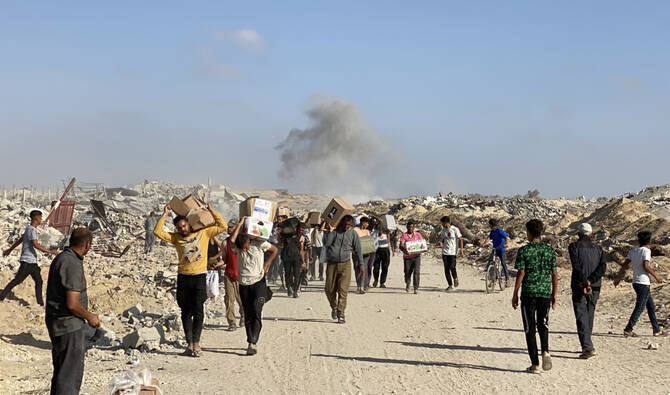
The foundation says it has provided millions of meals in southern Gaza since late May to Palestinians as Israel’s blockade and military campaign have driven the Gaza to the brink of famine.
But the effort has seen near-daily fatal shootings of Palestinians trying to reach the distribution sites. Major humanitarian groups also accuse the foundation of cooperating with Israel’s objectives in the 20-month-old war against Hamas in a way that violates humanitarian principles.
The group’s funding application was submitted to the US Agency for International Development, according to the US officials, who were not authorized to discuss the matter publicly and spoke on condition of anonymity.
The application was being processed this week as potentially one of the agency’s last acts before the Republican administration absorbs USAID into the State Department as part of deep cuts in foreign assistance.
Two of the officials said they were told the administration has decided to award the money. They said the processing was moving forward with little of the review and auditing normally required before Washington makes foreign assistance grants to an organization.
In a letter submitted Thursday as part of the application, Gaza Humanitarian Foundation secretary Loik Henderson said his organization “was grateful for the opportunity to partner with you to sustain and scale life-saving operations in Gaza.”
Neither the State Department nor Henderson immediately responded to requests for comment Saturday.
Israel says the foundation is the linchpin of a new aid system to wrest control from the United Nations, which Israel alleges has been infiltrated by Hamas, and other humanitarian groups. The foundation’s use of fixed sites in southern Gaza is in line with Israeli Prime Minister Benjamin Netanyahu’s plan to use aid to concentrate the territory’s more than 2 million people in the south, freeing Israel to fight Hamas elsewhere.
Aid workers fear it’s a step toward another of Netanyahu’s public goals, removing Palestinians from Gaza in “voluntary” migrations that aid groups and human rights organizations say would amount to coerced departures.
The UN and many leading nonprofit groups accuse the foundation of stepping into aid distribution with little transparency or humanitarian experience, and, crucially, without a commitment to the principles of neutrality and operational independence in war zones.
Since the organization started operations, several hundred Palestinians have been killed and hundreds more wounded in near-daily shootings as they tried to reach aid sites, according to Gaza’s Health Ministry. Witnesses say Israeli troops regularly fire heavy barrages toward the crowds in an attempt to control them.
The Israeli military has denied firing on civilians. It says it fired warning shots in several instance, and fired directly at a few “suspects” who ignored warnings and approached its forces.
It’s unclear who is funding the new operation in Gaza. No donor has come forward. The State Department said this past week that the United States is not funding it.
In documents supporting its application, the group said it received nearly $119 million for May operations from “other government donors,” but gives no details. It expects $38 million from those unspecific government donors for June, in addition to the hoped-for $30 million from the United States.
The application shows no funding from private philanthropy or any other source.