Cyprus arrests British man on suspicion of terror-related plot, police say
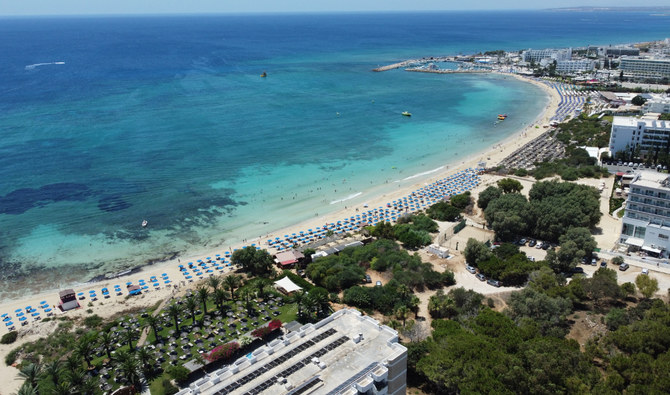
Cyprus police said they arrested an individual on espionage and terror charges on Saturday, with local media reporting the suspect had ties to Iran. (AFP/File)
Short Url
Updated 21 June 2025
Follow

Cyprus arrests British man on suspicion of terror-related plot, police say

  • The man appeared before a district court on Saturday
  • Israeli Foreign Minister Gideon Saar said in a post on X that an Iranian attempt to attack Israeli citizens in Cyprus was thwarted

NICOSIA: Police in Cyprus have arrested a British man on suspicion of terror-related offenses and espionage, authorities said on Saturday, with Israel accusing Iran’s Revolutionary Guards of trying to attack Israeli citizens on the island.

The man appeared before a district court on Saturday, which ordered an eight-day detention pending inquiries.

Police gave no further details, citing national security.

Israeli Foreign Minister Gideon Saar said in a post on X that an Iranian attempt to attack Israeli citizens in Cyprus was thwarted, “thanks to the activity of the Cypriot security authorities, in cooperation with Israeli security services.”

He gave no more details about the nature of the attack, and there was no immediate comment from Iranian authorities.

A spokesperson for Britain’s Foreign Office confirmed the individual’s nationality, saying it was in contact with local authorities.

“We are in contact (with) the authorities in Cyprus regarding the arrest of a British man,” the spokesperson told Reuters.

Several Cypriot news outlets reported the suspect was a man of Azeri ethnic descent and had been arrested in the Zakaki suburb of the coastal city of Limassol. The suspect was thought to have had a British RAF military base in nearby Akrotiri under surveillance, as well as Cyprus’s own Andreas Papandreou Air Base in the western region of Paphos since mid-April, Cyprus’s ANT1 news portal reported.

Cyprus lies very close to the Middle East and has in recent days been used as a transit point for people either leaving or going to the region amid the conflict between regional foes Israel and Iran.

Terror-related offenses on the island are very rare.


Saudi Arabia increasingly concerned by Israel’s impact on regional instability: Experts

Updated 13 sec ago
Follow

Saudi Arabia increasingly concerned by Israel’s impact on regional instability: Experts

  • Middle East Institute hosts panel discussion attended by Arab News

CHICAGO: Experts on Wednesday noted Saudi Arabia’s increased concern over Israel’s regional conduct during a panel discussion hosted by the Middle East Institute and attended by Arab News.

F. Gregory Gause III, professor emeritus of international affairs at the Bush School of Government at Texas A&M University, said Israel rather than Iran has become the more immediate worry for the Kingdom.

“I think there’s a real worry that post-Oct. 7 it’s the Israelis, not the Iranians, who might be the fomenters of instability in Syria, in Lebanon, even with the attack on Doha,” he said.

Saudi Arabia’s priority is achieving “stability in the region,” and it believes that closer relations with the US can achieve that, he added.

Former US Ambassador to Saudi Arabia Michael Ratney said the Kingdom’s concerns have pushed it to seek closer ties to the US through President Donald Trump, who has been more responsive than his predecessor Joe Biden.

During his recent visit to Washington, Crown Prince Mohammed bin Salman “got everything he wanted” for Saudi Arabia’s interests, Ratney said, adding that his priority is to make the Kingdom a lynchpin of regional stability.

The Saudis “are more positive about the relationship with the US than I think a lot of people here realize,” Ratney said. “They genuinely want their entire strategic outlook anchored in the US.”

Dr. Karen E. Young, a senior MEI fellow, said the Saudis have a growing concern for how regional instability impacts their economic advances under the Vision 2030 reform plan.

“Certainly there’s concern for the neighborhood, but in new ways and more geared toward what instability in the region means for economic development, tourism, logistics, trade and even connectivity, whether it’s in trading and selling electricity or perhaps in the transfer of data,” she added. “So they need calm, and that means on both sides of the Red Sea.”