

India says it will never restore Indus Waters Treaty with Pakistan

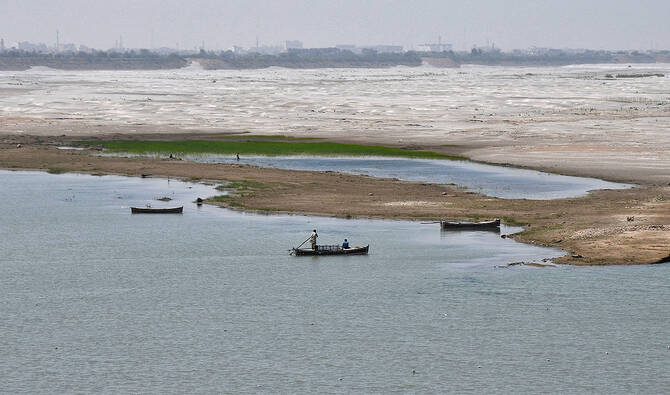
A man navigates a boat in the water next to the dry riverbed of the Indus River in Hyderabad, Pakistan, on April 25, 2025. (REUTERS/File)
Short Url
Updated 21 June 2025
Follow

India says it will never restore Indus Waters Treaty with Pakistan

  • India put into ‘abeyance’ its participation in the 1960 treaty, which governs usage of the Indus river system
  • The treaty had guaranteed water access for 80 percent of Pakistan’s farms through three rivers originating in India

NEW DELHI: India will never restore the Indus Waters Treaty with Islamabad and the water flowing to Pakistan will be diverted for internal use, Home Minister Amit Shah said in an interview with Times of India on Saturday.

India put into “abeyance” its participation in the 1960 treaty, which governs the usage of the Indus river system, after 26 civilians in Indian-administered Kashmir were killed in what Delhi described as an act of terror. The treaty had guaranteed water access for 80 percent of Pakistan’s farms through three rivers originating in India.

Pakistan has denied involvement in the incident, but the accord remains dormant despite a ceasefire agreed upon by the two nuclear-armed neighbors last month following their worst fighting in decades.

“No, it will never be restored,” Shah told the daily.

“We will take water that was flowing to Pakistan to Rajasthan by constructing a canal. Pakistan will be starved of water that it has been getting unjustifiably,” Shah said, referring to the northwestern Indian state.

The latest comments from Shah, the most powerful cabinet minister in Prime Minister Narendra Modi’s cabinet, have dimmed Islamabad’s hopes for negotiations on the treaty in the near term.

Last month, Reuters reported that India plans to dramatically increase the water it draws from a major river that feeds Pakistani farms downstream, as part of retaliatory action.

Pakistan’s foreign ministry did not immediately respond to Reuters’ request for comments.

But it has said in the past that the treaty has no provision for one side to unilaterally pull back and that any blocking of river water flowing to Pakistan will be considered “an act of war.”

Islamabad is also exploring a legal challenge to India’s decision to hold the treaty in abeyance under international law.


ADB approves $381 million for climate-resilient agriculture, social services in Punjab

Updated 8 sec ago
Follow

ADB approves $381 million for climate-resilient agriculture, social services in Punjab

  • Support will upgrade Punjab’s education and nursing systems, improving learning outcomes and health care capacity
  • Package includes $124 million for agriculture, $107 million for STEM schooling and $150 million for nursing reforms

KARACHI: The Asian Development Bank (ADB) said on Saturday it approved $381 million in financing for Pakistan’s Punjab province to modernize agriculture and strengthen education and health services, with a major focus on building climate resilience after monsoon floods this year caused widespread destruction across the country’s most populous province.

The package includes concessional loans and grants for farm mechanization, STEM education, and nursing sector reforms.

ADB said the investments are intended to help Punjab, home to more than half of Pakistan’s population and a key contributor to its economy, recover from climate shocks and transition toward more sustainable and resilient development.

“Investing in education, health, and agricultural mechanization will play a transformative role in driving the growth of Punjab, a vital pillar of Pakistan’s economy,” said ADB Country Director for Pakistan Emma Fan. “These strategic investments will modernize agriculture, enhance human capital, and significantly improve livelihoods for millions of people across Punjab.”

The bank approved $120 million in concessional loans and a $4 million grant for the Punjab Climate-Resilient and Low-Carbon Agriculture Mechanization Project, which will support 220,000 rural farm households.

The program aims to reduce climate vulnerability by shifting farmers toward modern, low-emission machinery, provide alternative livelihoods for agricultural workers and train 15,000 women in new skills. It will also introduce a financing model to help small farmers access advanced equipment.

Punjab produces most of Pakistan’s wheat, rice, and maize but still relies on outdated machinery, contributing to grain losses and routine burning of crop residues, a major source of air pollution, said ADB.

It noted the new project will promote modern mechanization, including rice harvesters, to address these issues.

ADB also approved $107 million for the Responsive, Ready, and Resilient STEM Secondary Education in Punjab Program, including a $7 million grant from the Asian Development Fund.

The results-based program aims to modernize secondary schooling by expanding inclusive STEM education, improving access and quality across the province.

A further $150 million concessional loan was approved for the Punjab Nursing and Health Workforce Reform Program, which will upgrade nursing curricula, develop disaster-resilient training facilities, strengthen workforce governance, and introduce digital human-resource systems.

The program seeks to expand the pool of qualified nurses to strengthen health service delivery and meet rising national and global demand.

Key components include the establishment of three centers of excellence in Lahore, Multan and Rawalpindi, equipped with simulation labs, digital learning platforms, and gender-responsive hostels.

ADB said it remains committed to supporting climate-resilient and inclusive development across Asia and the Pacific through innovative financing tools and partnerships.