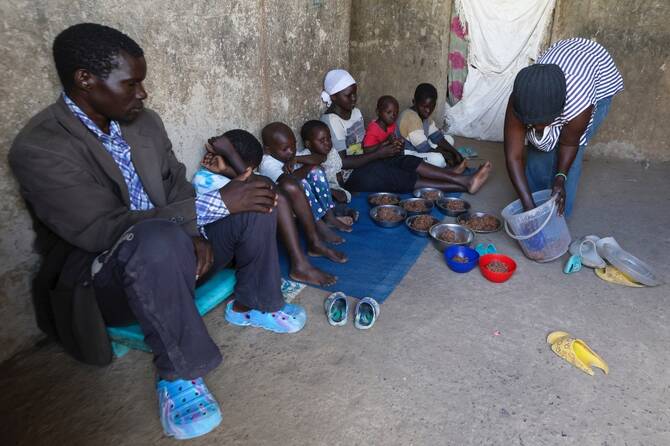
KAKUMA: At a refugee camp in northern Kenya, Aujene Cimanimpaye waits as a hot lunch of lentils and sorghum is ladled out for her and her nine children — all born while she has received United Nations assistance since fleeing her violence-wracked home in Congo in 2007.
“We cannot go back home because people are still being killed,” the 41-year-old said at the Kakuma camp, where the UN World Food Program and UN refugee agency help support more than 300,000 refugees.
Her family moved from Nakivale Refugee Settlement in neighboring Uganda three years ago to Kenya, now home to more than a million refugees from conflict-hit east African countries.
A few kilometers (miles) away at the Kalobeyei Refugee Settlement, fellow Congolese refugee Bahati Musaba, a mother of five, said that since 2016, “UN agencies have supported my children’s education — we get food and water and even medicine,” as well as cash support from WFP to buy food and other basics.
This year, those cash transfers — and many other UN aid activities — have stopped, threatening to upend or jeopardize millions of lives.
As the UN marks its 80th anniversary this month, its humanitarian agencies are facing one of the greatest crises in their history: The biggest funder — the United States — under the Trump administration and other Western donors have slashed international aid spending. Some want to use the money to build up national defense.
Some UN agencies are increasingly pointing fingers at one another as they battle over a shrinking pool of funding, said a diplomat from a top donor country who spoke on condition of anonymity to comment freely about the funding crisis faced by some UN agencies.
Such pressures, humanitarian groups say, diminish the pivotal role of the UN and its partners in efforts to save millions of lives — by providing tents, food and water to people fleeing unrest in places like Myanmar, Sudan, Syria and Venezuela, or helping stamp out smallpox decades ago.
“It’s the most abrupt upheaval of humanitarian work in the UN in my 40 years as a humanitarian worker, by far,” said Jan Egeland, a former UN humanitarian aid chief who now heads the Norwegian Refugee Council. “And it will make the gap between exploding needs and contributions to aid work even bigger.”
‘Brutal’ cuts to humanitarian aid programs
UN Secretary-General Antonio Guterres has asked the heads of UN agencies to find ways to cut 20 percent of their staffs, and his office in New York has floated sweeping ideas about reform that could vastly reshape the way the United Nations doles out aid.
Humanitarian workers often face dangers and go where many others don’t — to slums to collect data on emerging viruses or drought-stricken areas to deliver water.
The UN says 2024 was the deadliest year for humanitarian personnel on record, mainly due to the war in Gaza. In February, it suspended aid operations in the stronghold of Yemen’s Houthi rebels, who have detained dozens of UN and other aid workers.
Proponents say UN aid operations have helped millions around the world affected by poverty, illness, conflict, hunger and other troubles.
Critics insist many operations have become bloated, replete with bureaucratic perks and a lack of accountability, and are too distant from in-the-field needs. They say postcolonial Western donations have fostered dependency and corruption, which stifles the ability of countries to develop on their own, while often UN-backed aid programs that should be time-specific instead linger for many years with no end in sight.
In the case of the Nobel Peace Prize-winning WFP and the UN’s refugee and migration agencies, the US has represented at least 40 percent of their total budgets, and Trump administration cuts to roughly $60 billion in US foreign assistance have hit hard. Each UN agency has been cutting thousands of jobs and revising aid spending.
“It’s too brutal what has happened,” said Egeland, alluding to cuts that have jolted the global aid community. “However, it has forced us to make priorities ... what I hope is that we will be able to shift more of our resources to the front lines of humanity and have less people sitting in offices talking about the problem.”
With the UN Security Council’s divisions over wars in Ukraine and the Middle East hindering its ability to prevent or end conflict in recent years, humanitarian efforts to vaccinate children against polio or shelter and feed refugees have been a bright spot of UN activity. That’s dimming now.
Not just funding cuts cloud the future of UN humanitarian work
Aside from the cuts and dangers faced by humanitarian workers, political conflict has at times overshadowed or impeded their work.
UNRWA, the aid agency for Palestinian refugees, has delivered an array of services to millions — food, education, jobs and much more — in Lebanon, Syria and Jordan as well as in the West Bank and Gaza since its founding in 1948.
Israel claims the agency’s schools fan antisemitic and anti-Israel sentiment, which the agency denies. Israel says Hamas siphons off UN aid in Gaza to profit from it, while UN officials insist most aid gets delivered directly to the needy.
“UNRWA is like one of the foundations of your home. If you remove it, everything falls apart,” said Issa Hajj Hassan, 38, after a checkup at a small clinic at the Mar Elias Palestinian refugee camp in Beirut.
UNRWA covers his diabetes and blood pressure medication, as well as his wife’s heart medicine. The United States, Israel’s top ally, has stopped contributing to UNRWA; it once provided a third of its funding. Earlier this year, Israel banned the aid group, which has strived to continue its work nonetheless.
Ibtisam Salem, a single mother of five in her 50s who shares a small one-room apartment in Beirut with relatives who sleep on the floor, said: “If it wasn’t for UNRWA we would die of starvation. ... They helped build my home, and they give me health care. My children went to their schools.”
Especially when it comes to food and hunger, needs worldwide are growing even as funding to address them shrinks.
“This year, we have estimated around 343 million acutely food insecure people,” said Carl Skau, WFP deputy executive director. “It’s a threefold increase if we compare four years ago. And this year, our funding is dropping 40 percent. So obviously that’s an equation that doesn’t come together easily.”
Billing itself as the world’s largest humanitarian organization, WFP has announced plans to cut about a quarter of its 22,000 staff.
The aid landscape is shifting
One question is how the United Nations remains relevant as an aid provider when global cooperation is on the outs, and national self-interest and self-defense are on the upswing.
The United Nations is not alone: Many of its aid partners are feeling the pinch. Groups like GAVI, which tries to ensure fair distribution of vaccines around the world, and the Global Fund, which spends billions each year to help battle HIV, tuberculosis and malaria, have been hit by Trump administration cuts to the US Agency for International Development.
Some private-sector, government-backed groups also are cropping up, including the divisive Gaza Humanitarian Foundation, which has been providing some food to Palestinians. But violence has erupted as crowds try to reach the distribution sites.
No private-sector donor or well-heeled country — China and oil-rich Gulf states are often mentioned by aid groups — have filled the significant gaps from shrinking US and other Western spending.
The future of UN aid, experts say, will rest where it belongs — with the world body’s 193 member countries.
“We need to take that debate back into our countries, into our capitals, because it is there that you either empower the UN to act and succeed — or you paralyze it,” said Achim Steiner, administrator of the UN Development Program.


As the UN turns 80, its crucial humanitarian aid work faces a clouded future
https://arab.news/nm7br
As the UN turns 80, its crucial humanitarian aid work faces a clouded future

- Aside from the cuts and dangers faced by humanitarian workers, political conflict has at times overshadowed or impeded their work


Rohingya refugees hope new leaders can pave a path home
- Some 1.7 million Rohingya Muslims displaced in Myanmar's military crackdown live in squalid camps in Cox’s Bazar, Bangladesh
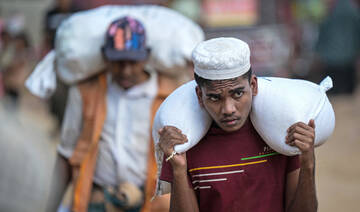
COX’S BAZAR, Bangladesh: Rohingya refugees living in squalid camps in Bangladesh have elected a leadership council, hoping it can improve conditions and revive efforts to secure their return home to Myanmar.
Spread over 8,000 acres in Cox’s Bazar in Bangladesh, the camps are home to 1.7 million members of the stateless group, many of whom fled a 2017 military crackdown that is now subject to a genocide probe at the UN court.
In July, the refugees held their first elections since their influx began eight years ago, resulting in the formation of the United Council of Rohang (UCR).
“They are working to take us home,” said Khairul Islam, 37, who back home had a thriving timber business.
The new council has brought him a glimmer of hope amid an uncertain future.
“We can hardly breathe in these cramped camp rooms... all our family members live in a single room,” he said.
“It’s unbearably hot inside. Back in Myanmar, we didn’t even need a ceiling fan. In summer, we used to sit under tall trees,” Islam said, his eyes welling up.
More than 3,000 voters from across 33 refugee camps cast their ballots to elect an executive committee and five rotating presidents to focus on human rights, education and health.
Addressing a gathering at one of the camps, UCR president Mohammad Sayed Ullah urged refugees not to forget the violence that forced the mostly Muslim group to flee Myanmar’s Rakhine state.
“Never forget that we left our parents’ graves behind. Our women died on the way here. They were tortured and killed... and some drowned at sea,” said Sayed Ullah, dressed in a white full-sleeved shirt and lungi.
“We must prepare ourselves to return home,” he said, prompting members of the audience to nod in agreement.
A seat at the table
“UCR wants to emerge as the voice of the Rohingyas on the negotiation table,” Sayed Ullah later told AFP.
“It’s about us, yet we were nowhere as stakeholders.”
The council is not the first attempt to organize Rohingya refugees.
Several groups emerged after 2017, including the Arakan Rohingya Society for Peace and Human Rights, once led by prominent activist Mohib Ullah.
But he was murdered in 2021.
And even before that, many organizations were shut down after a major 2019 rally, when the Rohingya said they would go home only with full rights and safety guarantees.
“Some newspapers misrepresented us, claiming we wanted to stay permanently in Bangladesh,” Sayed Ullah said.
“Many organizers were detained. The hardest blow was the assassination of Mohib Ullah.”
But trust is slowly building up again among the Rohingya crammed in the camps in Cox’s Bazar.
“Of course we will return home,” said 18-year-old Mosharraf, who fled the town of Buthidaung with his family.
“UCR will negotiate for better education. If we are better educated, we can build global consensus for our return,” he told AFP.
Security threats
Many refugees have started approaching the body with complaints against local Rohingya leaders, reflecting a slow but noticeable shift in attitudes.
On a recent sunny morning, an AFP reporter saw more than a dozen Rohingya waiting outside the UCR office with complaints.
Some said they were tortured while others reported losing small amounts of gold they had carried while fleeing their homes.
Analysts say it remains unclear whether the new council can genuinely represent the Rohingya or if it ultimately serves the interests of Bangladeshi authorities.
“The UCR ‘elections’ appear to have been closely controlled by the authorities,” said Thomas Kean, senior consultant at the International Crisis Group.
Security threats also loom large, undermining efforts to forge political dialogue.
Armed groups like the Arakan Rohingya Salvation Army and Rohingya Solidarity Organization continue to operate in the camps.
A report by campaign group Fortify Rights said at least 65 Rohingyas were killed in 2024.
“Violence and killings in the Rohingya camps need to stop, and those responsible must be held to account,” the report quoted activist John Quinley as saying.