

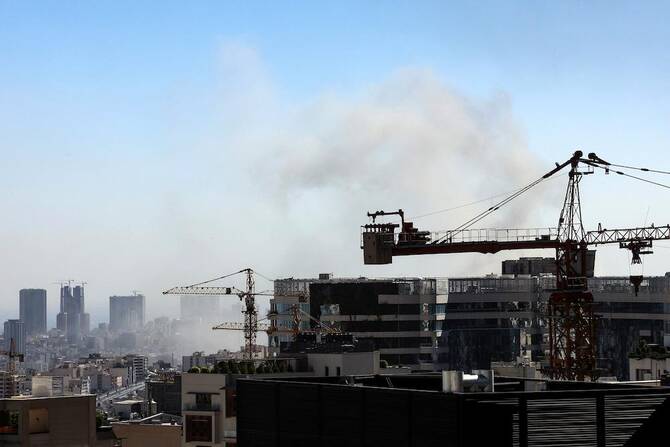

JERUSALEM: Israel said Saturday it had killed three Iranian commanders in its unprecedented bombing campaign across the Islamic republic, which Foreign Minister Gideon Saar claimed had already delayed Tehran’s presumed nuclear plans by two years.
Israel’s military said its fighter jets successfully targeted top Iranian official Saeed Izadi, in charge of coordination with Palestinian militant group Hamas, in Qom south of Tehran and announced the deaths of two other commanders from Iran’s Revolutionary Guards.
As Israel continued to strike Iran’s nuclear facilities and military targets, Israeli Foreign Minister Gideon Saar said in an interview that by the country’s own assessment, it had “already delayed for at least two or three years the possibility for them to have a nuclear bomb.”
“We will do everything that we can do there in order to remove this threat,” Saar told German newspaper Bild, asserting Israel’s onslaught would continue.
Israel and Iran have traded wave after wave of devastating strikes, after Israel launched its aerial campaign on June 13, saying Tehran was on the verge of developing a nuclear weapon — an ambition Iran has denied.
Israel said it had attacked Iran’s Isfahan nuclear site for a second time after its air force said it had also launched salvos against missile storage and launch sites in central Iran.
The military later said it struck military infrastructure in southwest Iran.
US President Donald Trump warned on Friday that Tehran has a “maximum” of two weeks to avoid possible American air strikes, as Washington weighs whether to join Israel’s unprecedented bombing campaign.
Iranian Foreign Minister Abbas Araghchi arrived in Istanbul on Saturday, for a meeting of the Organization of Islamic Cooperation to discuss the conflict.
Top diplomats from Britain, France and Germany met Araghchi in Geneva on Friday, and urged him to resume talks with the United States that had been derailed by Israel’s attacks.
But Araghchi told NBC News after the meeting that “we’re not prepared to negotiate with them (the United States) anymore, as long as the aggression continues.”
Trump was dismissive of European diplomatic efforts, telling reporters, “Iran doesn’t want to speak to Europe. They want to speak to us. Europe is not going to be able to help in this.”
Trump also said he is unlikely to ask Israel to stop its attacks to get Iran back to the table.
“If somebody’s winning, it’s a little bit harder to do,” he said.
Any US involvement would likely feature powerful bunker-busting bombs that no other country possesses to destroy an underground uranium enrichment facility in Fordo.
A US-based NGO, the Human Rights Activists News Agency, said on Friday that based on its sources and media reports at least 657 people have been killed in Iran, including 263 civilians.
Iran’s health ministry said on Saturday at least 350 people had been killed in the Israeli strikes including military commanders, nuclear scientists and civilians.
Nasrin, 39, who gave only her first name, explained she had been thrown across a room in her Tehran home by an Israeli strike.
“I just hit the wall. I don’t know how long I was unconscious. When I woke up, I was covered in blood from head to toe,” she said as she received treatment at Hazrat Rasool hospital in the Iranian capital.
Traffic police and Fars news agency reported congestion on roads into Tehran on Saturday, indicating some inhabitants were returning to the capital.
Internet access remained highly unstable and limited in Tehran on Saturday, with slow connections and many sites still inaccessible, according to AFP journalists.
Iran’s retaliatory strikes have killed at least 25 people, in Israel, according to official figures.
Overnight, Iran said it targeted central Israel with drones and missiles.
Israeli rescuers said there were no casualties after an Iranian missile struck a residential building in Beit She’an.
At the site of the strike in the north of Israel, mounds of soil had been gouged from the ground and the wall of a ground-floor room destroyed.
Israel’s National Public Diplomacy Directorate said more than 450 missiles have been fired at the country so far, along with about 400 drones.
Iran’s Revolutionary Guards said they had targeted military sites and air force bases.
Western powers have repeatedly expressed concerns about the rapid expansion of Iran’s nuclear program, questioning in particular the country’s accelerated uranium enrichment.
The International Atomic Energy Agency’s chief Rafael Grossi has said that Iran is the only country without nuclear weapons to enrich uranium to 60 percent.
However, it added that there was no evidence Tehran had all the components to make a functioning nuclear warhead.
Grossi told CNN it was “pure speculation” to say how long it would take Iran to develop weapons.


