

Israel may have breached EU pact, bloc’s foreign policy arm says

1 / 2
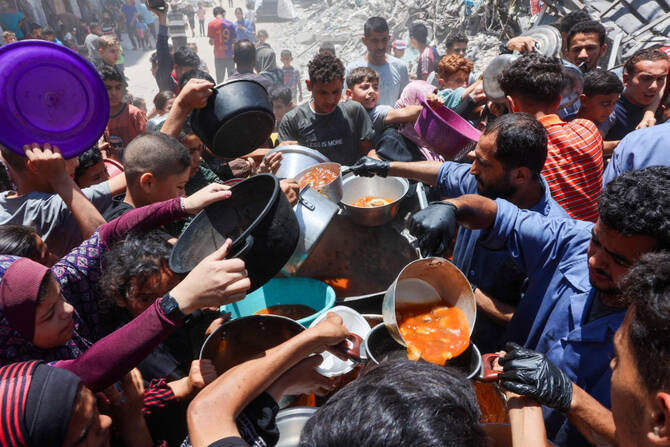
Palestinians try to get food at a charity kitchen providing hot meals in Rimal neighborhood in Gaza City on June 18, 2025, amid the ongoing war between Israel and the Palestinian Hamas movement. (AFP)
2 / 2
Palestinians carry sacks and boxes of food and humanitarian aid that was unloaded from a World Food Program convoy that had been heading to Gaza City in the northern Gaza Strip on June 16, 2025. (AP)
Short Url
Updated 21 June 2025
Follow

Israel may have breached EU pact, bloc’s foreign policy arm says

  • EU-Israel pact requires “respect for human rights and democratic principles” for both sides
  • EU foreign ministers are set to discuss the review during a gathering in Brussels on Monday

BRUSSELS: The European Union’s diplomatic service said on Friday there were indications that Israel had breached its human rights obligations under the terms of a pact governing its ties with the bloc, according to a document seen by Reuters.

Citing assessments by independent international institutions, the European External Action Service said “there are indications that Israel would be in breach of its human rights obligations under Article 2 of the EU-Israel Association Agreement.”

The report comes after months of deepening concern in European capitals about Israel’s operations in Gaza and the humanitarian situation in the enclave.

“Israel’s continued restrictions to the provision of food, medicines, medical equipment, and other vital supplies affect the entire population of Gaza present on the affected territory,” the document said.


Palestinians try to get food at a charity kitchen providing hot meals in Rimal neighborhood in Gaza City on June 18, 2025, amid the ongoing war between Israel and the Palestinian Hamas movement. (AFP)

Asked about the EU review, an Israeli official called it “a one-sided report that exemplifies the double standards the EU uses toward Israel.”

Under the EU-Israel Association Agreement, which came into force in 2000, the EU and Israel agreed that their relationship “shall be based on respect for human rights and democratic principles.”

The EU’s top diplomat, Kaja Kallas, announced in May that the bloc would examine whether Israel was complying with the terms of the pact, after over half of EU members backed the conducting of a review.

The report includes a section dedicated to the situation in Gaza, covering issues related to denial of humanitarian aid, attacks with a significant number of casualties, attacks on hospitals and medical facilities, displacement, and lack of accountability.


Mourners carry a body for burial outside al-Awda hospital in Nuseirat camp in central Gaza, on June 20, 2025, after several Palestinians were killed as they reportedly headed to a food distribution centre in the war-stricken Gaza Strip. (AFP)

The report also looks at the situation in the West Bank, including settler violence.

The document relies on “facts verified by and assessments made by independent international institutions, and with a focus on most recent events in Gaza and the West Bank,” it said.

Israel has said that it respects international law and that operations in Gaza are necessary to destroy Hamas, the Palestinian group responsible for the Oct. 7, 2023, attacks on Israel.

EU foreign ministers are set to discuss the review during a gathering in Brussels on Monday. Member countries remain divided in their approach to Israel.

While some ministers could advocate for moving toward taking action based on the review, no concrete decisions are expected at Monday’s session.

Diplomats expect EU officials will reach out to Israel with the outcome of the review in an effort to influence it, and that ministers will return to the subject during a July meeting.


Palestinians attempt to use Gaza’s Rafah Border crossing amidst delays

Updated 08 February 2026
Follow

Palestinians attempt to use Gaza’s Rafah Border crossing amidst delays

  • The Rafah Crossing opened to a few Palestinians in each direction last week, after Israel retrieved the body of the last hostage held in Gaza and several American officials visited Israel to press for the opening

CAIRO: Palestinians on both sides of the crossing between Gaza and Egypt, which opened last week for the first time since 2024, were making their way to the border on Sunday in hopes of crossing, one of the main requirements for the US-backed ceasefire. The opening comes as Prime Minister Benjamin Netanyahu is expected to travel to Washington this week, though the major subject of discussion will be Iran, his office said.
The Rafah Crossing opened to a few Palestinians in each direction last week, after Israel retrieved the body of the last hostage held in Gaza and several American officials visited Israel to press for the opening. Over the first four days of the crossing’s opening, just 36 Palestinians requiring medical care were allowed to leave for Egypt, plus 62 companions, according to United Nations data.
Palestinian officials say nearly 20,000 people in Gaza are seeking to leave for medical care that they say is not available in the war-shattered territory. The few who have succeeded in crossing described delays and allegations of mistreatment by Israeli forces and other groups involved in the crossing, including and an Israeli-backed Palestinian armed group, Abu Shabab.
A group of Palestinian patients and wounded gathered Sunday morning in the courtyard of a Red Crescent hospital in Gaza’s southern city of Khan Younis, before making their way to the Rafah crossing with Egypt for treatment abroad, family members told The Associated Press.
Amjad Abu Jedian, who was injured in the war, was scheduled to leave Gaza for medical treatment on the first day of the crossing’s reopening, but only five patients were allowed to travel that day, his mother, Raja Abu Jedian, said. Abu Jedian was shot by an Israeli sniper while he was building traditional bathrooms in the central Bureij refugee camp in July 2024, she said.
On Saturday, his family received a call from the World Health Organization notifying them that he is included in the group that will travel on Sunday, she said.
“We want them to take care of the patients (during their evacuation),” she said. “We want the Israeli military not to burden them.”
The Israeli defense branch that oversees the operation of the crossing did not immediately confirm the opening.
A group of Palestinians also arrived Sunday morning at the Egyptian side of the Rafah crossing border to return to the Gaza Strip, Egypt’s state-run Al-Qahera News satellite television reported.
Palestinians who returned to Gaza in the first few days of the crossing’s operation described hours of delays and invasive searches by Israeli authorities and an Israeli-backed Palestinian armed group, Abu Shabab. A European Union mission and Palestinian officials run the border crossing, and Israel has its screening facility some distance away.
The crossing was reopened on Feb. 2 as part of a fragile ceasefire deal that stopped the war between Israel and Hamas. Amid confusion around the reopening, the Rafah crossing was closed Friday and Saturday.
The Rafah crossing, an essential lifeline for Palestinians in Gaza, was the only crossing not controlled by Israel prior to the war. Israel seized the Palestinian side of Rafah in May 2024, though traffic through the crossing was heavily restricted even before that.
Restrictions negotiated by Israeli, Egyptian, Palestinian and international officials meant that only 50 people would be allowed to return to Gaza each day and 50 medical patients — along with two companions for each — would be allowed to leave, but far fewer people than expected have crossed in both directions.