

Thousands protest in Iraq against the Iran-Israel war

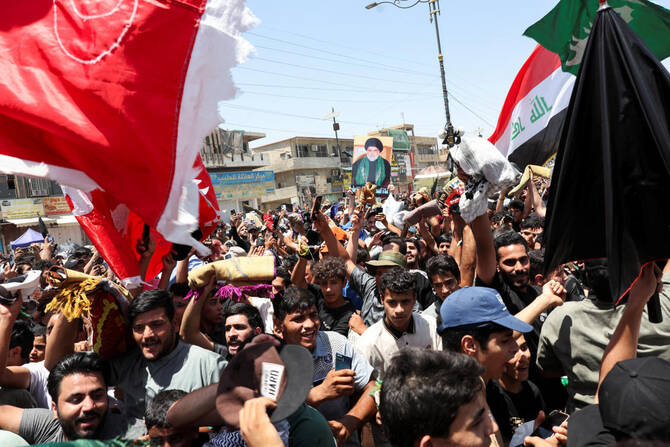
Supporters of Iraqi Shi'ite cleric Moqtada al-Sadr gather after Friday prayers to protest against repeated violations of Iraqi airspace, amid the Iran-Israel conflict, in Baghdad, Jun. 21, 2025. (Reuters)
Short Url
Updated 20 June 2025
Follow

Thousands protest in Iraq against the Iran-Israel war

  • “No to Israel! No to America!” chanted demonstrators gathered after Friday prayers in the Sadr City district of Baghdad
  • In Iraq's southern city of Basra, around 2,000 people demonstrated after the prayers

BAGHDAD: Thousands of supporters of powerful Iraqi cleric Moqtada Sadr rallied Friday in Baghdad and other cities against Israel’s war with Iran, AFP correspondents said.

“No to Israel! No to America!” chanted demonstrators gathered after Friday prayers in the Sadr City district of Baghdad, Moqtada Sadr’s stronghold in the capital, holding umbrellas to shield themselves from Iraq’s scorching summer sun.

“It is an unjust war... Israel has no right” to hit Iran, said protester Abu Hussein.

“Israel is not in it for the (Iranian) nuclear (program). What Israel and the Americans want is to dominate the Middle East,” added the 54-year-old taxi driver.

He said he hoped Iran would come out of the war victorious, and that Iraq should support its neighbor “with money, weapons and protests.”

In Iraq’s southern city of Basra, around 2,000 people demonstrated after the prayers, according to an AFP correspondent.

Cleric Qusai Assadi, 43, denounced Israel’s use of Iraqi airspace to bomb Iran. “It is a violation of Iraq’s sovereignty,” he said, warning against “a third world war against Islam.”

Echoing the views of Sadr, Assadi said that Iraq should not be dragged into the conflict.

In a statement earlier this week, Sadr condemned “the Zionist and American terrorism” and the “aggression against neighboring Iran, Palestine, Lebanon, Syria and Yemen,” referring to Israel’s military operations in those countries.

Sadr, who once led a militia fighting US-led forces after the 2003 invasion, retains a devoted following of millions among the country’s majority community of Shiite Muslims, and wields great influence over Iraqi politics.

He has previously criticized Tehran-backed Iraqi armed factions, who have threatened US interests in the region if the United States were to join Israel in its war against Iran.

On Friday, Israel launched a surprise attack targeting Iran’s military and nuclear sites and killing top commanders and scientists, saying it was acting to prevent Iran from obtaining a nuclear weapon, an ambition Tehran denies having.

The assault has prompted Iran to retaliate with barrages of missiles aimed at Israel, with residential areas in both countries suffering.

Iraq is both a significant ally of Iran and a strategic partner of Israel’s key supporter, the United States, and has for years negotiated a delicate balancing act between the two foes.

It has only recently regained a semblance of stability after decades of devastating conflicts and turmoil.



UN experts slam Israeli ‘terrorist’ death penalty bill

Updated 8 sec ago
Follow

UN experts slam Israeli ‘terrorist’ death penalty bill

GENEVA: United Nations experts on Wednesday called on Israel to withdraw a bill proposing the mandatory death penalty for terrorist acts, warning it would violate the right to life and discriminate against Palestinians.
Israel’s parliament last November passed a first reading of a draft amendment to the country’s penal code, demanded by far-right National Security Minister Itamar Ben Gvir.
“Mandatory death sentences are contrary to the right to life,” a dozen independent UN rights experts warned in a statement.
“By removing judicial and prosecutorial discretion, they prevent a court from considering the individual circumstances, including mitigating factors, and from imposing a proportionate sentence that fits the crime,” they said.
While the death penalty exists for a small number of crimes in Israel, it has become a de facto abolitionist country: the last person to be executed was the Nazi Holocaust perpetrator Adolf Eichmann in 1962.
But the amendment, which must pass a second and third reading before becoming law, would change that and would introduce two tracks for the death penalty in Israel, a dozen independent UN rights experts warned in a statement.
In the occupied West Bank, the statement said “the death penalty would be imposed by military courts under military law for terrorist acts causing the death of a person, even if not intended.”
In Israel and occupied East Jerusalem, meanwhile, capital punishment would continue to be applied only under Israeli criminal law and only for the “intentional killing of Israeli citizens or residents.”
‘Vague and overbroad’
The experts’ statement warned that under both tracks, “vague and overbroad definitions of terrorist offenses under Israeli law would apply, which can include conduct that is not genuinely terrorist, and the death penalty would be mandatory.”
The experts, including Francesca Albanese, the special rapporteur for the rights situation in the occupied Palestinian territories, stressed that unintentional killings were not considered among the “most serious” crimes to which the death penalty can be applied under international law.
“Since Israeli military trials of civilians typically do not meet fair trial standards under international human rights law and humanitarian law, any resulting death sentence would further violate the right to life,” said the experts, who also included the special rapporteurs for protecting rights while countering terrorism and for extrajudicial, summary or arbitrary executions.
“Denial of a fair trial is also a war crime,” they stressed.
The independent experts, who are mandated by the UN Human Rights Council but who do not speak on behalf of the United Nations, also warned that “the bill makes matters worse by allowing death sentences to be imposed by a simple majority vote of military judges.”
Hamas said in November that the proposed law “embodies the ugly fascist face of the rogue Zionist occupation and represents a blatant violation of international law.”
The Ramallah-based Palestinian foreign ministry called it a “new form of escalating Israeli extremism and criminality against the Palestinian people.”