

Saudi gold demand defies price surge amid cultural, digital shift

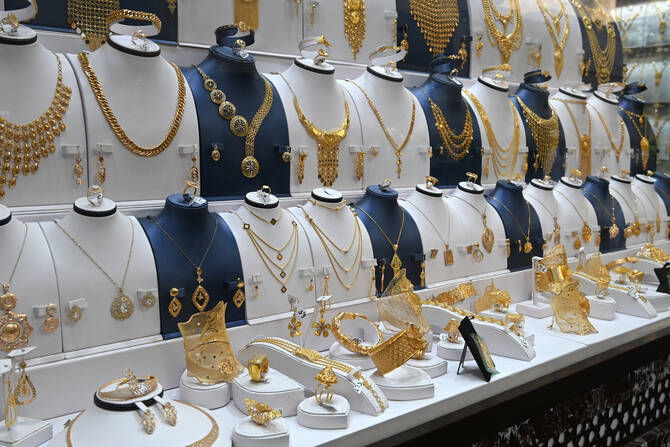
Gold products, jewelry and bijouterie are sold in large quantities on the streets of old Jeddah in the Al Balad district. Getty
Short Url
Updated 20 June 2025
Follow

Saudi gold demand defies price surge amid cultural, digital shift

RIYADH: Gold prices may be at record highs, but that has not stopped Saudi consumers from buying. In the first quarter of 2025, demand for gold jewelry in the Kingdom jumped 35 percent year on year, even as global demand fell 21 percent, according to the World Gold Council.

That surge comes amid a global price rally, with gold breaching $3,500 per ounce in April, up from around $2,370 a year earlier — driven by geopolitical tensions, inflation fears, and aggressive central bank buying. 

“This rapid increase in the price of the bullion can be attributed to one main reason – central bank buying,” Vijay Valecha, chief investment officer at Century Financial, told Arab News. 

Yet despite the soaring cost, Saudi Arabia’s deep-rooted gold culture continues to shine, with consumers purchasing 11.5 tonnes of gold jewelry in the first quarter, up from 8.5 tonnes a year earlier.

“This feat occurred despite the 34 percent rise in prices in early 2025, demonstrating Saudi consumers’ strong demand and purchasing power,” said Valecha.


Vijay Valecha, chief investment officer at Century Financial. Supplied

Gold in the Kingdom is more than a financial asset — it represents tradition, adornment, and intergenerational wealth. From bullion bars to minimalist 18-carat jewelry, Saudi buyers are proving resilient even as other regional markets, such as the UAE and Kuwait, witness sharp declines in demand.

Hamza Dweik, head of trading for the MENA region at Saxo Bank, emphasized gold’s cultural role, telling Arab News: “Gold is deeply embedded in Saudi traditions, especially during weddings and festive occasions. This cultural attachment ensures a steady baseline of demand, even during price surges.”

Global factors

Valecha explained that following the conflict in Ukraine, many countries grew concerned about holding excessive reserves in US dollars, prompting nations such as China and Russia to increase their gold purchases.

“China has spearheaded record levels of global central bank purchases of gold. Hence, looking ahead, the trend of gold buying by central banks is expected to continue,” he added.

​​Another push came in May, when Moody’s downgraded the US credit rating from Aaa to Aa1, citing “a sustained increase in government debt (exceeding $36 trillion), rising interest payment ratios, and persistent fiscal deficits exacerbated by political dysfunction and policy uncertainty.”

Valecha added that this marked the first time the US lost its top-tier rating from all three major agencies. 

Cultural drivers

In different parts of the Kingdom, people buy gold for different reasons. In the north, around 70 percent of buyers view gold primarily as an investment, while in the south, it is more closely tied to tradition and adornment. Gold bars and coins are also gaining popularity, with people stocking their safes with bars of varying weights and purity.

In the first quarter, gold demand in Saudi Arabia grew 15 percent year on year to 4.4 tonnes. Jewelry preferences are also shifting — from favoring diamonds to a growing obsession with gold.

More young buyers are opting for 18-carat pieces due to their affordability, modern style, and lighter tone, as they appear less yellow than 21- and 24-carat gold.

“They also have a less flashy design/colour, which makes them better for everyday use,” Valecha explained.


Hamza Dweik, head of trading for the MENA region at Saxo Bank. Supplied

Digital platforms and online gold purchases are also on the rise, blending tradition with technology — from buying fractional gold and using savings apps to investing through exchange-traded funds.

“Younger generations are blending tradition with technology — embracing digital gold platforms, fractional ownership, and ETFs, while still participating in cultural gifting. This is reshaping how gold is marketed and consumed,” Dweik added.

While countries including the UAE and Kuwait have seen gold demand decline, Saudi Arabia is moving in the opposite direction, with domestic consumers leading the surge, supported by strong spending habits.

Consumer spending in the Kingdom hit an all-time high in March, rising 17 percent to SR148 billion ($39.44 billion) — the highest monthly increase since May 2021 — before easing to SR113.9 billion in April.

The shift in consumer behavior is evident across the Kingdom. Jewelers in Riyadh spoken to by Arab News reported a growing interest in custom pieces, lighter-weight ornaments, and contemporary designs that suit both festive occasions and everyday wear. 

The 18-carat trend, once seen as a budget-friendly option, has become a fashion choice, according to the jewelers. More women are purchasing gold for themselves, breaking away from the traditional gift-only narrative. 

While physical stores remain popular for high-value purchases, particularly during wedding seasons and religious festivals, digital platforms are making inroads. Online retailers like L’azurde are adapting to this demand by offering buy-now-pay-later plans, making gold more accessible to a wider audience. Popular jewelry items include 21-carat necklaces and rings, while younger buyers favor 18-carat pieces for daily wear.

Market outlook

Looking ahead, both Valecha and Dweik expect prices to remain strong. Valecha predicts gold could reach $3,700 per ounce by year-end, though he cautions short-term investors. “Buyers should assess their investment horizon — long-term holders may still find value, while short-term buyers should be mindful of volatility,” he said.

“Sustained central bank purchases, heightened investor appetite in a period of uncertainty in the economic landscape, and projected interest rate cuts drive this bullish projection. The projected price under a recession scenario is as high as $3,880 per ounce,” Valecha added.

Dweik agreed, and said: “While structural drivers support continued growth, potential corrections could occur if inflation eases or interest rates rise.”

Saudi Arabia may also be poised to grow into a regional gold trading hub. Valecha believes that with the right infrastructure and regulatory framework, the Kingdom could play a larger role in the global market. “To elevate its status, a modern, transparent gold market ecosystem and enhanced refining capabilities would be essential,” he said.

With deep-rooted traditions, rising investment activity, and a modernized retail environment, Saudi Arabia’s gold market is not only resilient — it is evolving. In a time of global uncertainty, gold continues to shine across the Kingdom.


How AI and financial literacy are redefining the Saudi workforce

Updated 26 December 2025
Follow

How AI and financial literacy are redefining the Saudi workforce

  • Preparing people capable of navigating money and machines with confidence

ALKHOBAR: Saudi Arabia’s workforce is entering a transformative phase where digital fluency meets financial empowerment. 

As Vision 2030 drives economic diversification, experts emphasize that the Kingdom’s most valuable asset is not just technology—but people capable of navigating both money and machines with confidence.

For Shereen Tawfiq, co-founder and CEO of Balinca, financial literacy is far from a soft skill. It is a cornerstone of national growth. Her company trains individuals and organizations through gamified simulations that teach financial logic, risk assessment, and strategic decision-making—skills she calls “the true language of empowerment.”

An AI-driven interface showing advanced data insights, highlighting the increasing demand for leaders who can navigate both technology and strategy. (creativecommons.org)

“Our projection builds on the untapped potential of Saudi women as entrepreneurs and investors,” she said. “If even 10–15 percent of women-led SMEs evolve into growth ventures over the next five years, this could inject $50–$70 billion into GDP through new job creation, capital flows, and innovation.”

Tawfiq, one of the first Saudi women to work in banking and later an adviser to the Ministry of Economy and Planning on private sector development, helped design early frameworks for the Kingdom’s venture-capital ecosystem—a transformation she describes as “a national case study in ambition.”

“Back in 2015, I proposed a 15-year roadmap to build the PE and VC market,” she recalled. “The minister told me, ‘you’re not ambitious enough, make it happen in five.’” Within years, Saudi Arabia had a thriving investment ecosystem supporting startups and non-oil growth.

Opinion

This section contains relevant reference points, placed in (Opinion field)

At Balinca, Tawfiq replaces theory with immersion. Participants make business decisions in interactive simulations and immediately see their financial impact.

“Balinca teaches finance by hacking the brain, not just feeding information,” she said. “Our simulations create what we call a ‘business gut feeling’—an intuitive grasp of finance that traditional training or even AI platforms can’t replicate.”

While AI can personalize lessons, she believes behavioral learning still requires human experience.

Saudi women take part in a financial skills workshop, reflecting the growing role of financial literacy in shaping the Kingdom’s emerging leadership landscape. (AN File)

“AI can democratize access,” she said, “but judgment, ethics, and financial reasoning still depend on people. We train learners to use AI as a co-pilot, not a crutch.”

Her work aligns with a broader national agenda. The Financial Sector Development Program and Al Tamayyuz Academy are part of Vision 2030’s effort to elevate financial acumen across industries. “In Saudi Arabia, financial literacy is a national project,” she said. “When every sector thinks like a business, the nation gains stability.”

Jonathan Holmes, managing director for Korn Ferry Middle East, sees Saudi Arabia’s digital transformation producing a new generation of leaders—agile, data-literate, and unafraid of disruption.

“What we’re seeing in the Saudi market is that AI is tied directly to the nation’s economic growth story,” Holmes told Arab News. “Unlike in many Western markets where AI is viewed as a threat, here it’s seen as a catalyst for progress.”

Saudi Arabia's Vision 2030 and the national AI strategy are producing “younger, more dynamic, and more tech-fluent” executives who lead with speed and adaptability. (SPA photo)

Holmes noted that Vision 2030 and the national AI strategy are producing “younger, more dynamic, and more tech-fluent” executives who lead with speed and adaptability. Korn Ferry’s CEO Tracker Report highlighted a notable rise in first-time CEO appointments in Saudi Arabia’s listed firms, signaling deliberate generational renewal.

Korn Ferry research identifies six traits for AI-ready leadership: sustaining vision, decisive action, scaling for impact, continuous learning, addressing fear, and pushing beyond early success.

“Leading in an AI-driven world is ultimately about leading people,” Holmes said. “The most effective leaders create clarity amid ambiguity and show that AI’s true power lies in partnership, not replacement.”

He believes Saudi Arabia’s young workforce is uniquely positioned to model that balance. “The organizations that succeed are those that anchor AI initiatives to business outcomes, invest in upskiling, and move quickly from pilots to enterprise-wide adoption,” he added.

DID YOU KNOW?

• Saudi women-led SMEs could add $50–$70 billion to GDP over five years if 10–15% evolve into growth ventures.

• AI in Saudi Arabia is seen as a catalyst for progress, unlike in many Western markets where it is often viewed as a threat.

• Saudi Arabia is adopting skills-based models, matching employees to projects rather than fixed roles, making flexibility the new currency of success.

The convergence of Tawfiq’s financial empowerment approach and Holmes’s AI leadership vision points to one central truth: the Kingdom’s greatest strategic advantage lies in human capital that can think analytically and act ethically.

“Financial literacy builds confidence and credibility,” Tawfiq said. “It transforms participants from operators into leaders.” Holmes echoes this sentiment: “Technical skills matter, but the ability to learn, unlearn, and scale impact is what defines true readiness.”

Saudi women in the transportation sector represent the expanding presence of female talent across high-impact industries under Vision 2030. (AN File)

As organizations adopt skills-based models that match employees to projects rather than fixed job titles, flexibility is becoming the new currency of success. Saudi Arabia’s workforce revolution is as much cultural as it is technological, proving that progress moves fastest when inclusion and innovation advance together.

Holmes sees this as the Kingdom’s defining opportunity. “Saudi Arabia can lead global workforce transformation by showing how technology and people thrive together,” he said.

Tawfiq applies the same principle to finance. “Financial confidence grows from dialogue,” she said. “The more women talk about money, valuations, and investment, the more they’ll see themselves as decision-makers shaping the economy.”

Together, their visions outline a future where leaders are inclusive, data-literate, and AI-confident—a model that may soon define the global standard for workforce transformation under Vision 2030.