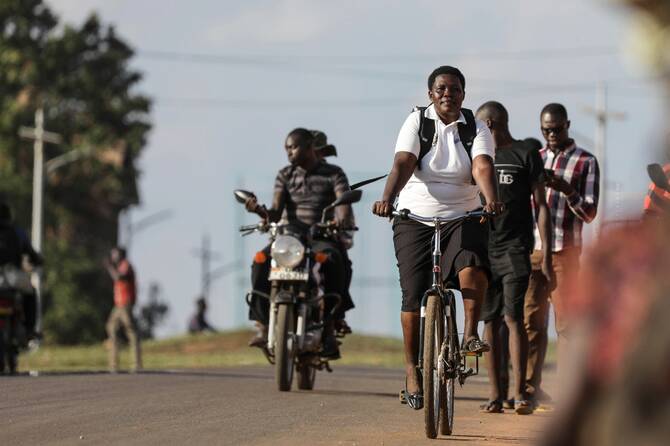
LIRA: The bicycle parked in Lucy Abalo’s compound doesn’t belong to her. Any one of the hundreds of people in her village can show up and ask to use it.
A man might wish to take his pregnant wife for a checkup. A woman might need transport to pick up HIV medication. An injured child might need a trip to a hospital.
“The goodness about this bike,” Abalo said, is its availability to all.
She is one of dozens of “village doctors” in rural Uganda who recently were supplied with the Buffalo Bicycle, so called because its steel parts are reinforced to perform in areas with bad roads.
World Bicycle Relief, a Chicago-based nonprofit, promotes the Buffalo Bicycle in remote parts of Africa. It collaborates with governments, non-governmental groups and others who use the bikes to improve access to health services.
In Uganda, an east African country of 45 million people, efforts to market the bicycle have focused on supporting health workers like Abalo, who visits people’s homes and reports any issues to authorities.
As a community health extension worker, or CHEW, she has gained the trust of villagers, who can knock on her door in emergency situations. She said she helps to look after about 8,000 people in the area.
And at least twice a week, she is required to report to a government-run health center about 5 kilometers (3 miles) away and assist with triaging patients.
Ugandan health authorities acknowledge that one challenge for CHEWs is transportation, part of a larger burden of poverty that can leave health facilities lacking ambulances or even gas to move them.
World Bicycle Relief, operating locally as Buffalo Bicycles Uganda, has collaborated with Ugandan health authorities since 2023 to equip 331 CHEWs in two of the country’s 146 districts. One is Lira, 442 kilometers (274 miles) north of the capital, Kampala.
Bicycles have long been ubiquitous, and many families tend to have one. Cultural norms in northern Uganda don’t prohibit women from riding. While the roads in Lira town are paved, dirt paths lead into the heart of the district where farming is the main economic activity.
The Buffalo Bicycle is a recent arrival. Many have never heard of it, or can’t afford it. Retailing for roughly $200, it is three times more expensive than the cheapest regular bicycle — otherwise out of reach for many CHEWs, who do not yet earn a salary.
The bike’s promoters cite its durability in rough terrain, needing fewer trips to the mechanic as a way to save money.
The Buffalo Bicycle’s heavy-gauge steel frame is so strong that it comes with a five-year warranty, said Amuza Ali, a monitoring officer in Lira for Buffalo Bicycles Uganda.
Abalo and others told the AP the Buffalo Bicycle felt uncomfortable to use in the beginning, with a braking system that doesn’t permit carefree backpedaling.
“When I climbed on it, it wasn’t that easy as I thought,” Abalo said. “I was like, ‘I am trying again to learn how to ride.’”
CHEWs using the bicycles reported a 108 percent increase in households reached each week, and the time to reach health facilities dropped by nearly half, according to a study published in May by World Bicycle Relief.
The study shows that “mobility is not a luxury in health care” but a lifeline, CEO Dave Neiswander said in a statement released for the report.
Diana Atwine, permanent secretary at the Ministry of Health, has urged the distribution of bicycles to more CHEWs across Uganda, saying front-line health workers save an unknown number of lives each year.
Abalo received her Buffalo Bicycle from the health minister last year.
One of her neighbors, Babra Akello, said she has used the bicycle at least six times already. The first was for transport to an antenatal checkup. She praised Abalo’s willingness to help.
The bike has also been used for emergencies. One evening earlier this year, a neighbor’s 4-year-old child suffered a deep cut while playing in the dirt. With the child’s parents away, Abalo transported the bleeding boy to a facility where he briefly lost consciousness before being revived.
“That bike, not me, saved the life of that child,” Abalo said. “If that bike hadn’t been there, I don’t know what would have happened.”


![]()

In Uganda, a tougher bicycle offers hope for better health coverage in rural areas
Short Url
https://arab.news/85mew
In Uganda, a tougher bicycle offers hope for better health coverage in rural areas
- World Bicycle Relief, a Chicago based nonprofit, promotes the Buffalo Bicycle in remote parts of Africa
- It collaborates with governments, NGOs and others who use the bikes to improve access to health services
Latest updates


© 2026 SAUDI RESEARCH & PUBLISHING COMPANY, All Rights Reserved And subject to Terms of Use Agreement.