ISLAMABAD: Pakistan’s defense minister has described the country’s governance as a “hybrid model” in which military and civilian leaders share power — an open secret in political circles but a rare public admission by a serving official that has taken on added significance amid the army chief’s solo visit to the United States and an unprecedented meeting with President Donald Trump.
Officials have presented Field Marshal Asim Munir’s trip as an effort to bolster security ties with Washington, particularly in light of last month’s military standoff with India and escalating hostilities in the Middle East. But the army chief’s meeting with Trump — without Pakistan’s prime minister or foreign minister present — has also drawn renewed attention to how much Islamabad relies on its army to handle high-stakes foreign relations, economic ties and sensitive regional issues.
The chief’s visit comes on the heels of the most serious clash in years between nuclear-armed Pakistan and India in which they exchanged drone, missile and artillery fire until a ceasefire brokered by Washington on May 10 brought an end to hostilities. Pakistan has declared victory in the confrontation, saying it downed six Indian fighter jets and struck military facilities. Munir’s leadership during the crisis has won him a rare promotion to field marshal and broad public support, reinforcing the military’s standing as one of the country’s most influential institutions despite past criticism of its outsized role in politics.
In an interview this week conducted as the army chief visited the United States for talks with Trump, Defense Minister Khawaja Asif acknowledged that the military’s prestige had “skyrocketed” after the conflict with India, calling it a “blessing in disguise,” but rejected that this would erode democratic authority or give the army unchecked control.
“No, it doesn’t worry me,” he told Arab News when asked if Pakistan’s history of direct and indirect military rule made him uneasy about the army’s stronger image.
“This is a hybrid model. It’s not an ideal democratic government … So, this arrangement, the hybrid arrangement, I think [it] is doing wonders,” Asif said, adding that the system was a practical necessity until Pakistan was “out of the woods as far as economic and governance problems are concerned.”
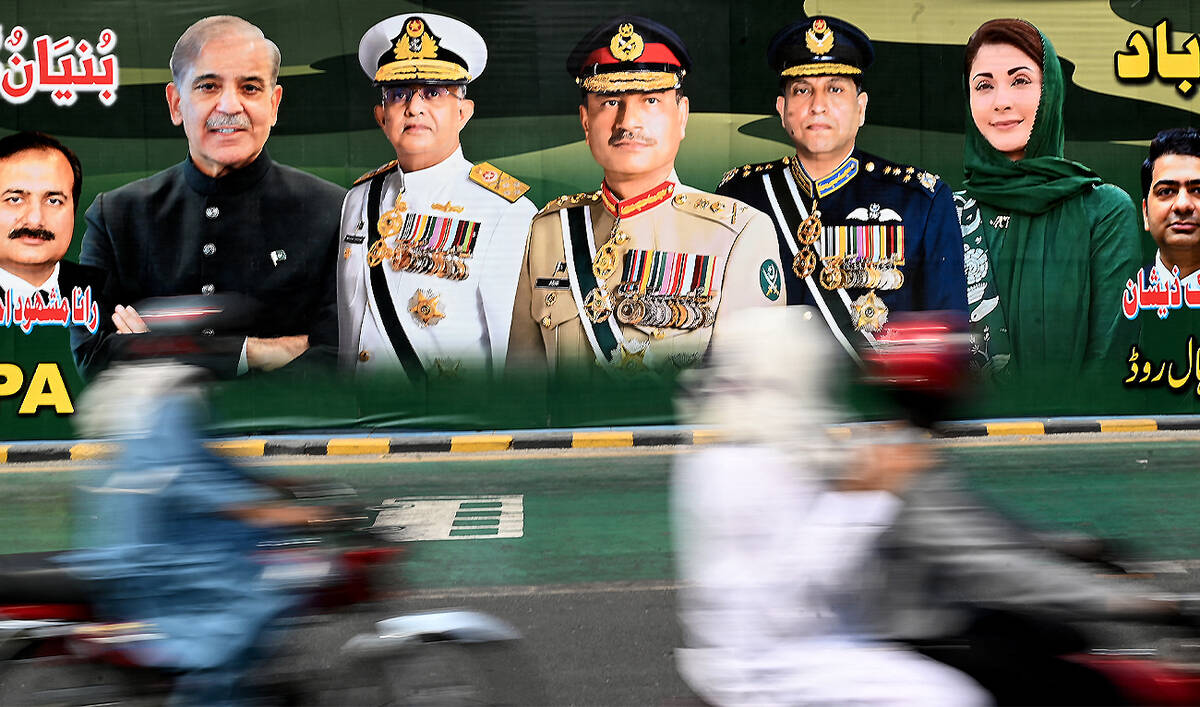
Commuters ride past a billboard with portraits of Pakistan's Prime Minister Shehbaz Sharif (2L), Navy Chief Admiral Naveed Ashraf (3L), Chief of Army Staff General Syed Asim Munir (C), Air Chief Marshal Zaheer Ahmad Baber (3R) and Chief Minister of the country's Punjab province Maryam Nawaz Sharif (2R), displayed along a street in Lahore on May 24, 2025. (AFP)
The long-running political instability and behind-the-scenes military influence in earlier decades had slowed democratic development, the defense chief argued, but the current arrangement had improved coordination.
Pakistan’s military has played a central role in national affairs since independence in 1947, including periods of direct rule after coups in 1958, 1977 and 1999, when General Pervez Musharraf toppled then-Prime Minister Nawaz Sharif, the elder brother of current Prime Minister Shehbaz Sharif. Musharraf ruled until 2008 when elections restored civilian governance. Even under elected governments, however, the army is widely considered the invisible guiding hand in politics and in shaping foreign policy, security strategy, and often key aspects of governance.
“If this sort of [hybrid] model was adopted way back in the 90s, things would have been much, much better,” Asif said, “because the confrontation between [military] establishment and the political government, it actually retarded the progress of our democracy.”
By contrast, he said, the current “de facto” hybrid arrangement had brought the army and elected leaders together on joint forums such as the Special Investment Facilitation Council (SIFC), a civil-military body tasked with setting and managing economic priorities jointly and overseeing big-ticket investments and trade reforms.
“We have common platforms, like SIFC and other platforms, where military leadership and civilian leadership, they sit together and decide about the business,” Asif said. “So, this is something which is a de facto arrangement and it’s working very well.”
The military’s media wing did not respond to a request for comments.
“TOTAL AGREEMENT”
Asif’s remarks about power-sharing with the army on an ever-expanding policy portfolio appear particularly relevant after Munir’s rare White House meeting with Trump on Wednesday, the first time in years that a Pakistani army chief was received by a sitting US president without civilian leadership present.
Munir was accompanied by National Security Adviser Lt Gen Muhammad Asim Malik, Pakistan’s serving intelligence chief who now also holds the national security portfolio. This too is a first for the country: that a sitting ISI director general is serving as NSA.
According to a statement from ISPR, the military’s public relations wing, the Munir-Trump meeting lasted two hours instead of the scheduled one, and covered not only security cooperation and the ongoing Israel-Iran conflict but also wider collaboration in “trade, economic development, mines and minerals, artificial intelligence, energy, cryptocurrency, and emerging technologies.”
These are areas traditionally handled by civilian ministries.
While independent analysts say this reflects the military’s increasingly visible role in economic and financial initiatives and could permanently weaken civilian supremacy in these domains, Asif insisted PM Sharif remained firmly in charge of key decisions:
“It’s something mutual, we have a co-ownership of the power structure …
“There is no superimposed system or superimposed organization on Shehbaz Sharif which dictates him and he acts accordingly … [He] is making his decisions independently and obviously he is in regular consultation with the establishment on all levels.”
But were there “crisis moments” in the relationships when the prime minister had not prevailed over the army chief in decision-making?
Asif responded:
“Believe me, very honestly, we haven’t had any moment where decisions were not made unanimously with total agreement. Things are moving very smoothly. And god willing, one day we will achieve the sort of democracy which is needed by our country.”